Facts
On 22 December 2010, Guru Prasad Dhuri was riding his motorcycle near Village Motimpur-Lata when a tractor bearing registration No. CG10-A-1031, allegedly driven rashly and negligently by Vijay Kumar Pandey, collided with him. Guru Prasad sustained fatal injuries and died at the spot. An FIR was registered against the appellant under Section 304-A IPC, and the tractor, trolley and driving licence were seized during investigation
Source reference: para. 2, 13The deceased’s wife and minor son filed a claim petition under the Motor Vehicles Act, claiming ₹7,33,000 as compensation and asserting that the deceased earned ₹6,000 per month from an agricultural centre. The Motor Accident Claims Tribunal assessed his income at ₹3,000 per month and awarded ₹2,53,000, fastening liability upon the driver alone
Source reference: para. 3, 6, 12The appellant challenged the award, contending that he had been acquitted in the criminal case, that the FIR and criminal-proceeding documents had not been duly proved, that the accident was not caused by his negligence, and that the compensation was excessive. He also contended that the registered owner should have been held liable
Source reference: para. 7The vehicle was uninsured, and the appellant admittedly held a valid driving licence
Source reference: para. 11The evidence showed that the vehicle stood registered in the name of Motilal Kesharwani on the date of the accident, although it was transferred in the appellant’s name only on 14 January 2011. The appellant admitted that he had purchased the vehicle before the accident and was in possession of it when the accident occurred
Source reference: para. 21–24Issues
Whether the appellant’s acquittal in the criminal case exonerated him from civil liability for the motor accident and death of Guru Prasad?
Source reference: para. 16–19Whether the evidence established that the accident and death were caused by the rash and negligent driving of the appellant?
Source reference: para. 13–19Whether the compensation of ₹2,53,000 awarded by the Tribunal was excessive or legally unsustainable?
Source reference: para. 12Whether the registered owner and the appellant, who was in possession of and driving the vehicle, were liable to satisfy the award jointly and severally?
Source reference: para. 20–28Law Applied
The Court applied the principles governing claims under Sections 166 and 173 of the Motor Vehicles Act, 1988, under which negligence in a motor accident claim is determined on the basis of preponderance of probabilities, rather than proof beyond reasonable doubt
Source reference: para. 17Police records, including the FIR, seizure memos and final report, may constitute prima facie evidence of rash and negligent driving in MACT proceedings, and an acquittal in a criminal case does not determine or extinguish tortious liability
Source reference: para. 16–18Section 2(30) of the Motor Vehicles Act defines “owner” principally as the person in whose name the vehicle is registered
Source reference: para. 25Relying on Naveen Kumar v. Vijay Kumar & Ors., AIR 2018 SC 983, the Court held that a registered owner remains liable despite an unrecorded transfer of the vehicle, since claimants should not be required to trace successive informal transfers
Source reference: para. 26The Court also relied on Reena v. Managing Director, Karnataka State Road Transport, 2026 SCC OnLine SC 1663, for the distinction between criminal culpability and civil negligence in MACT proceedings
Source reference: para. 17Reasoning
The Court found that the police investigation, seizure of the offending vehicle, final report and the testimony of eyewitness Shriram Dhadsena consistently supported the claimants’ case that the appellant drove the tractor at high speed, moved onto the wrong side of the road and struck the deceased’s motorcycle
Source reference: para. 13–14The appellant’s alternative explanations were inconsistent: he claimed that he had stopped only to assist the deceased, but also suggested that the motorcycle had collided with another vehicle; he further admitted that he had not complained of false implication or wrongful seizure to any superior police authority
Source reference: para. 15His criminal acquittal could not control the MACT proceedings because the standards and purposes of the two proceedings differed
Source reference: para. 16–19The Court upheld the Tribunal’s assessment of income at ₹3,000 per month because the claimants produced no documentary proof of the deceased’s asserted income of ₹6,000 per month. Considering the deceased’s occupation, the date of the accident and prevailing economic conditions, the award of ₹2,53,000 was held reasonable and not excessive
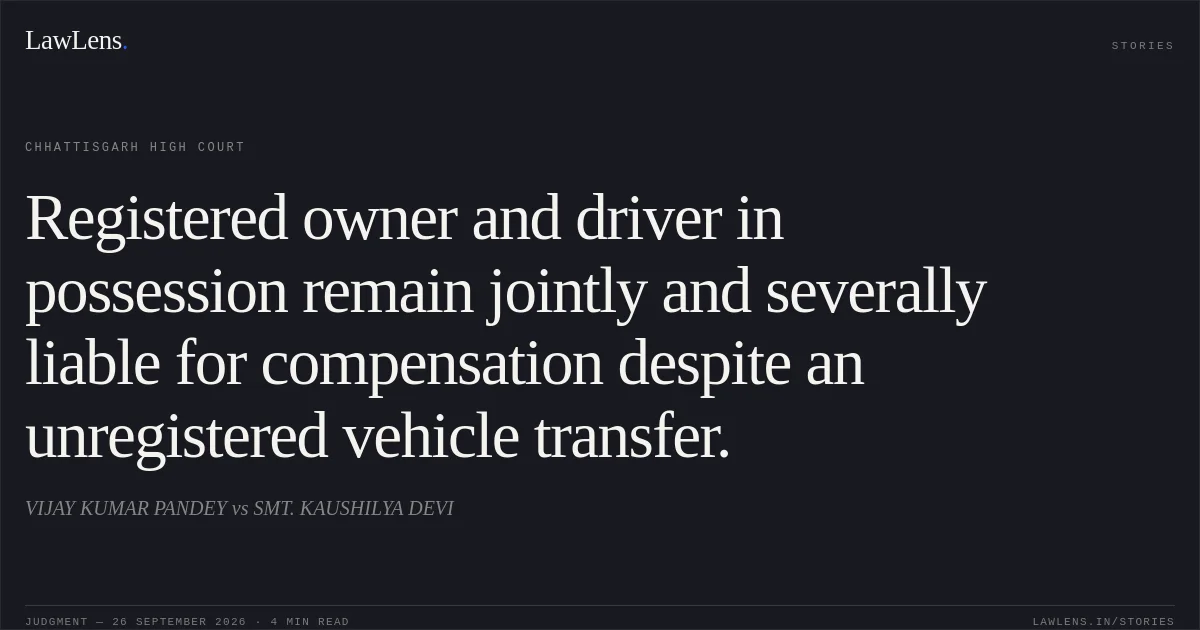
Source reference: para. 12As to liability, the vehicle remained registered in Motilal Kesharwani’s name on the date of the accident, notwithstanding the subsequent transfer to the appellant. Under Section 2(30) and Naveen Kumar, the registered owner could not avoid statutory liability. At the same time, the appellant admitted that he had purchased the vehicle, possessed it and was driving it at the time of the accident. Consequently, both the registered owner and the appellant were liable for the accident and the resulting compensation
Source reference: para. 21–28Holding
The High Court partly allowed the appeal. It upheld the finding that the accident was caused by the appellant’s rash and negligent driving and affirmed the compensation of ₹2,53,000 awarded to the claimants
However, it modified the award on liability: the registered owner, Motilal Kesharwani, and the appellant-driver, Vijay Kumar Pandey, were held jointly and severally liable to satisfy the compensation award, since the vehicle stood registered in the owner’s name while the appellant was in possession of and driving it at the time of the accident
Source reference: para. 27–29Acts & Sections Cited
3 provisions across 1 statute referred to in this judgment. Each provision opens on LawLens.
Motor Vehicles Act, 19883
Original Court PDF
VIJAY KUMAR PANDEYvsSMT. KAUSHILYA DEVI
Click to open original judgment
Original judgment, available to read, download and summarize on LawLens.in