Facts
The appellant/plaintiff claimed ownership of the suit property through a chain of title commencing with Pethaiya’s registered purchase from A.R. Syed Ibramsha on 22.01.1978, followed by Pethaiya’s registered sale to his son Elango on 20.01.1994, a power of attorney executed by Elango in favour of Alagu on 15.03.1996, and the registered sale deed executed by Alagu, as Elango’s power agent, in favour of the plaintiff on 14.10.1999.
Source reference: para. 4(a)The plaintiff asserted that the first defendant and her daughter, the second defendant, were tenants, that rent was paid until October 2001, and that they thereafter defaulted and refused to vacate.
Source reference: para. 4(a)The defendants denied the tenancy and claimed that the first defendant was Pethaiya’s wife and the second defendant was his daughter.
Source reference: para. 4(b)They alleged that Pethaiya had executed an unregistered Will dated 15.05.1994 in their favour and that the plaintiff’s title documents had been fabricated by Munusamy, a former employee of Pethaiya.
Source reference: para. 4(b)The plaintiff instituted O.S.No.158 of 2004 seeking declaration of title, recovery of possession, arrears of rent, and mandatory injunction for transfer of the municipal tax assessment.
Source reference: para. 2The Principal District Judge, Pudukkottai, dismissed the suit on 12.12.2008, holding that the plaintiff had not proved her title.
Source reference: para. 7Issues
1. Whether the plaintiff proved her title over the suit property through Exs.A.10, A.11 and A.14 and the connected title documents?
Source reference: para. 17, Point No.12. Whether Ex.A.10 sale deed, Ex.A.11 power of attorney and Ex.A.14 sale deed were forged or fabricated documents, and whether the defendants proved that allegation?
Source reference: para. 17, Point No.23. Whether the trial Court’s judgment dismissing the suit was legally sustainable?
Source reference: para. 17, Point No.34. Whether the plaintiff was entitled to declaration, recovery of possession and the other consequential reliefs sought in the suit?
Source reference: para. 17, Point No.4; para. 28Law Applied
The Court applied Sections 101 and 102 of the Indian Evidence Act, 1872, placing the initial burden on the plaintiff to establish her title, and Section 103, placing the burden on the party alleging forgery to prove that specific allegation.
Source reference: paras. 20, 23Section 110 was considered in the context of the defendants’ possession, although the Court held that the plaintiff, having sought declaration and possession, was required to independently prove her title.
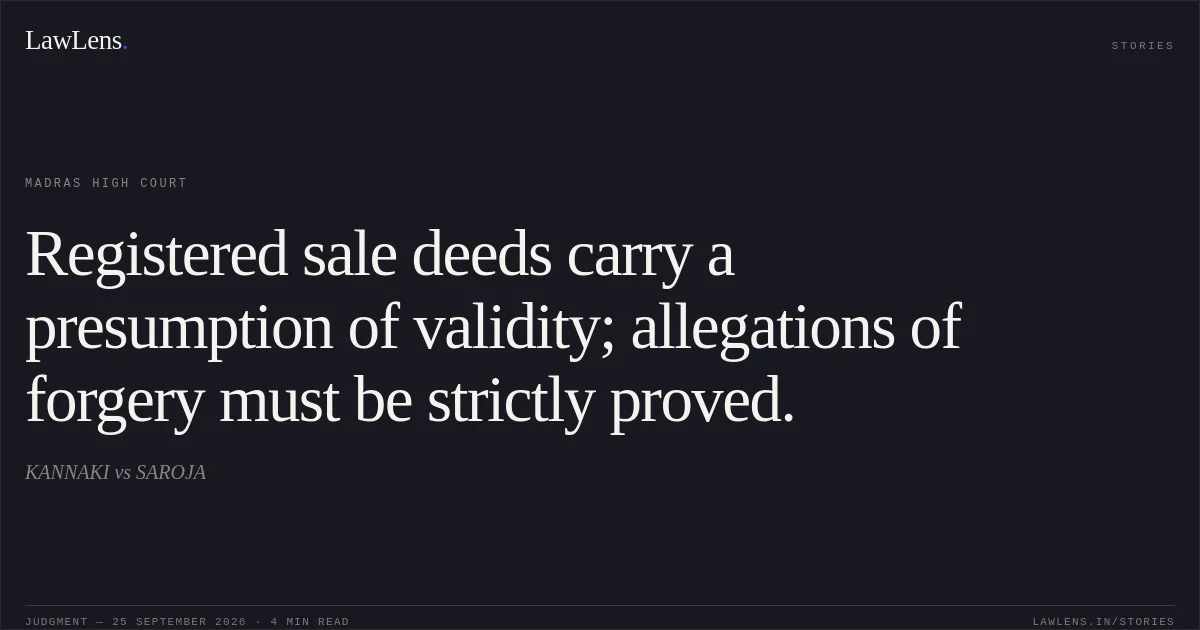
Source reference: para. 19Under Section 54 of the Transfer of Property Act, 1882, a registered sale transfers ownership where the parties intended a sale for a price paid, promised, or partly paid and partly promised; actual payment of the entire consideration at execution is not essential.
Source reference: para. 26The Court relied on Vidhyadhar v. Manikrao, as reiterated in Raziya Begum v. Nafisa Begum, 2026 INSC 814, and rejected the proposition that non-proof of full consideration invalidates a registered sale.
Source reference: para. 26The Court also applied the presumption under Section 114(e) of the Evidence Act that official acts, including registration, have been regularly performed, and relied on Prem Singh v. Birbal, Jamila Begum v. Shami Mohd., Rattan Singh v. Nirmal Gill and Hemalatha v. Tukaram, 2026 INSC 82, for the principle that a registered document carries a strong presumption of validity and cannot be casually declared sham or forged.
Source reference: paras. 21–23The Court further held that the absence of the purchaser’s signature did not invalidate the pre-2001 sale deeds, since the requirement under Section 34-A of the Registration Act came into force only from 14.04.2001.
Source reference: para. 27Reasoning
The Court found that the plaintiff had established a coherent chain of title through the original registered sale deed in favour of Pethaiya, the registered sale deed in favour of Elango, Elango’s duly notarised and registered power of attorney in favour of Alagu, and the registered sale deed in favour of the plaintiff.
Source reference: paras. 18–20The plaintiff also produced tax receipts and electricity records showing subsequent mutation and possession-related acts in her name.
Source reference: para. 19P.Ws.1 and 2 supported the transactions, thereby discharging the plaintiff’s initial burden under Sections 101 and 102 of the Evidence Act.
Source reference: para. 20Once the registered documents were produced, the burden shifted to the defendants to establish their plea that the documents were forged.
Source reference: para. 23The defendants neither examined witnesses to disprove the transactions nor initiated criminal or other effective proceedings concerning the alleged fraud.
Source reference: paras. 23–25They also failed to obtain handwriting-expert evidence or otherwise establish that the signatures and documents were fabricated.
Source reference: paras. 23–25The defendants’ reliance on absence of proof of consideration was rejected because a sale may be completed where consideration is promised or partly promised, and non-payment ordinarily gives rise to a claim for recovery of money rather than invalidation of the sale.
Source reference: para. 26Their objection regarding the purchaser’s non-signature was likewise rejected because the deeds predated the statutory requirement introduced by Section 34-A of the Registration Act.
Source reference: para. 27The defendants’ claim under the alleged Will could not assist them because the Will was not produced or proved, and their counsel conceded that the claim under the Will was not pressed.
Source reference: para. 18Consequently, the defendants had no established legal basis to remain in possession, whereas the plaintiff had proved her title and entitlement to possession.
Source reference: para. 28Holding
The High Court allowed the appeal and set aside the judgment and decree dated 12.12.2008 in O.S.No.158 of 2004.
It held that the plaintiff had proved her title through the registered title documents and that the defendants had failed to prove forgery, invalidity, or any superior title.
Source reference: paras. 28–29The suit was decreed as prayed for, including declaration of title, recovery of possession and consequential reliefs.
Source reference: para. 29Defendants 1 and 2 were directed to hand over possession of the suit property to the plaintiff within three months.
Source reference: para. 29No costs were awarded.
Source reference: para. 29Acts & Sections Cited
6 provisions across 6 statutes referred to in this judgment. Each provision opens on LawLens.
Code of Civil Procedure, 19081
Limitation Act, 19631
Registration Act, 19081
Indian Contract Act, 18721
Transfer of Property Act, 18821
Bharatiya Sakshya Adhiniyam, 20231
Original Court PDF
KANNAKIvsSAROJA
Click to open original judgment
Original judgment, available to read, download and summarize on LawLens.in