Facts
The appellant, Hemlata Kalita, filed an application under Section 276 of the Indian Succession Act, 1925, seeking probate of a registered Will dated 07.03.2011 executed by her late father, Manik Kalita.
Source reference: para 4The appellant claimed the testator lived with her because his son (Respondent No. 1) failed to care for him.
Source reference: para 25Respondent No. 1 contested the Will, alleging it was obtained through undue influence while the testator was bedridden.
Source reference: para 30, 45The Trial Court dismissed the probate suit, holding that the appellant failed to prove the Will in accordance with Section 63 of the Succession Act.
Source reference: para 9The appellant challenged this dismissal before the Gauhati High Court.
Source reference: para 3Issues
1. Whether the appellant proved the due execution and attestation of the Will in accordance with Section 63 of the Succession Act and Section 68 of the Evidence Act?
Source reference: para 17(i)2. Whether the Trial Court was justified in dismissing the probate suit on the grounds of technical deficiencies in evidence?
Source reference: para 17(ii)3. Whether the impugned judgment and decree call for interference by the High Court?
Source reference: para 17(iii)Law Applied
Section 299 of the Indian Succession Act, 1925, which treats probate appeals as first appeals under the CPC, allowing re-appreciation of facts.
Source reference: para 14-15Section 63(c) of the Succession Act defines valid execution (attestation by two witnesses).
Source reference: para 19Section 68 of the Indian Evidence Act, 1872, requires at least one attesting witness to prove such execution.
Source reference: para 20The propounder's burden to dispel suspicious circumstances established in Daulat Ram v. Sodha [(2005) 1 SCC 40].
Source reference: para 22The legal presumption of genuineness attached to registered documents as per Metpalli Lasum Bai v. Metapalli Muthaih [2025 SCC OnLine SC 1488].
Source reference: para 40Reasoning
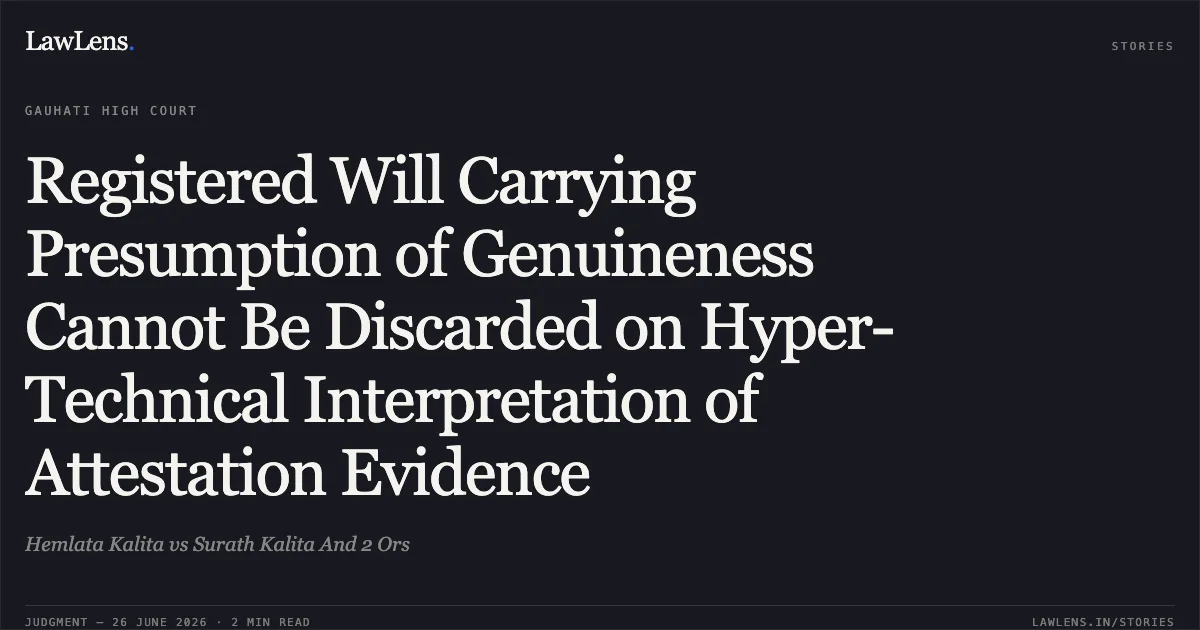
The High Court found that the Trial Court adopted a "hyper-technical approach" by requiring witnesses to recite statutory language verbatim regarding "signing in each other's presence".
Source reference: para 38-39Upon re-evaluating the testimony of PW-2 (an attesting witness), the Court determined that his identification of signatures and the testator’s presence at the Sub-Registrar's office satisfied Section 68 of the Evidence Act.
Source reference: para 36, 39The Court noted that the Will was registered, creating a presumption of validity that the respondents failed to rebut with medical evidence of the testator's alleged incapacity.
Source reference: para 40, 46The court observed that the bequest was natural given that the testator resided with the appellant, and another daughter (Respondent No. 3) supported the Will's validity.
Source reference: para 43-44Holding
The Court answered all issues in favor of the appellant and held that the Will dated 07.03.2011 was the genuine and last testament of late Manik Kalita.
The High Court set aside the Trial Court's judgment and decree and granted probate to the appellant, subject to the assessment and payment of the requisite court fees based on the current market value of the scheduled properties.
Source reference: para 49, 50-51The Registry was directed to issue the Probate Certificate accordingly.
Source reference: para 52Acts & Sections Cited
4 provisions across 1 statute referred to in this judgment. Each provision opens on LawLens.
Indian Succession Act, 19254
Original Court PDF
Hemlata KalitavsSurath Kalita And 2 Ors
Click to open original judgment
Original judgment, available to read, download and summarize on LawLens.in