Facts
Vaiyapuri Gounder owned the suit properties and had three wives: Mottaiammal, Pappammal and Arukkaniammal. After the deaths of the first two wives and Vaiyapuri Gounder, Arukkaniammal, the issueless third wife, became entitled to the properties.
Source reference: paras. 4–8The appellants claimed through the branches of Mottaiammal and asserted that Arukkaniammal died intestate, attracting Section 15(2)(b) of the Hindu Succession Act and entitling them collectively to a two-thirds share.
Source reference: para. 9The respondents relied upon a registered lease deed dated 10.04.1943 and a registered Will dated 15.12.1976, under which Arukkaniammal allegedly bequeathed the A-schedule agricultural properties to the four sons of Alamathal, the daughter of Pappammal.
Source reference: paras. 10–12The appellants instituted O.S. No. 665 of 1985 for partition, while the respondents filed O.S. No. 1344 of 1990 seeking permanent injunction based substantially on the Will and their alleged possession.
Source reference: paras. 13–17The Trial Court held that the Will was not proved, granted a preliminary decree declaring the appellants’ collective two-thirds share, and dismissed the injunction suit.
Source reference: paras. 29–36The Madras High Court reversed that decision, accepted the Will, and decreed the respondents’ suit for injunction.
Source reference: paras. 37–40Issues
Whether the registered Will dated 15.12.1976 was duly executed and attested in accordance with Section 63(c) of the Indian Succession Act, 1925.
Source reference: paras. 48–71Whether the respondents were entitled to invoke Section 69 of the Evidence Act, 1872 when neither named attesting witness was examined.
Source reference: paras. 71–98Whether the respondents established that Arukkaniammal possessed testamentary capacity, understood the contents of the Will, and acted voluntarily.
Source reference: paras. 98–121Whether the suspicious circumstances surrounding the Will were satisfactorily explained and removed by the propounders.
Source reference: paras. 122–134If the Will failed, whether the properties devolved upon the heirs of Vaiyapuri Gounder under Section 15(2)(b) of the Hindu Succession Act, 1956.
Source reference: paras. 135–139Law Applied
The Court applied Section 63(c) of the Indian Succession Act, 1925, which requires execution of an unprivileged Will by the testator and attestation by at least two witnesses who witnessed the testator’s signature or acknowledgment and signed in the testator’s presence.
Source reference: paras. 50–52Section 68 of the Evidence Act ordinarily requires examination of at least one available and capable attesting witness, and its proviso does not exempt Wills merely because they are registered.
Source reference: paras. 53–55Under Section 69, the propounder must first establish that no attesting witness can be found, and must then prove the handwriting of at least one attesting witness and the signature or mark of the executant.
Source reference: paras. 72–76A scribe is not an attesting witness unless he signed with animus attestandi: M.L. Abdul Jabbar Sahib v. H.V. Venkata Sastri & Sons, (1969) 1 SCC 573; N. Kamalam v. Ayyasamy, (2001) 7 SCC 503.
Source reference: paras. 60–68Proof of a Will also requires the propounder to establish testamentary capacity, knowledge of the contents and voluntary execution: H. Venkatachala Iyengar v. B.N. Thimmajamma, AIR 1959 SC 443.
Source reference: paras. 99–104Where suspicious circumstances exist, the propounder bears the duty to remove them by cogent evidence; relevant circumstances include incorrect recitals, exclusion of natural heirs, an unnatural disposition, participation of beneficiaries, and doubts concerning free volition: Bharpur Singh v. Shamsher Singh, (2009) 3 SCC 687.
Source reference: paras. 122–123The Court also relied on Janki Narayan Bhoir v. Narayan Namdeo Kadam, (2003) 2 SCC 91, regarding proof of the complete statutory attestation ceremony, and Babu Singh v. Ram Sahai, (2008) 14 SCC 754, regarding the foundational requirement for invoking Section 69.
Source reference: paras. 58–59, 75–76On succession, Section 15(2)(b) of the Hindu Succession Act directs that property inherited by a female Hindu from her husband, in the absence of her issue, devolves upon the heirs of the husband rather than under the general rule in Section 15(1).
Source reference: paras. 136–139Reasoning
The respondents failed to prove the Will through the ordinary mode under Section 68 because neither named attesting witness entered the witness box.
Source reference: paras. 64–70The scribe, D.W.2, expressly stated that he signed only as scribe and not as an attesting witness; therefore, his evidence could not substitute for attestation under Section 63(c).
Source reference: paras. 64–70Although the death of Marappa Gounder was sufficiently established through his son, the respondents failed to satisfactorily prove that Avanashi Gounder was dead, unavailable or untraceable.
Source reference: paras. 77–85A general statement by an interested beneficiary that both witnesses were dead, unsupported by evidence from Avanashi’s relatives, village or public records, did not satisfy the condition precedent for Section 69.
Source reference: paras. 77–85Even assuming Section 69 applied, the evidence established at most the handwriting of Marappa Gounder and the attribution of the thumb impression to Arukkaniammal; it did not independently establish that the Will represented her informed and voluntary testamentary act.
Source reference: paras. 87–98The Court further found that the respondents did not provide sufficient assurance regarding Arukkaniammal’s understanding of the document and free agency.
Source reference: paras. 110–114The Will inaccurately described property inherited from her husband as self-acquired, described Alamathal as Arukkaniammal’s daughter, excluded the other two branches without explanation, and benefited the branch that was in possession and close proximity to the testatrix.
Source reference: paras. 110–114, 124–130Alamathal, who was alive and was the most natural witness to explain the relationship, care, maintenance and alleged reasons for the disposition, was not examined.
Source reference: paras. 115–117, 131The cumulative effect of these circumstances, together with the uncertain custody of the Will and defective invocation of Section 69, created legitimate doubt that the respondents failed to remove.
Source reference: paras. 132–134Since the Will was not proved, Section 15(2)(b) applied and the properties devolved among the heirs of Vaiyapuri Gounder in three equal branches.
Source reference: paras. 135–137Holding
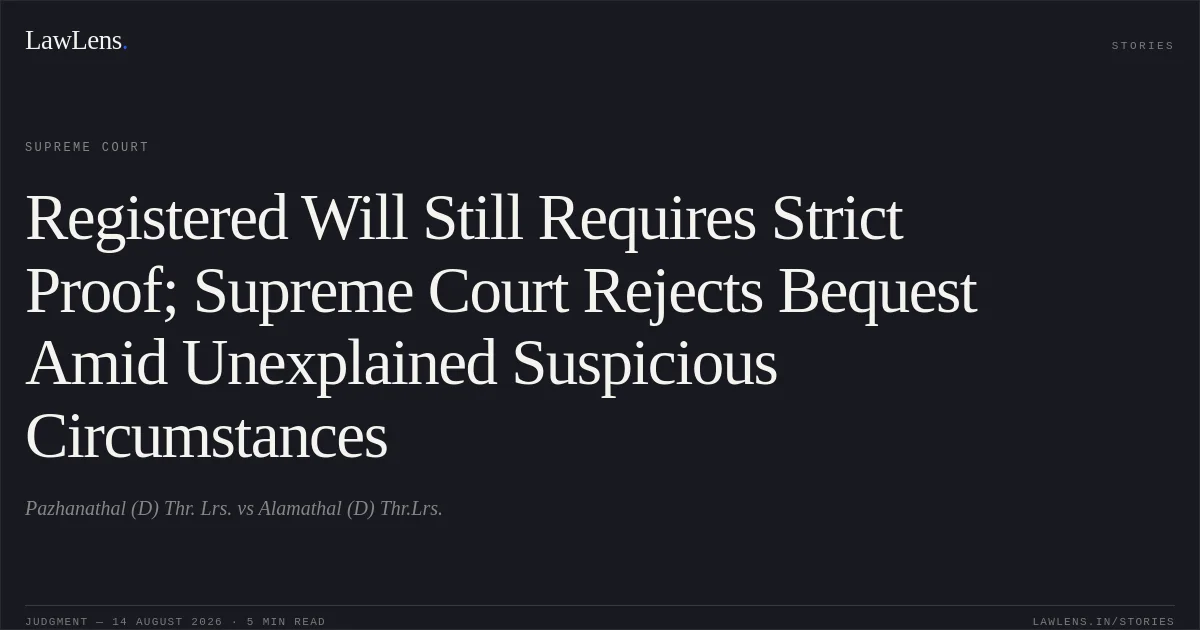
The Supreme Court held that the Will dated 15.12.1976 was not proved as the lawful last Will and testament of Arukkaniammal under Section 63(c) of the Indian Succession Act read with Sections 68 and 69 of the Evidence Act.
Arukkaniammal was therefore treated as having died intestate in respect of the suit properties.
Source reference: para. 135Under Section 15(2)(b) of the Hindu Succession Act, the branches of Ramathal, Chellammal and Alamathal each received a one-third share; the appellants, representing the first two branches, were collectively entitled to two-thirds.
Source reference: paras. 136–139The appeals were allowed, the High Court’s judgment dated 28.10.2008 was set aside, the Trial Court’s decree dated 22.01.1991 was restored, and the respondents’ suit for permanent injunction, O.S. No. 1344 of 1990, was dismissed.
Source reference: paras. 140–142Acts & Sections Cited
5 provisions across 2 statutes referred to in this judgment. Each provision opens on LawLens.
Hindu Succession Act, 19562
Indian Succession Act, 19253
Original Court PDF
Pazhanathal (D) Thr. Lrs.vsAlamathal (D) Thr.Lrs.
Click to open original judgment
Original judgment, available to read, download and summarize on LawLens.in