Facts
Respondent No. 3 applied under Section 13(3) of the Registration of Births and Deaths Act, 1969, for registration of the death of Sadashiva Rao, stated to have occurred on 15 September 1998.
Source reference: pp. 4–5, 8The Magistrate allowed the application on 28 August 2018, and a death certificate was issued on 17 November 2018. The petitioners sought to quash both, apprehending that respondent No. 3 would rely on the registration to claim rights in property they possessed. Respondent No. 3 disputed their standing, asserting that they were not Sadashiva Rao’s legal heirs.
Source reference: pp. 4–5, 8Issues
1. Whether the petitioners, who were not shown to be Sadashiva Rao’s legal heirs, had locus to challenge the Magistrate’s order registering his death.
Source reference: pp. 5, 8–92. Whether registration of the death under Section 13(3) determined any civil or inheritance rights, warranting the petitioners’ challenge to the order and certificate.
Source reference: pp. 9–10Law Applied
Section 13(3) of the Registration of Births and Deaths Act, 1969, permits registration of a birth or death not registered within one year only pursuant to a Magistrate’s order verifying its correctness.
Source reference: pp. 5–8The Court relied on Smt. Muniyamma and Others v. Devegowda and Others, ILR 2013 KAR 4703, which discussed procedural safeguards in such applications, including notice to persons likely to be affected and an enquiry where appropriate.
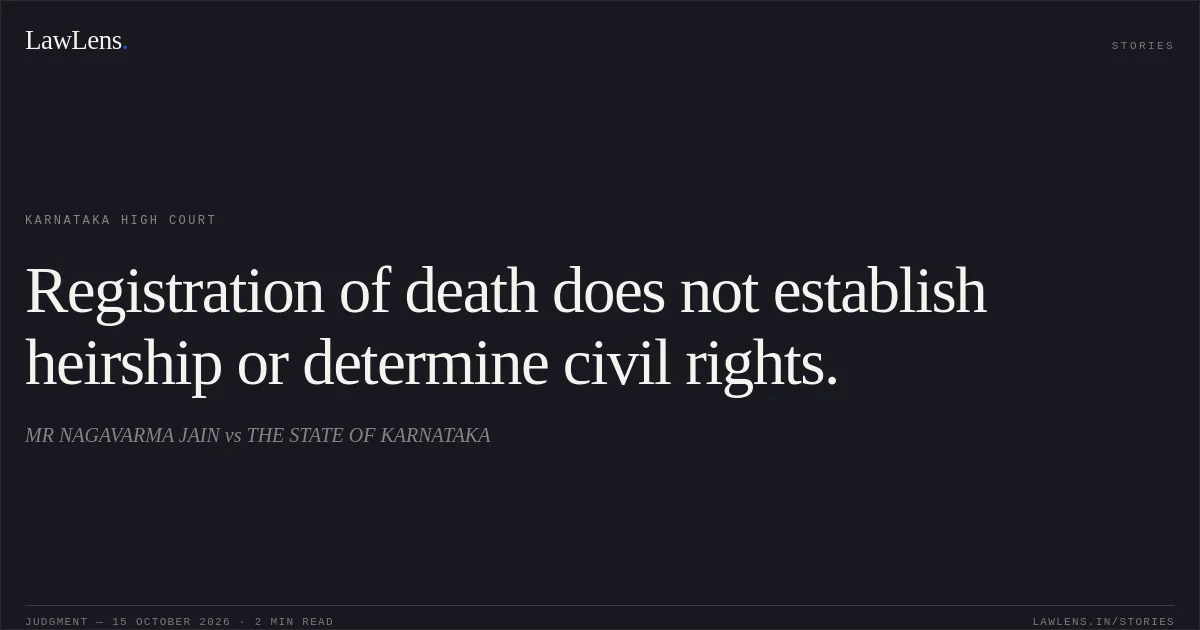
Source reference: pp. 5–8The Court held that registration of a death does not, by itself, determine civil rights or establish that any person is a legal heir; disputed civil rights must be established independently in a civil suit.
Source reference: pp. 9–10Reasoning
The petitioners’ asserted interest arose from their apprehension that respondent No. 3 might use the death registration to claim property rights. The Court held that they lacked locus to challenge the Magistrate’s order because they were not shown to be legal heirs of the deceased.
Source reference: paras. 10–14It further reasoned that the registration merely recorded the death and did not settle ownership or inheritance rights. The petitioners could therefore protect their property claims in a civil suit, where the death registration would have probative value only as evidence of the registered death; respondent No. 3 would have to prove any claimed status as legal representative independently.
Source reference: paras. 10–14Holding
The Court dismissed the writ petition and declined to quash either the Magistrate’s order or the death certificate.
It clarified that the registration did not establish respondent No. 3’s status as legal heir or determine civil rights, leaving the petitioners to pursue any property claims in a properly constituted civil suit.
Source reference: para. 15; pp. 9–10Acts & Sections Cited
3 provisions across 2 statutes referred to in this judgment. Each provision opens on LawLens.
Code of Criminal Procedure, 19731
Registration of Births and Deaths Act, 19692
Original Court PDF
MR NAGAVARMA JAINvsTHE STATE OF KARNATAKA
Click to open original judgment
Original judgment, available to read, download and summarize on LawLens.in


