Facts
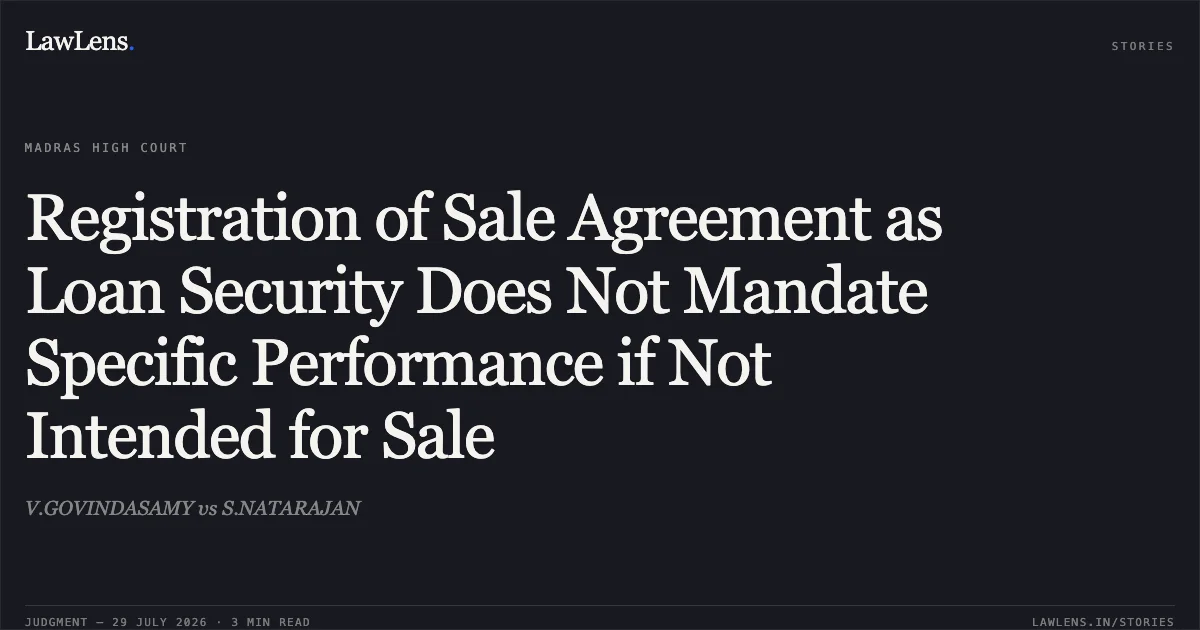
The Plaintiff (Respondent 1) filed a suit for specific performance based on a registered Sale Agreement dated Sept 9, 2015 (Ex-A.2) for property worth Rs. 12,00,000, having paid Rs. 10,00,000 as advance.
Source reference: p. 3The Appellant/1st Defendant contended the agreement was never intended as a sale but was executed as security for a loan of Rs. 10,00,000 borrowed for his son's education.
Source reference: p. 4The Trial Court decreed the suit in favor of the Plaintiff, holding the agreement valid and proved.
Source reference: p. 8The 1st Defendant appealed, arguing the transaction was a loan and highlighting that an 11-month period was fixed despite 80% of consideration being paid.
Source reference: p. 9Procedurally, the Plaintiff had also suppressed the fact that he held the original title deeds.
Source reference: p. 21Issues
1. Whether Ex-A.2 (Sale Agreement) was intended for the sale of properties or executed as security for a loan transaction.
Source reference: p. 112. Whether the plaintiff is entitled to the equitable relief of specific performance.
Source reference: p. 113. Whether the bar under Sections 91 and 92 of the Indian Evidence Act applies to oral evidence contradicting the written agreement.
Source reference: p. 12Law Applied
The Court applied Sections 91 and 92 of the Indian Evidence Act, 1872, noting that while terms of a written contract cannot be varied by oral evidence, a party may lead evidence to show the document was a sham or not intended to be acted upon.
Source reference: p. 12-15It relied on Kamireddi Sattiaraju v. Kandamuri Boolaeswari (2007) and Apex Court precedents in Roop Kumar v. Mohan Thedani and Parvinder Singh v. Renu Gautam to hold that an inquiry into the reality of a transaction is not excluded by the existence of a writing.
Source reference: p. 13-14Regarding the discretionary nature of specific performance, the court applied Section 20 of the Specific Relief Act, 1963 (pre-2018 amendment), as clarified in Annamalai v. Vasanthi (2026).
Source reference: p. 24Reasoning
The Court found several factors probablizing the loan theory: (i) fixing an 11-month period for a meager balance of Rs. 2,00,000 was inconsistent with a genuine sale.
Source reference: p. 18The Plaintiff’s shifting testimony regarding the reason for the delay (measuring the property) was an afterthought.
Source reference: p. 18The Plaintiff failed to verify encumbrances or obtain an EC for 12 years, which no prudent buyer would omit.
Source reference: p. 18The Plaintiff suppressed custody of the original Title Deeds in his pleadings, which indicated a lack of bona fides required for equitable relief.
Source reference: p. 21The Court noted that the 1st Defendant had a history of executing sale agreements as loan security, as evidenced by Ex-A.7.
Source reference: p. 19Consequently, the Court determined the Plaintiff failed to prove readiness and willingness beyond mere averments and had not approached the court with clean hands.
Source reference: p. 21-23Holding
The High Court set aside the Trial Court’s decree for specific performance; it held that the agreement was a security for a loan and not a sale transaction.
The Court passed a Money Decree in favor of the Plaintiff for Rs. 10,00,000 with simple interest at 15% per annum from the date of the suit until realization.
Source reference: p. 26The Plaintiff was ordered to return the original Title Deeds upon satisfaction of the decree, and a charge was created on the suit properties to secure the repayment.
Source reference: p. 27Acts & Sections Cited
3 provisions across 2 statutes referred to in this judgment. Each provision opens on LawLens.
Code of Civil Procedure, 19081
Specific Relief Act, 19632
Original Court PDF
V.GOVINDASAMYvsS.NATARAJAN
Click to open original judgment
Original judgment, available to read, download and summarize on LawLens.in