01Facts
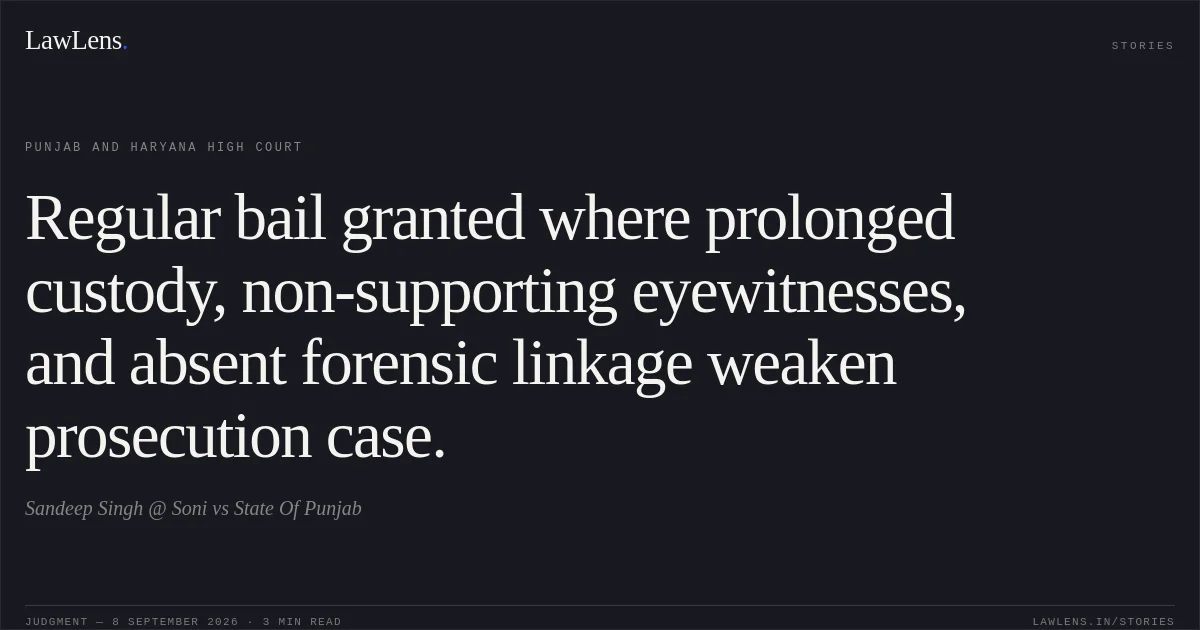
The petitioner sought regular bail under Section 483 of the Bharatiya Nagarik Suraksha Sanhita, 2023, corresponding to Section 439 of the erstwhile Code of Criminal Procedure, in FIR No. 19 dated 04.03.2024, registered under Sections 302 and 120-B IPC, corresponding to Sections 103 and 61 of the Bharatiya Nyaya Sanhita, and Sections 25/54/59 of the Arms Act, at Police Station Phase-11, District SAS Nagar, Mohali.
¶ 1His earlier bail petition had been dismissed as withdrawn on 30.01.2026.
¶ 1The FIR arose from the shooting death of Rajesh Dogra outside C.P. Mall, Sector 67, Mohali.
¶ 2The prosecution alleged that five or six assailants arrived in three vehicles and fired multiple shots at the deceased.
¶ 2The petitioner had remained in custody since 07.03.2024.
¶ 3He contended that the alleged eyewitnesses, Rajiv Sharma and Dalinder Singh, had been examined but neither supported the prosecution case nor identified him; that the alleged weapon recovery was not forensically connected with the crime; and that the CCTV footage and evidence of the vehicle owners did not establish his presence or participation.
¶ 3.1–3.3The State opposed bail on the grounds of the grave and heinous nature of the offence, the petitioner’s alleged specific role, and the advanced stage of the trial.
¶ 4–4.202Issues
i.Whether the petitioner was entitled to regular bail under Section 483 of the BNSS, notwithstanding the serious allegations of murder, conspiracy and offences under the Arms Act?
¶ 1, 4–5.3ii.Whether the developments during trial—including the failure of the alleged eyewitnesses and vehicle owners to implicate the petitioner, and the absence of forensic linkage between the recovered weapon and the crime—justified reconsideration of the petitioner’s continued incarceration?
¶ 5–5.2iii.Whether prolonged pre-trial custody, in circumstances where the trial was unlikely to conclude shortly, engaged the petitioner’s right to personal liberty and speedy trial under Article 21 of the Constitution?
¶ 3, 5.203Law Applied
The Court applied Section 483 of the Bharatiya Nagarik Suraksha Sanhita, 2023, corresponding to Section 439 Cr.P.C., governing the High Court’s power to grant regular bail.
¶ 1The underlying prosecution concerned alleged offences under Sections 302 and 120-B IPC, corresponding to Sections 103 and 61 BNS, and Sections 25/54/59 of the Arms Act.
¶ 1The Court applied the constitutional principle that the right to a speedy trial forms part of the right to life and personal liberty under Article 21, and that pre-trial detention should not become punitive in character.
¶ 3, 5.2It further applied the bail-stage principle that the Court should not conduct a meticulous appreciation of evidence or record a final finding on the merits, while still considering material developments in the evidence relevant to the necessity of continued incarceration.
¶ 5.2Provisions in the judgment · 8 · Linked ones open on LawLens
Bharatiya Nagarik Suraksha Sanhita, 2023 Section 483
Code of Criminal Procedure, 1973 Section 439
Indian Penal Code, 1860 Section 302
Bharatiya Nyaya Sanhita, 2023 Section 103Section 61
Arms Act, 1959 Section 25Section 54Section 59
04Reasoning
The Court found that the circumstances had materially changed since the earlier bail proceedings.
¶ 5Both alleged eyewitnesses had been examined and had neither supported the prosecution in material particulars nor identified the petitioner, thereby reducing the concern that his release could influence their testimony.
¶ 5The alleged weapon recovered from the petitioner had not been forensically connected with the weapon used in the offence; the CCTV footage did not prima facie establish his presence; and the owners of the vehicles allegedly used by the assailants did not identify him.
¶ 5.1Without finally determining the evidentiary merits, the Court held that these circumstances did not disclose an unimpeachable or cogent nexus between the petitioner and the offence.
¶ 5.2Considering his custody since 07.03.2024, the present stage of the trial, and the likelihood of further delay, the Court held that continued detention would serve no discernible punitive or useful purpose and could not be allowed to assume the character of punishment.
¶ 5.205Holding
The Court allowed the petition and granted the petitioner regular bail, subject to furnishing bail and surety bonds to the satisfaction of the competent Magistrate.
¶ 5.3–5.4The bail was made subject to conditions prohibiting inducement, threats, witness contact or tampering; restricting travel outside India without permission; requiring verification of permanent and current addresses; disclosure of PAN, Aadhaar, bank-account and property particulars; intimation of changes in address or mobile number; abstention from similar offences; and regular appearance before the Trial Court unless exempted.
¶ 5.4(i)–(vii)Violation of the conditions could result in cancellation of bail and issuance of coercive process.
¶ 5.4(vii)Pending miscellaneous applications were disposed of as infructuous.
¶ 6Original Court PDF
Sandeep Singh @ SonivsState Of Punjab
Click to open original judgment
Original judgment, available to read, download and summarize on LawLens.in