Facts
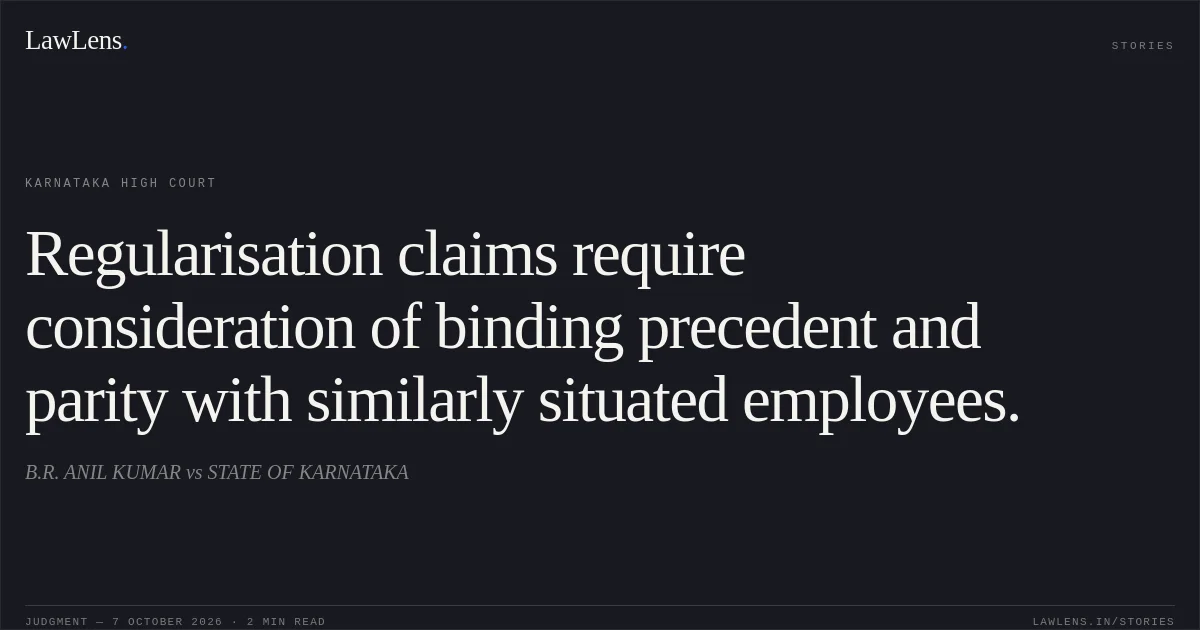
The petitioners, employees of the Sakaleshapura Town Municipal Council, sought consideration of their representation dated 16 January 2026 for regularisation from the date each completed ten years of daily-wage service, with consequential service and financial benefits.
Source reference: pp. 5–7They relied on regularisation orders concerning other groups of daily-wage employees and on the Supreme Court’s decision in Shripal and Another v. Nagar Nigam, Ghaziabad, 2025 SCC OnLine SC 221.
Source reference: pp. 5–7The petition was brought under Articles 226 and 227 of the Constitution seeking a mandamus to consider the representation.
Source reference: p. 5Issues
1. Whether the respondents should be directed to consider the petitioners’ representation seeking regularisation and consequential benefits.
Source reference: pp. 5–62. Whether, in considering the representation, the respondents must address the petitioners’ reliance on Shripal and the asserted parity with other regularised daily-wage employees.
Source reference: pp. 7–9Law Applied
Article 141 of the Constitution makes the law declared by the Supreme Court binding on all courts and authorities.
Source reference: p. 8The Court referred to Shripal and Another v. Nagar Nigam, Ghaziabad, 2025 SCC OnLine SC 221, as a relevant Supreme Court decision on regularisation.
Source reference: pp. 7–8It also stated that authorities considering regularisation claims should take account of applicable judicial pronouncements and, where parity with other employees is specifically asserted, apply their minds to the cited orders.
Source reference: pp. 8–9Reasoning
The Court confined its decision to the petitioners’ request for consideration of their representation.
Source reference: pp. 7–8It noted their reliance on Shripal and on regularisation orders concerning similarly placed employees, and the State’s submission that it would examine the records and pass appropriate orders.
Source reference: pp. 7–8The Court therefore directed the respondents to consider the representation, requiring them to take account of the binding legal position and address the parity material relied on, rather than dispose of the claim mechanically by invoking matters such as the 1 July 1984 cut-off date or non-availability of sanctioned posts.
Source reference: pp. 8–9Holding
The petition was disposed of with a direction to the respondents to consider the representation at Annexure-K and pass appropriate orders within two months of receiving a certified copy of the order.
The Court did not itself order regularisation or grant consequential benefits; those claims were left for the authorities to decide after considering the cited law and parity materials.
Source reference: pp. 8–9Original Court PDF
B.R. ANIL KUMARvsSTATE OF KARNATAKA
Click to open original judgment
Original judgment, available to read, download and summarize on LawLens.in