Facts
The applicant, Laxman Kumar Das, aged 46 years, had been working as a casual labourer under the respondents since 1998.
Source reference: p.2Despite the regularization of services for 1655 casual labourers across India, the applicant was allegedly discriminated against.
Source reference: p.2Failing to secure regularization through internal channels, the applicant filed the Original Application (OA) seeking a direction for temporary status and regularization of his service, challenging an order dated March 16, 2019.
Source reference: p.3The respondents filed a counter-objection contesting the case on both merit and limitation.
Source reference: p.3Issues
1. Whether the applicant's service as a casual labourer under the Bharat Sanchar Nigam Limited (BSNL) should be regularized.
Source reference: p.22. Whether the OA is barred by limitation and laches.
Source reference: p.3Law Applied
The court primarily applied the principle that a successor body steps into the shoes of its predecessor subject to liabilities and obligations arising from the prior regime, as held in Dharma Singh (supra).
Source reference: p.4It further recognized that the "law declared" by the Supreme Court is binding on all courts under Article 141 of the Constitution of India and serves as a judicial precedent, as established in Fida Hussain v. Moradabad Development Authority, Ambica Quarry Works v. State of Gujarat, and CIT v. Sun Engg. Works (P) Ltd.
Source reference: p.6The court also applied the principle that denying relief to identically situated employees would be discriminatory and violative of Article 14 of the Constitution, as articulated in State of UP v. Arvind Kumar Shrivastva, especially for judgments delivered in rem regarding policy matters like regularization schemes.
Source reference: p.6-7The court additionally relied on the decisions in Jaggo v. Union of India and Others, Dharam Singh & Others v. State of U.P & Another, Shripal and Anr. vrs. Nagar Nigam, Ghaziabad, Bhola Nath Vs State of Jharkhand and Ors, and Pawan Kumar Vs Union of India, which supported regularization of long-serving casual employees, even when appointments lacked adherence to procedural formalities and dismissed the plea of limitation or laches in cases of Article 14 infraction.
Source reference: p.3-4, 8, 10-11Reasoning
The court found that the facts and issues in the present OA were akin to those decided by a Full Bench in OA No. 654/2015.
Source reference: p.4The Full Bench had relied on Supreme Court decisions such as Chander Mohan Negi and Others vs. State of Himachal Pradesh & Ors., Jaggo Vrs. Union of India and Others, Vinod Kumar & Ors. Vs. Union of India & Ors., Dharam Singh & Others Vs. State of U.P & Another, Shripal and Anr. vrs. Nagar Nigam, Ghaziabad, and Bhola Nath Vs State of Jharkhand and Ors to decide in favor of applicants seeking regularization.
Source reference: p.3-4Specifically, the Full Bench noted that BSNL, as a successor, was obligated to regularize casual workers engaged prior to its formation under Dharma Singh (supra).
Source reference: p.4-5The Full Bench also dismissed the plea of limitation and laches, stating that the OA was filed within the one-year period and that the delay was not intentional but due to internal correspondence and the long history of engagement.
Source reference: p.5-6It further emphasized that the Hon'ble Apex Court's decisions, particularly those in rem like State of UP Vs. Arvind Kumar Shrivastva, require extending benefits to all similarly situated persons to avoid discrimination under Article 14.
Source reference: p.6-7The Division Bench concurred with the Full Bench, noting that the latest decision in Pawan Kumar Vs Union of India also established that tribunals were not justified in denying relief based on Umadevi (3) when appointments were not illegal but lacked procedural adherence.
Source reference: p.10-11The court found that denying regularization to the applicant, while others were regularized, would violate Articles 14 and 16 of the Constitution.
Source reference: p.11Holding
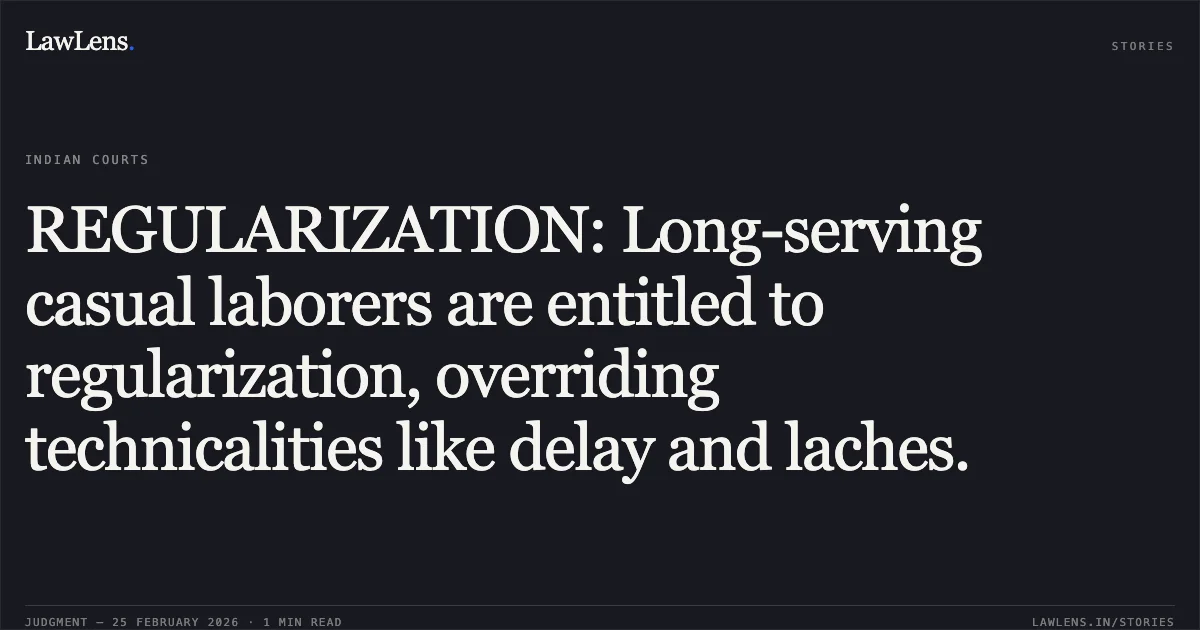
The court quashed the impugned order dated March 16, 2019.
The OA was allowed, and the respondents were directed to regularize the service of the applicant by following the principles set out by the Hon’ble Apex Court in Jaggo (supra), Dharam Singh (supra), Shripal and Anr. (supra), Bhola Nath (supra) and Pawan Kumar (supra).
Source reference: p.11-12The regularization was to be effective from the date other 455 persons were regularized, for the purpose of qualifying service, within a period of 90 days from the date of receipt of a copy of the order.
Source reference: p.11-12Acts & Sections Cited
1 provisions across 1 statute referred to in this judgment. Linked provisions open on LawLens.
AT Act, 19851
Original Court PDF
Laxman Kumar Das v. Union of India, O.A. No. 260/00502 of 2019
Click to open original judgment
Original judgment, available to read, download and summarize on LawLens.in


![Subsequent exoneration does not retrospectively invalidate a finalized promotion select list.. UNNIKRISHNAN M vs M/o Environment And Forests. CAT - ['Ernakulam']. LawLens](/stories/thumbnails/subsequent-exoneration-does-not-retrospectively-invalidate-a-finalized-promotion-select-li-ce80a0e84f2f4887857271e8b4341c42.webp)