Facts
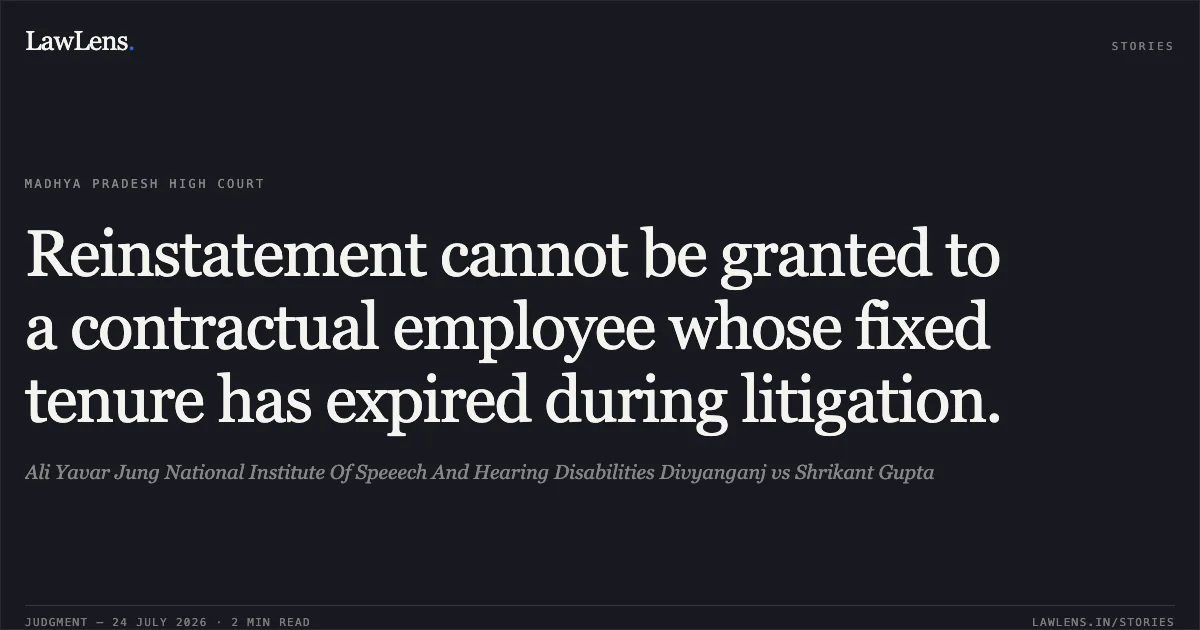
The respondent was appointed as an Administrative Officer (Consultant) on a purely contractual basis for one year effective 16.11.2023.
Source reference: para. 2Alleging misconduct and indiscipline, the appellants issued a show-cause notice and subsequently terminated his services on 23.08.2024, prior to the expiry of the tenure.
Source reference: para. 2The respondent challenged this before a Single Judge, who set aside the termination as punitive/stigmatic, ordering reinstatement with 50% back wages.
Source reference: para. 1, 2The appellants appealed, arguing that the contractual tenure had already expired (on 15.11.2024) during the litigation, making reinstatement legally impermissible.
Source reference: para. 3Issues
1. Whether a contractual employee is entitled to reinstatement and continuity of service after the original contractual period has expired by efflux of time.
Source reference: para. 62. Whether the incorporation of CCS (Conduct) and CCA Rules into a contract grants a contractual employee the same procedural safeguards as a regular government servant.
Source reference: para. 83. Whether the termination was "founded" on misconduct (punitive) or merely "motivated" by it (simpliciter).
Source reference: para. 7Law Applied
The Court applied the principle that contractual employees do not have a right to continue in service beyond the fixed tenure.
Source reference: para. 6It relied on State of Haryana v. Satyender Singh Rathore (2005) to distinguish between "foundation" (punitive termination requiring inquiry) and "motive" (termination of suitability).
Source reference: para. 6, 7It further applied A.P. State Federation of Coop. Spinning Mills Ltd. v. P.V. Swaminathan (2001), which establishes that while reinstatement cannot be granted after the expiry of a contract, an employee may be entitled to pecuniary benefits for the unexpired portion of the term if the termination was improper.
Source reference: para. 9The court also held that contractual clauses adopting the CCS (CCA) Rules do not convert a contract into a regular appointment.
Source reference: para. 8Reasoning
The Court reasoned that the Single Judge erred by granting reinstatement because the respondent’s contract naturally expired on 15.11.2024; thus, no enforceable right to the post survived.
Source reference: para. 6While the termination order mentioned misconduct, the Court noted that a contractual employee cannot claim full-fledged departmental inquiry protections under the CCS (CCA) Rules, as these rules apply only to the extent contemplated by the contract and do not override the temporary nature of the engagement.
Source reference: para. 8However, since the termination occurred before the contract ended without a formal inquiry into the "foundation" of misconduct, the Court determined that the equities must be balanced.
Source reference: para. 9Following Supreme Court precedent, it shifted the remedy from reinstatement to limited monetary compensation for the remaining months of the contract.
Source reference: para. 9Holding
The Division Bench allowed the appeal and set aside the Single Judge’s order of reinstatement and back wages.
The Court held that the respondent is not entitled to reinstatement or continuity of service as the contract period had lapsed.
Source reference: para. 9It directed the appellants to pay the respondent his salary for the specific period from the date of termination (23.08.2024) to the date the contract would have naturally expired (15.11.2024), within eight weeks.
Source reference: para. 10All other claims for relief were denied.
Source reference: para. 10Acts & Sections Cited
1 provisions across 1 statute referred to in this judgment. Linked provisions open on LawLens.
M.P. Uchcha Nyayalaya (Khand Nyayapeeth Ko Appeal) Adhiniyam, 20051
Original Court PDF
Ali Yavar Jung National Institute Of Speeech And Hearing Disabilities DivyanganjvsShrikant Gupta
Click to open original judgment
Original judgment, available to read, download and summarize on LawLens.in