Facts
The petitioner claimed that he had been engaged as a Safai Karmi/Sweeper at the Block Office, Bahadurganj, Kishanganj, from 3 February 2006, initially on monthly remuneration of ₹500, subsequently enhanced to ₹9,828.
Source reference: para. 3He relied on payment-related documents and an Experience Certificate issued by the Block Development Officer recording his work as a Sweeper from 3 February 2006 to 1 July 2022.
Source reference: para. 3; para. 8The petitioner alleged that he was orally removed from service on 14 August 2025 through a telephonic communication by a clerk, without notice or a formal termination order.
Source reference: para. 4He submitted representations to the authorities and the Labour Commissioner, but received no relief.
Source reference: para. 4He sought reinstatement, back wages, quashing of the alleged termination, regularisation, compensation and costs.
Source reference: para. 2The State contended that there was neither any appointment letter nor any document evidencing the petitioner’s termination.
Source reference: para. 7Issues
Whether the petitioner was entitled to a writ directing reinstatement when he had produced neither an appointment letter nor a formal termination order.
Source reference: paras. 7–9Whether the petitioner could obtain back wages, regularisation and consequential reliefs on the basis of his asserted long-term engagement and an Experience Certificate, in the absence of documentary proof of appointment and termination.
Source reference: paras. 2, 8–10Whether the principles of natural justice, “last-come-first-go” and Section 25-G of the Industrial Disputes Act, relied upon by the petitioner, could be applied when no order of termination or retrenchment was placed on record.
Source reference: paras. 5–9Law Applied
The Court applied the principle that a writ of reinstatement cannot ordinarily be granted without proof of an existing service relationship and a legally identifiable termination or discontinuation order.
Source reference: paras. 8–10The petitioner relied on the constitutional requirements of non-arbitrariness and equal treatment under Articles 14 and 16, the principles of natural justice, and the “last-come-first-go” safeguard under Section 25-G of the Industrial Disputes Act, as discussed in Madhwi Jha & Ors. v. Patna University through its Registrar & Ors., 2026 (1) BLJ 584.
Source reference: para. 5He also relied on Union of India & Ors. v. Baliram, Civil Appeal No. 13783 of 2015, for the proposition that procedural technicalities should not defeat equitable relief in writ jurisdiction.
Source reference: para. 6However, those principles presuppose proof of the relevant employment action being challenged; they do not dispense with the need to establish appointment and termination.
Source reference: paras. 8–9Reasoning
The Court found that the petitioner had not annexed any appointment letter or other conclusive document establishing his appointment to the post of Sweeper.
Source reference: para. 8Although an Experience Certificate and some payment documents indicated that he had performed work for the department, they did not, by themselves, establish the legal terms or status of his engagement.
Source reference: para. 8More importantly, the record contained no termination or removal order; the allegation of termination rested only on the petitioner’s assertion that he was orally informed through a telephone communication.
Source reference: para. 8In the absence of a documented termination, there was no identifiable impugned order for the Court to quash and no established basis for directing reinstatement.
Source reference: para. 8The decision in Madhwi Jha was therefore held inapplicable because that case involved a specific termination order that had been challenged.
Source reference: para. 9Consequently, the Court did not examine the alleged violation of natural justice or Section 25-G on merits.
Source reference: para. 9Holding
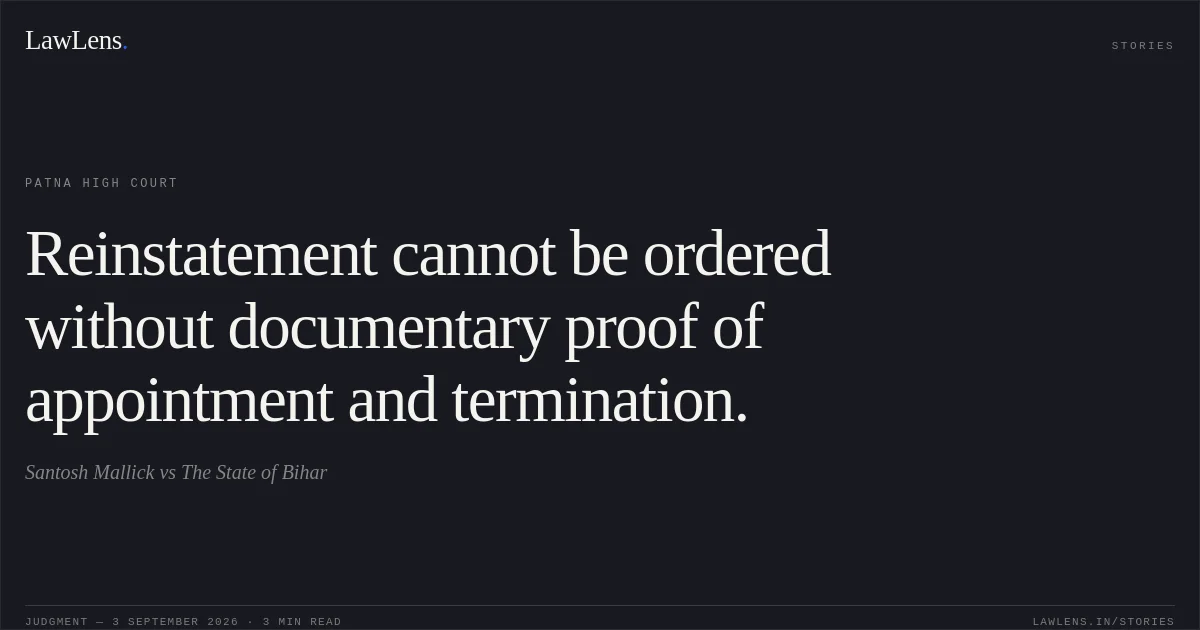
The Court held that the petitioner was not entitled to reinstatement or the other consequential reliefs because he had failed to produce an appointment letter or any document evidencing his termination from service.
The writ petition was dismissed for lack of merit, and any pending application was also disposed of.
Source reference: paras. 10–11Acts & Sections Cited
1 provisions across 1 statute referred to in this judgment. Linked provisions open on LawLens.
Industrial Disputes Act, 19471
Original Court PDF
Santosh MallickvsThe State of Bihar
Click to open original judgment
Original judgment, available to read, download and summarize on LawLens.in