Facts
Naresh Kumar was appointed by Shivalik Agro Poly Products Ltd. as a Civil Engineer on 11.09.1986, drawing a basic salary of ₹4,480 per month.
Source reference: para. 3(b)His duties included preparing estimates and drawings, physically verifying contractors’ work, preparing bills, and attending to the company’s construction and maintenance projects.
Source reference: paras. 4, 9–10The employer terminated his services by notice dated 08.01.2001, with effect from 07.02.2001, after he had completed more than 240 days of service in the preceding twelve months.
Source reference: para. 17No retrenchment compensation under Section 25-F(b) of the Industrial Disputes Act, 1947 (“the Act”) was paid.
Source reference: para. 18The Industrial Tribunal held that Naresh Kumar was a “workman” under Section 2(s) of the Act and that his termination was illegal, but awarded only ₹1,25,000 as lump-sum compensation instead of reinstatement.
Source reference: paras. 3(a), 19The employer challenged the award in CWP No. 4690 of 2012, while Naresh Kumar sought reinstatement with full back wages, or enhancement of the compensation, in CWP No. 2778 of 2012.
Source reference: paras. 1–2Issues
Whether Naresh Kumar, despite being designated and appointed as a Civil Engineer and drawing wages above the statutory threshold, was a “workman” within the meaning of Section 2(s) of the Act?
Source reference: paras. 8, 11–16Whether the termination of Naresh Kumar’s services was illegal for non-compliance with the conditions precedent under Section 25-F of the Act?
Source reference: paras. 17–18Whether he was entitled to reinstatement with back wages, or whether lump-sum compensation was the appropriate relief?
Source reference: paras. 19–24Whether the compensation of ₹1,25,000 awarded by the Industrial Tribunal was adequate?
Source reference: para. 24Law Applied
Section 2(s) of the Industrial Disputes Act, 1947, as applicable before the 2010 amendment, includes persons employed to perform manual, skilled, technical, operational, clerical, or supervisory work, but excludes persons employed mainly in managerial or administrative capacities and supervisory employees drawing wages above ₹1,600 per month or exercising mainly managerial functions.
Source reference: para. 11The court applied the principle that an employee’s designation is not decisive; the primary nature of the duties actually performed determines whether the employee is a workman.
Source reference: paras. 12, 14Relying on Anand Regional Co-operative Oil Seeds Growers’ Union Ltd. v. Shailesh Kumar Harshadbhai Shah, (2006) 6 SCC 548, and Ananda Bazar Patrika (P) Ltd. v. Workmen, (1970) 3 SCC 248, the court held that supervisory work involves direction, control, and genuine authority over subordinate employees.
Source reference: para. 15Section 25-F requires one month’s notice or wages in lieu thereof, payment of retrenchment compensation equivalent to fifteen days’ average pay for every completed year of service, and notice to the appropriate Government before retrenchment.
Source reference: para. 17The court further relied on Jagbir Singh v. Haryana State Agriculture Marketing Board, (2009) 15 SCC 327, and Assistant Engineer, Rajasthan Development Corporation v. Gitam Singh, (2013) 5 SCC 136, for the rule that reinstatement with back wages is not automatic for every illegal termination and that compensation may be granted instead.
Source reference: paras. 20–22Reasoning
The court found that Naresh Kumar’s principal functions were technical and related to civil construction and maintenance, including preparing estimates and drawings, verifying contractors’ work, and preparing bills.
Source reference: paras. 9, 16Although he signed gate passes, recommended leave, and dealt with workers’ records, he lacked authority to appoint employees, sanction leave, initiate disciplinary proceedings, or exercise disciplinary control.
Source reference: paras. 10, 14–16The actual evidence therefore did not establish that his primary duties were supervisory or managerial.
Source reference: paras. 10, 14–16His designation as Civil Engineer and his salary above ₹1,600 could not, by themselves, exclude him from the definition of “workman”.
Source reference: paras. 10, 14–16Since he had completed more than 240 days of service and the employer had not paid retrenchment compensation under Section 25-F(b), the termination was held illegal and void, notwithstanding the payment of one month’s notice wages.
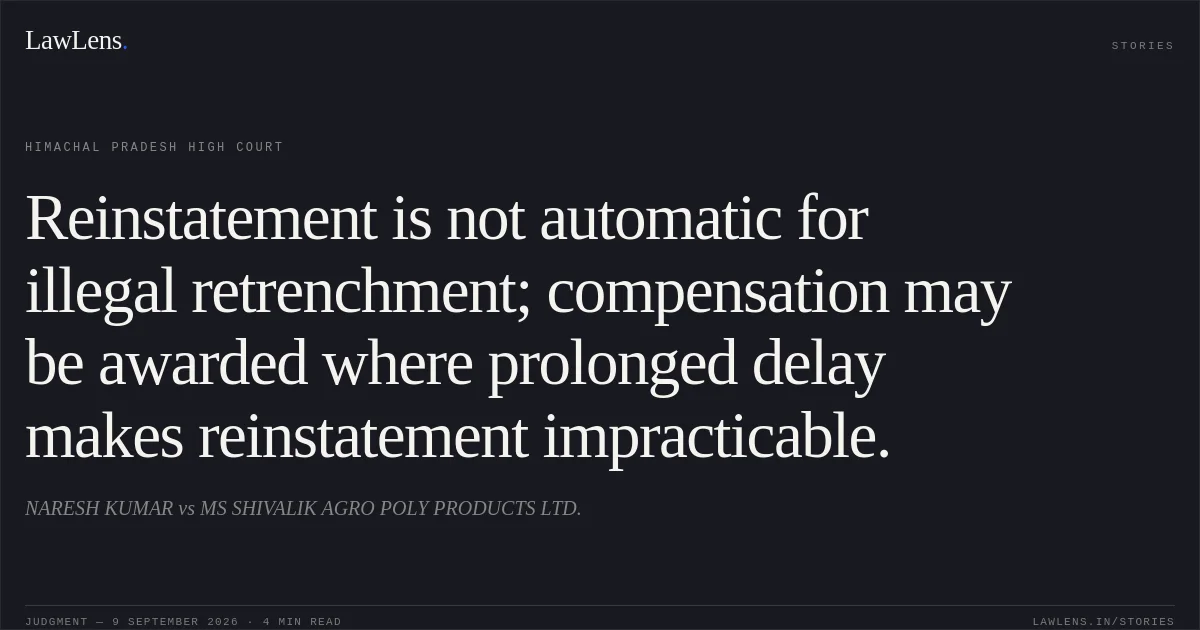
Source reference: paras. 17–18However, the court declined reinstatement with back wages because approximately twenty-five years had elapsed since the termination, making reinstatement impracticable.
Source reference: paras. 20–23Applying the principle that relief must be moulded according to the circumstances of each case, the court substituted monetary compensation for reinstatement.
Source reference: paras. 20–23Considering the long duration of service, the passage of time, and the circumstances of the case, it enhanced the compensation from ₹1,25,000 to ₹3,00,000.
Source reference: para. 24Holding
The court held that Naresh Kumar was a “workman” under Section 2(s) of the Act because his primary duties were technical rather than supervisory or managerial.
His termination was illegal for failure to comply with Section 25-F, particularly the requirement to pay retrenchment compensation.
Source reference: paras. 17–18Reinstatement with back wages was denied as inappropriate after a lapse of approximately twenty-five years.
Source reference: para. 25The award was modified, and Naresh Kumar was awarded lump-sum compensation of ₹3,00,000 in lieu of reinstatement, payable within six weeks.
Source reference: para. 25In default, the amount would carry interest at 6% per annum from the date of judgment until realization.
Source reference: para. 25The employer’s petition was dismissed, and the employee’s petition was partly allowed.
Source reference: para. 25Acts & Sections Cited
4 provisions across 1 statute referred to in this judgment. Linked provisions open on LawLens.
Companies Act, 19564
Original Court PDF
NARESH KUMARvsMS SHIVALIK AGRO POLY PRODUCTS LTD.
Click to open original judgment
Original judgment, available to read, download and summarize on LawLens.in