Facts
The respondent, a DTC Conductor confirmed in service in 1983, was alleged to have collected fare from six passengers on 29 October 1993 without issuing tickets.
Source reference: paras. 2–6He was suspended, charge-sheeted, subjected to a departmental enquiry, and removed from service on 20 October 1994 after the charges were held proved.
Source reference: paras. 2–6The respondent raised an industrial dispute. The Labour Tribunal initially held that the domestic enquiry was not fair because the management witnesses had not deposed in the respondent’s presence, and permitted the management to lead evidence.
Source reference: paras. 7–10, 22By award dated 12 August 2010, the Tribunal directed reinstatement without back wages, with continuity of service and seniority, finding that the misconduct was not established.
Source reference: para. 10During the writ proceedings, the respondent was granted wages under Section 17B of the Industrial Disputes Act, 1947, until superannuation.
Source reference: paras. 12, 32Issues
Whether the Labour Tribunal’s finding that the charge of collecting fare without issuing tickets was not proved was perverse or warranted interference under Articles 226 and 227 of the Constitution.
Source reference: paras. 19–29Whether reinstatement with continuity of service and seniority was an automatic or appropriate relief after the respondent’s removal was found unsustainable, particularly when the respondent had superannuated and had already received Section 17B wages.
Source reference: paras. 30–32Law Applied
The High Court applied the supervisory, non-appellate scope of judicial review under Articles 226 and 227, holding that it should not reappreciate evidence or interfere with a Labour Tribunal’s plausible findings unless they are arbitrary, perverse, or based on no relevant evidence.
Source reference: paras. 19–20, 29In departmental proceedings, strict rules of evidence do not apply; misconduct is assessed on the preponderance-of-probabilities standard.
Source reference: para. 20Relying on International Airport Authority of India v. International Air Cargo Workers Union, (2009) 13 SCC 374, the Court held that findings based on some relevant material ordinarily cannot be disturbed merely because another view is possible, although interference is permissible where findings rest on no evidence or irrelevant evidence.
Source reference: para. 29The Court also relied on Mahesh Chand v. D.T.C., 2026:DHC:7889, for the principle that absence of cash verification does not, by itself, vitiate a departmental enquiry, but may assume significance where other reliable evidence is lacking.
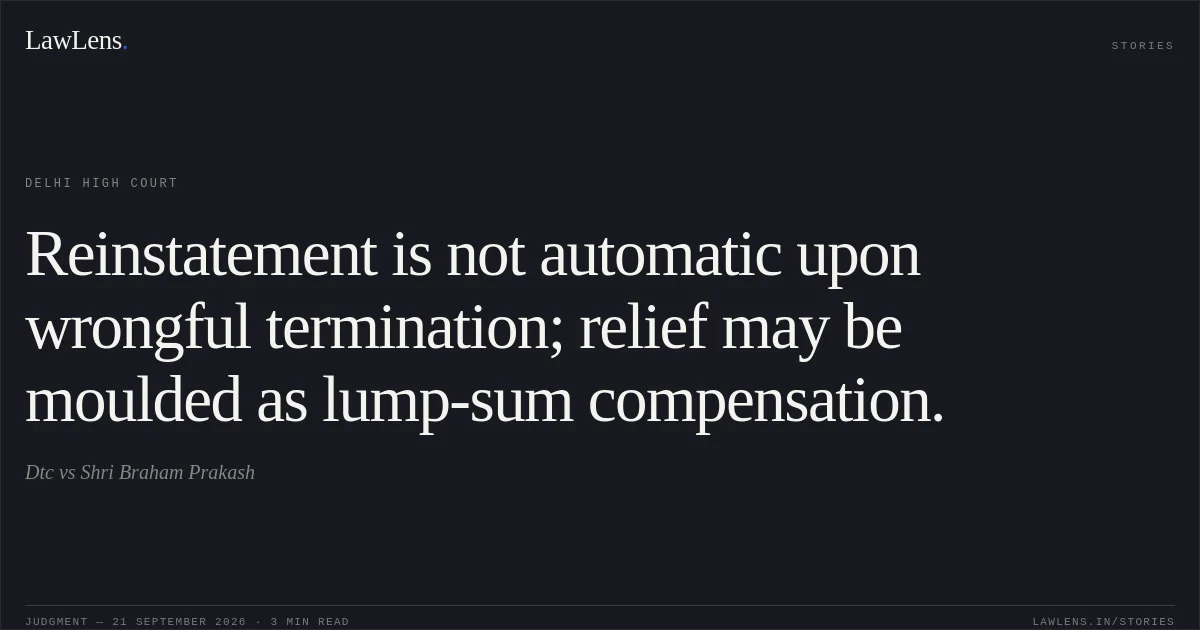
Source reference: paras. 26–28Further, under the principle stated in Allahabad Bank v. Krishan Pal Singh, (2021) 19 SCC 227, reinstatement with full back wages is not an automatic consequence of an illegal termination, and relief may be moulded according to the nature of employment, length of service, and surrounding circumstances.
Source reference: paras. 30–31Reasoning
The Court held that the Tribunal’s conclusion was a plausible view supported by the evidentiary deficiencies in the management’s case.
Source reference: paras. 23–25The checking staff’s testimony was substantially uncorroborated; the respondent’s alleged signatures on the surrendered unpunched tickets did not match his admitted signature on the challan; the passenger statements did not record the amounts allegedly paid; and no other member of the checking team testified.
Source reference: paras. 23–25Although non-verification of cash was not independently fatal, it became material because the management lacked other reliable evidence proving that the passengers had actually paid fare to the respondent and that he had failed to issue tickets.
Source reference: paras. 26–28The High Court therefore declined to reassess the evidence as an appellate court and upheld the Tribunal’s finding that the misconduct was not established.
Source reference: paras. 19–20, 28–29However, it held that reinstatement and continuity of service did not automatically follow. Considering the respondent’s approximately eleven years of prior service, the lapse of more than three decades, his superannuation, and the wages already paid under Section 17B, the Court considered lump-sum compensation more appropriate than reinstatement.
Source reference: para. 32Holding
The High Court found no perversity or jurisdictional error in the Tribunal’s conclusion that the charge was not proved and declined to interfere with that finding.
Nevertheless, it modified the relief of reinstatement, continuity of service, and seniority by awarding the respondent lump-sum compensation of ₹4,00,000, in view of the delay, his superannuation, and the Section 17B payments already received.
Source reference: paras. 32–34The writ petition was disposed of in those terms, with the compensation directed to be paid by the petitioner within the period specified in the order.
Source reference: para. 33Acts & Sections Cited
1 provisions across 1 statute referred to in this judgment. Linked provisions open on LawLens.
Industrial Disputes Act, 19471
Original Court PDF
DtcvsShri Braham Prakash
Click to open original judgment
Original judgment, available to read, download and summarize on LawLens.in