Facts
Lata Devi (Respondent) was engaged as a sweeper at IGI Airport via a contractor. Following the Supreme Court’s decision in Air India v. United Labour Union, the Petitioner (AAI) took her under its care on February 01, 1997, pending regularisation.
Source reference: p. 2AAI discontinued her services on July 13, 1998, alleging she violated service regulations by contracting a "dual marriage," based on name discrepancies of her husband in her ration card versus her affidavit.
Source reference: p. 2-3The Central Government Industrial Tribunal (CGIT), vide award dated December 13, 2013, set aside the termination for lack of an inquiry/proof and ordered reinstatement without back wages.
Source reference: p. 3-4Both parties filed cross-petitions: AAI challenging the reinstatement and the Respondent seeking back wages.
Source reference: p. 4-5Issues
1. Whether a direct employer-employee relationship existed between AAI and the Respondent in light of the overruling of Air India by SAIL v. National Union Waterfront Workers.
Source reference: p. 5/82. Whether the discontinuation of service on the grounds of a bigamous marriage without a formal inquiry was legally sustainable.
Source reference: p. 93. Whether reinstatement or back wages is the appropriate relief given the Respondent has surpassed the age of superannuation.
Source reference: p. 9-11Law Applied
The Court applied the principles of Section 10(1) of the Contract Labour (Regulation and Abolition) Act, 1970, regarding the prohibition of contract labour in sweeping/cleaning.
Source reference: p. 6-7It relied on Air India v. United Labour Union (1997), which held that upon prohibition of contract labour, a direct relationship arises between the worker and the principal employer.
Source reference: p. 7While acknowledging that SAIL v. National Union Waterfront Workers (2001) overruled Air India, the court noted the prospective application of SAIL.
Source reference: p. 8The court applied Jagbir Singh v. Haryana State Agriculture Mktg. Board and Allahabad Bank v. Krishan Pal Singh, which establish that reinstatement and back wages are not automatic consequences of illegal termination and can be substituted with lump-sum compensation.
Source reference: p. 10-11Reasoning
The Court observed that AAI had already implemented the Air India judgment by regularising 50-60 similarly placed co-employees; thus, it could not arbitrarily deny the Respondent the same status.
Source reference: p. 8Because the Respondent was treated as a direct employee, her services could not be terminated without following the Industrial Disputes Act and the principles of natural justice.
Source reference: p. 9The Court found the termination "illegal and unjustified" as AAI failed to conduct an inquiry or provide cogent evidence to prove the alleged bigamous marriage.
Source reference: p. 9The Court noted that nearly 30 years had passed since termination (1998) and the Respondent had reached the age of superannuation around 2007-08; furthermore, the Respondent failed to provide evidence of being unemployed during the intervening period to justify back wages.
Source reference: p. 11-12Holding
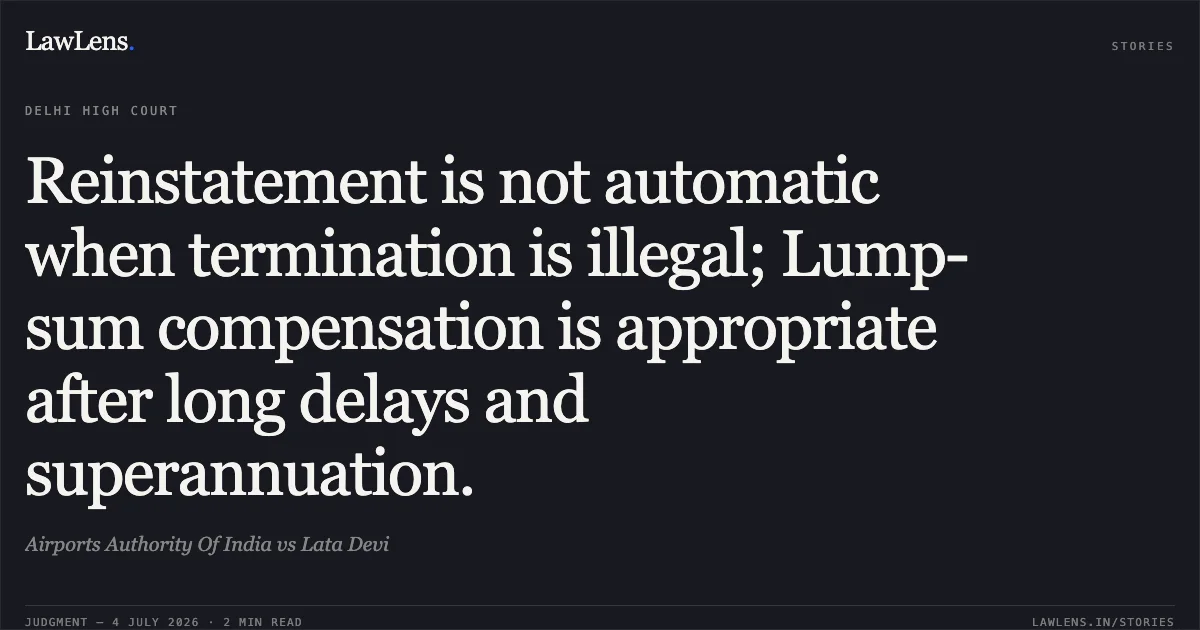
The Court upheld the Tribunal’s finding that the termination was illegal but modified the relief.
The Court set aside the order of reinstatement and directed AAI to pay a lump-sum compensation of ₹5,00,000/- to the Respondent in lieu of reinstatement and back wages, to be paid within eight weeks.
Source reference: p. 12Acts & Sections Cited
2 provisions across 2 statutes referred to in this judgment. Linked provisions open on LawLens.
Contract Labour (Regulation and Abolition) Act, 19701
Industrial Disputes Act, 19471
Original Court PDF
Airports Authority Of IndiavsLata Devi
Click to open original judgment
Original judgment, available to read, download and summarize on LawLens.in


![Subsequent exoneration does not retrospectively invalidate a finalized promotion select list.. UNNIKRISHNAN M vs M/o Environment And Forests. CAT - ['Ernakulam']. LawLens](/stories/thumbnails/subsequent-exoneration-does-not-retrospectively-invalidate-a-finalized-promotion-select-li-ce80a0e84f2f4887857271e8b4341c42.webp)