Facts
The Applicant and Respondent No. 2 are brothers and former directors of Unicom Skytech Limited. Respondent No. 2 alleged that the Applicant forged a 2014 company-meeting notice and relied on it in proceedings before the National Company Law Tribunal.
Source reference: para. 3.1–3.3The Applicant’s father had earlier filed a proceeding seeking investigation under Section 156(3) CrPC; the Magistrate rejected that prayer and disposed of the proceeding.
Source reference: paras. 8–10In revision, the Sessions Court observed that the complainant could file a complaint case, as the earlier proceeding had not been pursued under Sections 200–202 CrPC.
Source reference: paras. 8–10Respondent No. 2 then filed a complaint under Chapter XV; after recording his statement, receiving handwriting-expert evidence, and obtaining an enquiry report under Section 202, the Magistrate issued process against the Applicant under Sections 465 and 471 IPC.
Source reference: paras. 11–12The Sessions Court dismissed the Applicant’s revision, and he sought quashing of both orders before the High Court.
Source reference: paras. 13–14Issues
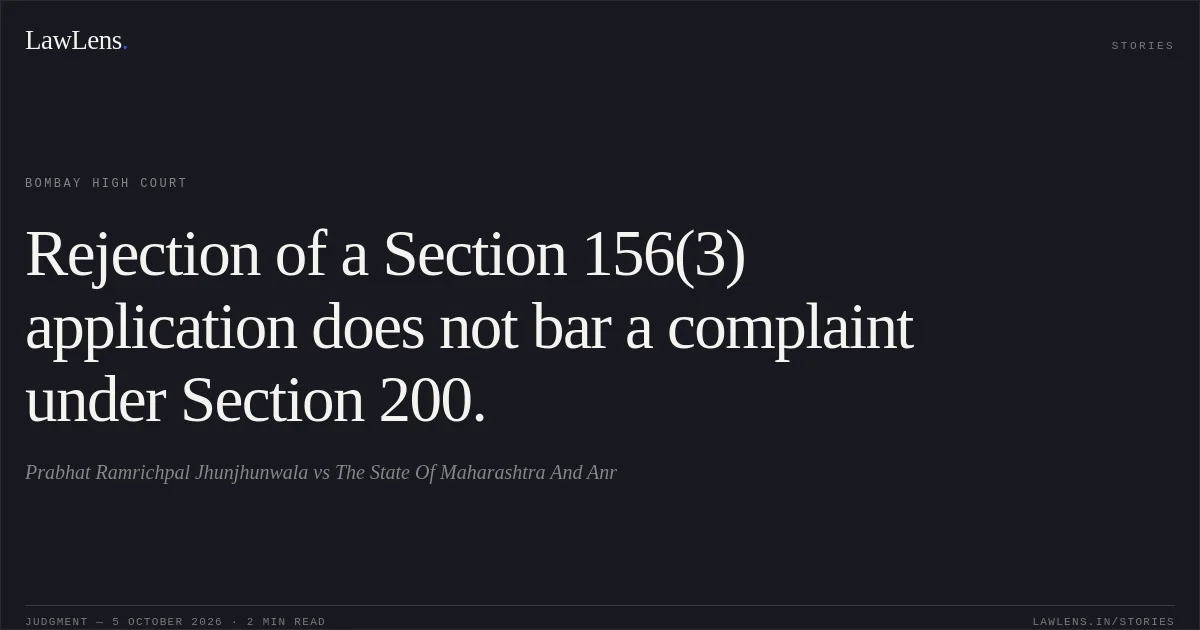
Whether rejection of the earlier application under Section 156(3) CrPC barred a subsequent complaint under Section 200 CrPC on the same allegations.
Source reference: paras. 7–10, 16–22Whether the Magistrate’s order issuing process under Sections 465 and 471 IPC, and the Sessions Court’s order affirming it, warranted interference.
Source reference: paras. 12–14, 18–24Law Applied
Section 156(3) CrPC concerns pre-cognizance police investigation, whereas Sections 200–204 operate after the Magistrate takes cognizance; an enquiry under Section 202 assists the Magistrate in deciding whether there is sufficient ground to proceed.
Source reference: para. 15.1; paras. 20–21Rejection of an application under Section 156(3) does not, by itself, preclude a complaint under Section 200 CrPC.
Source reference: para. 15.2Although a second complaint on the same facts is generally entertained only in exceptional circumstances when an earlier complaint was dismissed on its merits, that restriction did not apply where the earlier proceeding had only sought Section 156(3) investigation and had not proceeded as a complaint under Chapter XV.
Source reference: para. 15.3; paras. 17–22The Court also relied on the distinction between the remedies under Sections 156(3) and 200 recognised in *Jagannath Verma v. State of U.P.*
Source reference: paras. 15.2, 19Reasoning
The High Court found that the earlier proceeding had ended with rejection of the Section 156(3) prayer and had not involved examination of the complainant or an enquiry under Chapter XV.
Source reference: paras. 17–18, 22The Sessions Court had expressly noted that a complaint case could subsequently be filed, and the later complaint followed that course.
Source reference: paras. 17–18, 22In that complaint, the Magistrate recorded the complainant’s statement, considered the pre-process evidence, directed a Section 202 enquiry, and issued process after receiving the report.
Source reference: paras. 11–12, 18Applying the distinction between pre-cognizance investigation and post-cognizance complaint procedure, the Court held that the second complaint was not barred.
Source reference: paras. 19–23It therefore found the Sessions Court’s decision consistent with law.
Source reference: paras. 19–23Holding
The Court held that rejection of the earlier Section 156(3) application did not preclude the subsequent complaint under Section 200 CrPC, and found no basis to interfere with the orders issuing and affirming process.
The application was dismissed; the Magistrate was requested to take up the matter expeditiously.
Source reference: paras. 24–25Acts & Sections Cited
16 provisions across 3 statutes referred to in this judgment. Each provision opens on LawLens.
Code of Criminal Procedure, 1973
Bharatiya Nagarik Suraksha Sanhita, 20231
Indian Penal Code, 18605
Original Court PDF
Prabhat Ramrichpal JhunjhunwalavsThe State Of Maharashtra And Anr
Click to open original judgment
Original judgment, available to read, download and summarize on LawLens.in