Facts
The Plaintiff (Geekay Enterprises) filed a suit in 2021 seeking a declaration of its rights to develop the suit property under a Development Agreement (DA) dated October 28, 1997, executed with Defendant No. 1
Source reference: para 2The Plaintiff also sought recovery of sums paid, damages of approx. ₹308 crores, and an injunction against third-party interests
Source reference: para 2Defendant No. 7 (Applicant) moved an application under Order VII Rule 11 of the CPC for rejection of the plaint, arguing the suit was barred by limitation and lacked a cause of action
Source reference: para 1The Applicant contended that the Plaintiff had knowledge of a 2010 decree (in L.C. Suit No. 2257 of 2004) which restrained Defendant No. 1 from dispossessing the Applicant, yet waited until 2021 to file the suit
Source reference: para 4, 24The Plaintiff alleged that the 2004 suit was a "collusive" action between defendants to defeat the Plaintiff’s subsisting rights under the 1997 DA, which was never terminated
Source reference: para 13, 23, 25Issues
1. Whether the plaint is liable to be rejected under Order VII Rule 11(d) of the CPC as being ex-facie barred by the law of limitation
Source reference: para 1, 112. Whether the cause of action pleaded by the Plaintiff is illusory or a result of "clever drafting" intended to circumvent the Limitation Act
Source reference: para 10, 30, 36Law Applied
The court primarily applied Order VII Rule 11(a) and (d) of the CPC regarding the rejection of a plaint for lack of cause of action or being barred by law
Source reference: para 1, 11It evaluated the limitation periods under Articles 47 (refund of consideration), 55 (compensation for breach of contract), and 58 (declaration) of the Limitation Act, 1963
Source reference: para 4-5, 11The court relied on the Supreme Court’s rulings in Ramesh B. Desai v. Bipin Mehta, which established that limitation is a mixed question of law and fact and cannot be decided as a preliminary issue if it depends on evidence
Source reference: para 40The court relied on Vinod Infra Developers Ltd. v. Mahaveer Lunia, which held that a plaint cannot be rejected in its entirety if some reliefs are maintainable based on independent causes of action
Source reference: para 39Reasoning
The court observed that while Defendant No. 7 argued the limitation began in 2010 upon the Plaintiff gaining knowledge of the previous decree, the Plaintiff’s case was built on a "bundle of facts" involving a checkered history of title transfers and allegations of a collusive inter-se litigation between defendants
Source reference: para 33, 44The court reasoned that a stray sentence in the plaint regarding knowledge of the 2010 decree cannot be isolated to hold the suit barred by limitation while ignoring exhaustive pleadings regarding the continuous nature of the cause of action and the subsistence of the 1997 agreement
Source reference: para 43Following the principle in Nusli Neville Wadia, the court held that a plaint can only be rejected at the threshold if the bar of limitation is apparent from the face of the averments without requiring further evidence
Source reference: para 41In this instance, because the Plaintiff claims the contract is still valid and the inter-se decree was fraudulent, the "right to sue" involves triable issues that necessitate a full-fledged trial
Source reference: para 42, 44Holding
The Court dismissed the interim application filed by Defendant No. 7 for the rejection of the plaint
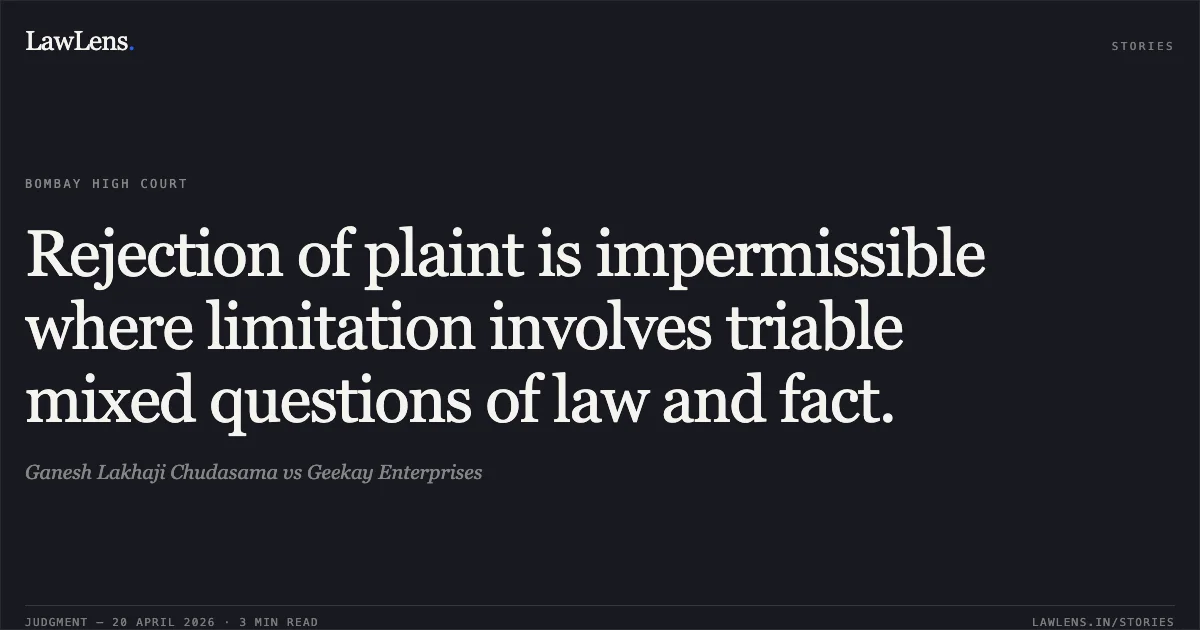
It held that the question of limitation in this specific case is a mixed question of law and fact that cannot be determined at a preliminary stage
Source reference: para 42The court concluded that since the pleadings disclose a cause of action and raise triable issues regarding the accrual of the right to sue, the Plaintiff is entitled to lead evidence to prove the suit is within the limitation period
Source reference: para 44-45Acts & Sections Cited
9 provisions across 2 statutes referred to in this judgment. Each provision opens on LawLens.
Code of Civil Procedure, 19082
Limitation Act, 19637
Original Court PDF
Ganesh Lakhaji ChudasamavsGeekay Enterprises
Click to open original judgment
Original judgment, available to read, download and summarize on LawLens.in


![Authorities must decide pensionary and retiral-benefit claims through a reasoned order within eight weeks.. Habibullah khan vs HOME DEPARTMENT. CAT - ['Srinagar']. LawLens](/stories/thumbnails/authorities-must-decide-pensionary-and-retiral-benefit-claims-through-a-reasoned-order-wit-d0cbe8a8119c48fbabe7df9f2d353488.webp)