Facts
The petitioner was convicted in 2013 for offences including murder (Section 302/149 IPC) and sentenced to life imprisonment
Source reference: para 4After his appeals were dismissed by the High Court and Supreme Court, and having remained in custody since November 7, 2010, the petitioner applied for premature release/remission under the Prison Rules
Source reference: para 4The Superintendent of Central Jail and the Court of conviction both provided positive recommendations for remission based on the petitioner's good conduct
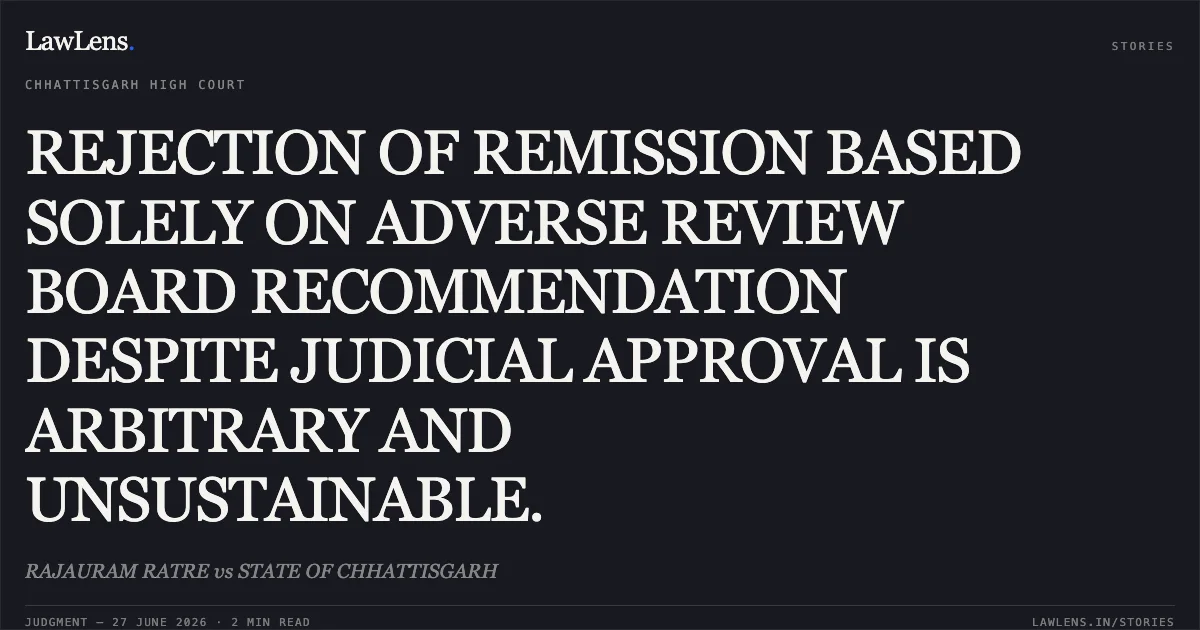
Source reference: para 4, 8However, the State Government, vide order dated March 22, 2026, rejected the claim solely based on an adverse recommendation by the Chhattisgarh State Punishment Review Board
Source reference: para 4, 9The petitioner challenged this rejection as arbitrary and contrary to the amended Prison Rules
Source reference: para 4Issues
1. Whether the State Government’s rejection of the petitioner’s remission claim was arbitrary and lacked objective basis
Source reference: para 92. Whether a life convict is entitled to a fair and non-arbitrary consideration for remission once they satisfy the requisite period of incarceration and exhibit good conduct
Source reference: para 11, 12Law Applied
Section 473 of the Bharatiya Nagarik Suraksha Sanhita, 2023 (formerly Section 432 Cr.P.C.) regarding the power to suspend or remit sentences
Source reference: para 5Chhattisgarh Prison Rules, 1968 (as amended in 2025), which removed earlier bars on remission for certain categories
Source reference: para 10Laxman Naskar v. State of West Bengal, which mandates examining the likelihood of recidivism and rehabilitation
Source reference: para 11Epuru Sudhakar v. Govt. of A.P., establishing that remission orders are subject to judicial review for arbitrariness
Source reference: para 11State of Haryana v. Jagdish, which emphasizes fair and consistent application of remission policies
Source reference: para 11Reasoning
The Court observed that the petitioner had completed the requisite period of incarceration and had earned positive recommendations from both the jail authorities and the sentencing court
Source reference: para 8, 12The State’s rejection was deemed unsustainable because it failed to provide any objective or tangible material proving the petitioner posed a threat to society
Source reference: para 9, 13The Court reasoned that the State cannot rely exclusively on the Punishment Review Board's adverse opinion while ignoring the reformative object of the law and the favourable reports of rehabilitation
Source reference: para 10, 12Furthermore, the 2025 amendment to the Prison Rules specifically removed previous bars to remission, which the State failed to adequately consider
Source reference: para 10Relying on the principle of consistency established in Manoj Sahu v. State of Chhattisgarh, the Court found that the rejection was founded on irrelevant considerations and ignored relevant ones
Source reference: para 12, 13Holding
The Court answered the issues in the affirmative, holding that the power of remission, though discretionary, must be exercised in a reasonable and non-arbitrary manner under Articles 14 and 21 of the Constitution
The High Court quashed the State's rejection order dated March 22, 2026
Source reference: para 14The respondents were directed to extend the benefit of remission to the petitioner and release him forthwith, provided he is not required in any other case and complies with standard release conditions
Source reference: para 14Acts & Sections Cited
9 provisions across 3 statutes referred to in this judgment. Each provision opens on LawLens.
Bharatiya Nagarik Suraksha Sanhita, 20231
Code of Criminal Procedure, 19731
Indian Penal Code, 18607
Original Court PDF
RAJAURAM RATREvsSTATE OF CHHATTISGARH
Click to open original judgment
Original judgment, available to read, download and summarize on LawLens.in


