Facts
The Appellant challenged the appointment of Respondent No. 3 (R-3) to the post of Anganwadi Assistant at Gram Panchayat Karnaliya, following an advertisement issued on 31/01/2023.
Source reference: para. 2The Appellant’s objections to the provisional merit list included claims that R-3’s mother-in-law was an Up-Sarpanch, violating Clause 4 of the recruitment circular, and that R-3’s application and marks were manipulated.
Source reference: para. 3After the Additional Collector rejected the first appeal on 12/04/2024, the Appellant filed a writ petition (W.P. No. 39430/2024), which the Learned Single Judge dismissed on 20/01/2025.
Source reference: para. 1, 4The Single Judge found that the mother-in-law was not the Sarpanch at the time of selection and did not fall within the prohibited degree of influence defined in the circular.
Source reference: para. 10The Appellant subsequently preferred this intra-court appeal.
Source reference: para. 1Issues
1. Whether the writ petition and subsequent appeal were maintainable given the availability of an alternative statutory remedy of a Second Appeal before the Divisional Commissioner.
Source reference: para. 13, 142. Whether the selection of Respondent No. 3 was vitiated by a violation of Clause 4 of the applicable circular regarding the involvement of relatives in the selection process.
Source reference: para. 13, 15Law Applied
The Court applied Section 2(1) of the Madhya Pradesh Uchch Nyayalay (Khand Nyaypeeth Ko Appeal) Adhiniyam, 2005, regarding the jurisdiction of the Division Bench in intra-court appeals.
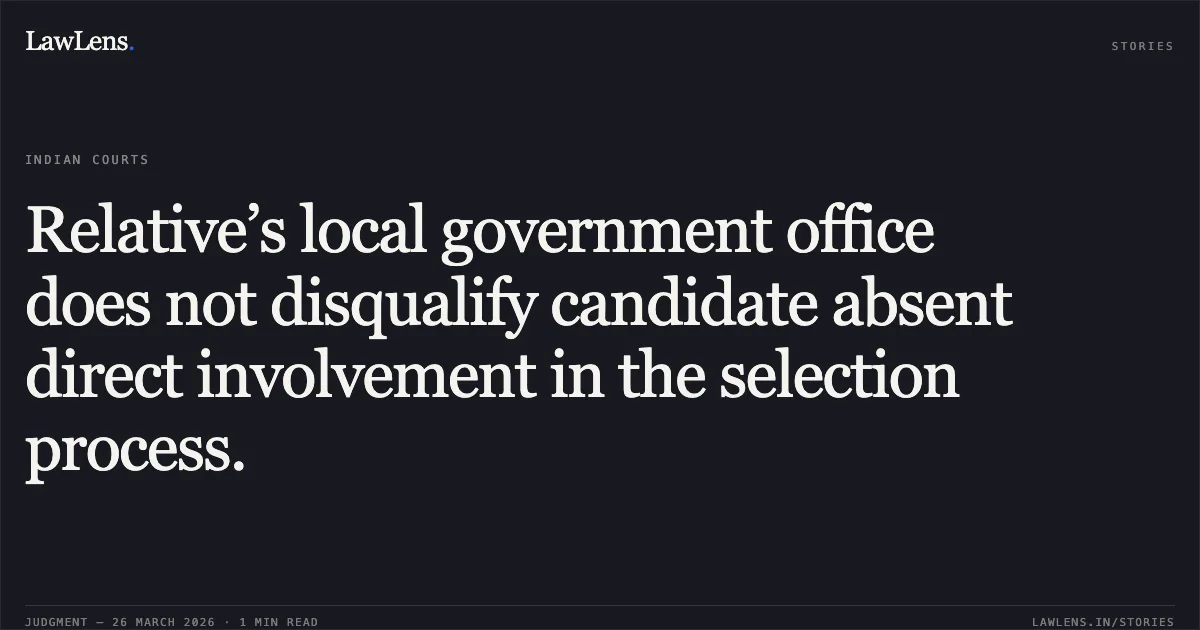
Source reference: para. 1It relied on the administrative guidelines in Clause 4 of the Anganwadi Circular dated 10/07/2007 (as amended), which prohibits candidates whose specified relatives are "directly related" to the selection process from appointment.
Source reference: para. 8, 9, 16Procedurally, the Court noted Section 6 of the Anganwadi Rules (amended 10/07/2007), which provides a statutory mechanism for a Second Appeal.
Source reference: para. 7, 14Furthermore, the Court reiterated the principle that a Division Bench will only interfere with a Single Judge’s order if it suffers from "patent illegality, perversity, or a manifest error of law".
Source reference: para. 12Reasoning
The Court first addressed maintainability, noting that while the Appellant bypassed the statutory Second Appeal before the Divisional Commissioner, the matter would be heard on merits since the Single Judge had already done so.
Source reference: para. 14Regarding Clause 4, the Court found no evidence that R-3’s mother-in-law was involved in the selection committee or held the post of Sarpanch at the specific time of selection.
Source reference: para. 10, 15The Court reasoned that Clause 4 requires a "direct relation" to the selection process itself; merely holding a parallel or past Panchayat post does not constitute an absolute bar.
Source reference: para. 16The Court further determined that the Appellant’s claims regarding Class 5 marks and Samagra ID manipulation were factual disputes already adjudicated by the Additional Collector, and the Appellant provided no "incontrovertible material" to prove fraud.
Source reference: para. 17Consequently, there was no procedural impropriety or jurisdictional error in the lower court’s findings.
Source reference: para. 18, 19Holding
The Court held that the selection of Respondent No. 3 was lawful and did not violate the applicable circulars.
The Division Bench affirmed the order dated 20/01/2025 passed by the Learned Single Judge, concluding that the findings were legally sound and lacked perversity.
Source reference: para. 19, 20The Writ Appeal was dismissed as devoid of merit.
Source reference: para. 20Acts & Sections Cited
2 provisions across 2 statutes referred to in this judgment. Linked provisions open on LawLens.
Anganwadi Rules1
M.P. Uchcha Nyayalaya (Khand Nyayapeeth Ko Appeal) Adhiniyam, 20051
Original Court PDF
Smt. TeenavsAdditional Collector
Click to open original judgment
Original judgment, available to read, download and summarize on LawLens.in