Facts
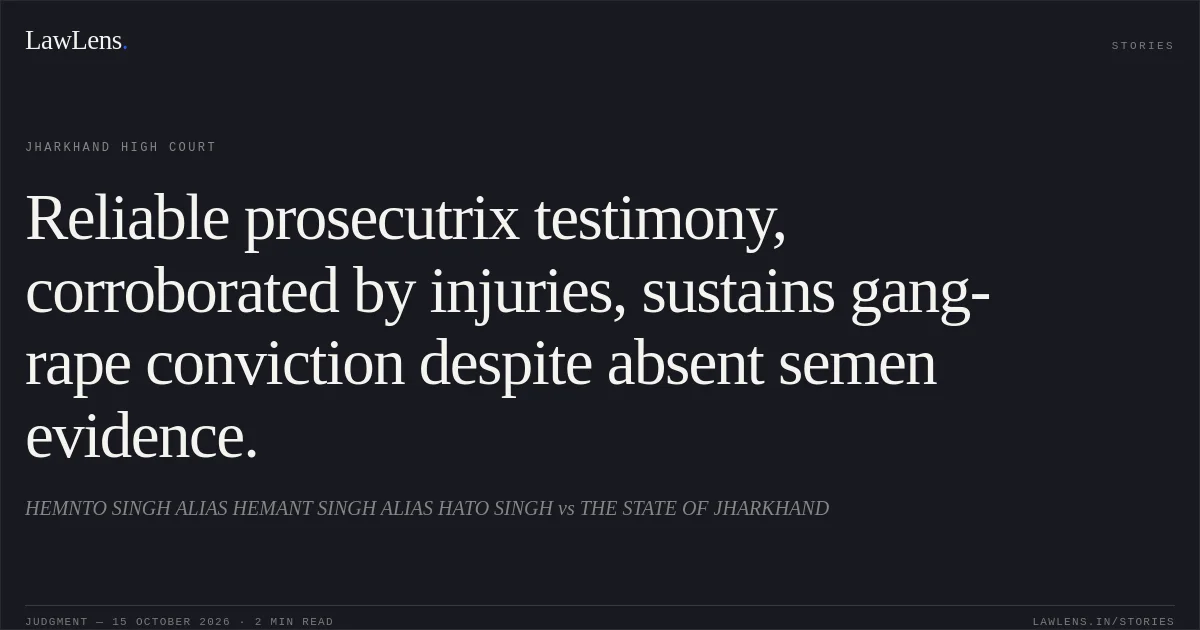
The prosecutrix alleged that on 5 November 2013, while travelling to her parental home through a forest, four appellants seized and gang-raped her.
Source reference: para. 4–7She reported the incident on 8 November 2013, after a village panchayat was convened; the appellants did not attend.
Source reference: para. 4–7The trial court convicted all four under Section 376D of the Indian Penal Code and sentenced each to 20 years’ rigorous imprisonment and a fine of ₹40,000.
Source reference: para. 3, 13They appealed, challenging, among other matters, the prosecutrix’s credibility and identification, the delay in reporting, and the absence of medical and forensic corroboration.
Source reference: para. 14–16Issues
1. Whether the trial court’s conviction and sentence under Section 376D IPC suffered from an error of law warranting appellate interference.
Source reference: para. 192. Whether the appellants’ challenges to the prosecutrix’s testimony, identification, delay in reporting, and medical evidence undermined the prosecution case.
Source reference: para. 14–16, 25Law Applied
Section 376D IPC provides for punishment where a woman is raped by one or more persons constituting a group or acting in furtherance of a common intention.
Source reference: para. 23Relying on Krishan Kumar Malik v. State of Haryana, (2011) 7 SCC 130, the Court stated that the prosecutrix’s uncorroborated testimony can sustain a rape conviction if it inspires confidence and is trustworthy and of sterling quality.
Source reference: para. 24The judgment also applied the principle that minor discrepancies do not undermine a prosecution case unless they shatter its substance.
Source reference: para. 25Reasoning
The Court found the prosecutrix’s account of being seized and raped by the four appellants consistent and reliable, and considered her identification of them by face sufficient despite her inability to state their names correctly.
Source reference: para. 20, 25It accepted her explanation that she reported the incident after a village panchayat and treated the three-day delay as explained in the circumstances.
Source reference: para. 25The medical examination, conducted approximately 72 hours after the incident, recorded abrasions on her back and breasts; the Court regarded these injuries as corroborative and considered the absence of spermatozoa unsurprising given the delay.
Source reference: para. 21, 25It found no basis to accept the defence suggestions of false implication and held that the discrepancies and investigative shortcomings did not displace the prosecutrix’s credible testimony.
Source reference: para. 22, 25Holding
The High Court found no error of law in the convictions under Section 376D IPC and dismissed both appeals, affirming the convictions and sentences.
The appellants in Appeal No. 1337 of 2018, who were on bail, were directed to surrender within two months; their bail bonds were cancelled and their sureties discharged.
Source reference: para. 29Acts & Sections Cited
4 provisions across 2 statutes referred to in this judgment. Each provision opens on LawLens.
Bharatiya Nyaya Sanhita, 20231
Code of Criminal Procedure, 19733
Original Court PDF
HEMNTO SINGH ALIAS HEMANT SINGH ALIAS HATO SINGHvsTHE STATE OF JHARKHAND
Click to open original judgment
Original judgment, available to read, download and summarize on LawLens.in


