Facts
The petitioner, an Assistant Director in the Food, Public Distribution and Consumer Affairs Department, Government of Assam, was transferred from Morigaon to Margherita on 18 September 2024 and released from his Morigaon post on 8 October 2024.
Source reference: pp.3–6Alleging that he continued to sign official documents, failed to hand over charge promptly, held a press conference criticising governmental procedures, and disobeyed transfer directions, the respondents issued disciplinary notices and suspended him.
Source reference: pp.3–6A departmental enquiry was conducted by respondent No. 5, who found Charges 1 and 2 proved and Charge 3 not fully established.
Source reference: p.6The enquiry officer relied, inter alia, on a preliminary enquiry report that had not been furnished to or conducted in the presence of the petitioner.
Source reference: pp.6, 10–11After considering the enquiry report and the petitioner’s representation, respondent No. 5 imposed compulsory retirement under Rule 7(v) of the Assam Services (Discipline and Appeal) Rules, 1964, by order dated 4 August 2025.
Source reference: p.6The petitioner challenged the enquiry and punishment under Article 226 of the Constitution.
Source reference: no citationIssues
Whether reliance upon a preliminary enquiry report in a regular departmental enquiry, without furnishing it to the delinquent employee or affording him an opportunity to contest the material and cross-examine relevant witnesses, violated the principles of natural justice and vitiated the enquiry.
Source reference: para. 31; pp.16–21Whether respondent No. 5 could validly act both as the Enquiry Officer and thereafter as the Disciplinary Authority by accepting her own enquiry report and imposing the penalty.
Source reference: para. 31; pp.15–16Law Applied
Under Rules 7, 8 and 9 of the Assam Services (Discipline and Appeal) Rules, 1964, compulsory retirement is a major penalty; it can be imposed only by the competent disciplinary authority after an enquiry conducted in accordance with the prescribed procedure, including definite charges, disclosure of relevant materials, opportunity to cross-examine witnesses, and a reasoned finding on each charge.
Source reference: pp.11–15Judicial review under Article 226 does not permit reappreciation of evidence in a departmental enquiry, but interference is justified where the enquiry violates statutory procedure or natural justice, or where the findings are perverse, arbitrary, or based on irrelevant or inadmissible material, as held in State of Andhra Pradesh v. S. Sree Rama Rao, AIR 1963 SC 1723.
Source reference: pp.8–10A preliminary enquiry is only exploratory and is intended to determine whether a prima facie case exists for initiating disciplinary proceedings; its materials cannot be treated as substantive evidence in the regular enquiry unless independently proved and the delinquent is given an effective opportunity to challenge them, as held in Narayan Dattatraya Ramteerthakhar v. State of Maharashtra, (1997) 1 SCC 299, and Nirmala J. Jhala v. State of Gujarat, (2013) 4 SCC 301.
Source reference: pp.16–19Reasoning
The Court found that respondent No. 5’s enquiry report expressly relied upon the preliminary enquiry conducted by respondent No. 3 and that the respondents themselves admitted that the report constituted “material evidence” in the disciplinary proceeding.
Source reference: pp.16–19However, the petitioner had neither participated in the preliminary enquiry nor received the report during the regular enquiry. Consequently, he could not controvert the statements and materials relied upon or cross-examine the persons concerned.
Source reference: pp.16–20Supplying the report only after completion of the enquiry and along with the enquiry report could not cure the defect, since natural justice required an opportunity before the material was relied upon in determining guilt.
Source reference: p.20The Court held that this was not a merely technical irregularity; the petitioner had specifically asserted that he was excluded from the preliminary enquiry, demonstrating actual procedural prejudice.
Source reference: pp.20–21The enquiry was therefore conducted in violation of natural justice. In view of this finding, the Court considered it unnecessary to decide the separate issue concerning respondent No. 5’s dual role as Enquiry Officer and Disciplinary Authority.
Source reference: para. 41Holding
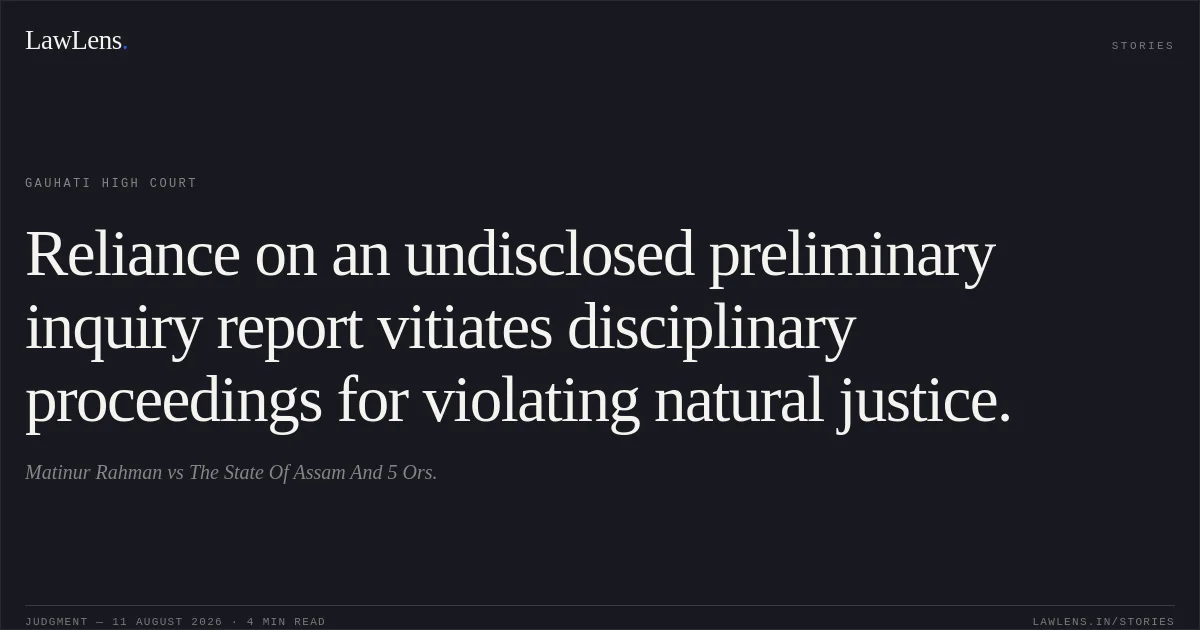
The Court answered the first issue in favour of the petitioner and held that reliance on the undisclosed and unproved preliminary enquiry report vitiated the departmental enquiry.
The enquiry and the consequential compulsory-retirement order dated 4 August 2025 were set aside and quashed.
Source reference: para. 42The respondents were directed to reinstate the petitioner, with consequential service benefits to be regulated under the applicable rules and subject to the outcome of any fresh proceedings.
Source reference: para. 43The Court clarified that it had not adjudicated the merits of the allegations and permitted the respondents, if so advised, to initiate fresh disciplinary proceedings from the stage of the procedural defect, strictly in accordance with law and natural justice.
Source reference: para. 44The writ petition was accordingly allowed and disposed of.
Source reference: para. 45Original Court PDF
Matinur RahmanvsThe State Of Assam And 5 Ors.
Click to open original judgment
Original judgment, available to read, download and summarize on LawLens.in