Facts
The Appellant, a Customs Broker licensed under the Customs Brokers Licensing Regulations, 2018 (“CBLR”), was proceeded against following the seizure of diamonds allegedly concealed in plastic hot fix during an attempted export by M/s Disha Enterprises on 16.12.2021.
Source reference: paras. 3–4An Offence Report dated 01.07.2022 led to a Show Cause Notice proposing revocation of the Appellant’s licence for alleged violations of Regulations 10(d), 10(e), 10(m), 10(n), 10(q) and 13(12) of the CBLR.
Source reference: para. 5Although the Appellant requested examination and cross-examination of the witnesses whose statements were relied upon, the Inquiry Officer submitted his report solely on the basis of investigation statements without examining those witnesses.
Source reference: paras. 5–6The Commissioner thereafter revoked the licence, forfeited the security deposit and imposed a penalty of ₹50,000 by Order-in-Original dated 14.03.2023.
Source reference: para. 6On appeal, the CESTAT held that the procedure was improper and remanded the matter for fresh adjudication after giving the Appellant an opportunity to cross-examine the relevant witnesses.
Source reference: para. 7The Appellant challenged the remand order under Section 130 of the Customs Act, 1962.
Source reference: paras. 1, 8Issues
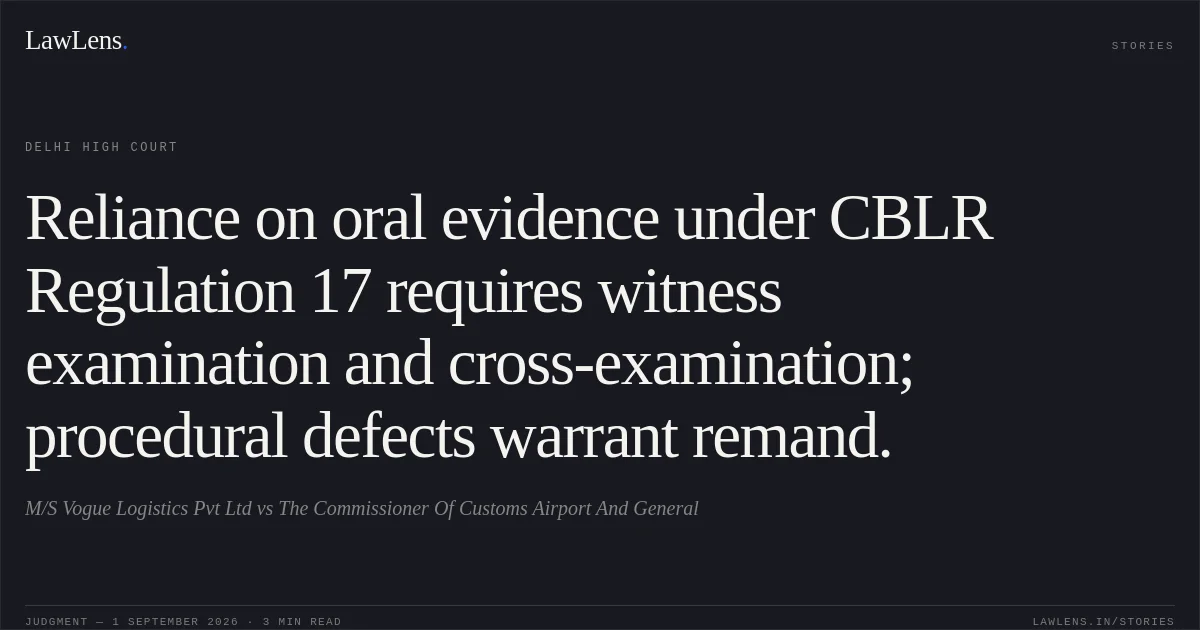
Whether the Inquiry Officer’s reliance on statements recorded during investigation, without examining the concerned witnesses and affording the Appellant an opportunity of cross-examination, violated Regulations 17(3) and 17(4) of the CBLR.
Source reference: paras. 16–19Whether Section 138B of the Customs Act governed the present Customs Broker licensing proceedings and independently required examination of the makers of the statements.
Source reference: paras. 14, 18Whether the CESTAT’s remand for fresh adjudication amounted to permitting the Department to fill a lacuna in its case and was therefore impermissible.
Source reference: para. 20Whether the procedural defect required the proceedings and the Commissioner’s order to be set aside altogether, rather than being cured through a remand.
Source reference: para. 21Law Applied
Section 108 of the Customs Act empowers a Gazetted Customs Officer to summon persons to give evidence or produce documents in an inquiry under the Act.
Source reference: para. 14Section 138B concerns the relevancy and admissibility of statements made before a Customs officer in specified circumstances, principally in proceedings relating to offences and prosecutions; its application to other proceedings is only “so far as may be”.
Source reference: paras. 14, 18Regulation 17(3) of the CBLR requires the Inquiry Officer to consider relevant or material documentary and oral evidence, while Regulation 17(4) confers on the Customs Broker a right to cross-examine persons examined in support of the charges; refusal to permit examination is permissible only on grounds of irrelevance or immateriality, with reasons recorded in writing.
Source reference: para. 15Proceedings under Regulation 17 bear some resemblance to a domestic inquiry, but not all principles of domestic disciplinary inquiries are automatically imported; the right of cross-examination arises specifically from Regulation 17(4).
Source reference: para. 19A procedural infirmity capable of being rectified by affording the affected party an opportunity does not necessarily invalidate the proceedings, and remand for fresh adjudication is permissible where no statutory prohibition exists.
Source reference: paras. 20–21Reasoning
The Court held that Section 108 merely concerns the power to summon persons, whereas Section 138B primarily addresses the use of statements in offence and prosecution proceedings and was not, by itself, determinative of the present licensing action.
Source reference: paras. 14, 18Nevertheless, the CBLR independently required the Inquiry Officer to take relevant oral evidence and entitled the Appellant to cross-examine persons examined in support of the charges.
Source reference: paras. 16, 19Since the Inquiry Officer relied on investigation statements without examining the witnesses and without recording reasons for dispensing with their examination, the inquiry suffered from a procedural infirmity.
Source reference: paras. 17, 20–21The CESTAT therefore correctly directed a fresh adjudication with an opportunity for cross-examination.
Source reference: paras. 17, 20–21The remand did not permit the Department to fill a substantive lacuna; it sought to cure an identified procedural defect.
Source reference: paras. 20–21Nor did the defect automatically warrant quashing the proceedings, because it could be remedied by granting the Appellant the procedural opportunity mandated by Regulation 17(4).
Source reference: paras. 17, 20–21Holding
The Delhi High Court dismissed the appeal and upheld the CESTAT’s remand order.
It affirmed that, where oral evidence is relied upon in proceedings under Regulation 17 of the CBLR, the Customs Broker must be afforded an opportunity to cross-examine the persons examined in support of the charges.
Source reference: para. 22The pending applications were also closed.
Source reference: para. 22Acts & Sections Cited
6 provisions across 3 statutes referred to in this judgment. Each provision opens on LawLens.
Customs Act,19623
Code of Civil Procedure, 19081
Indian Penal Code, 18602
Original Court PDF
M/S Vogue Logistics Pvt LtdvsThe Commissioner Of Customs Airport And General
Click to open original judgment
Original judgment, available to read, download and summarize on LawLens.in