Facts
The Applicant, a Senior Administrative Officer at the Centre for Development of Advanced Computing (C-DAC), was suspended in 2021 pending disciplinary proceedings
Source reference: p. 2He was served with a memorandum containing four articles of charges, primarily alleging that he bypassed official channels to send unauthorized emails to the Union Finance Minister and Minister of State for Finance, raising baseless allegations of corruption and misappropriation against C-DAC officials
Source reference: p. 2-3, 7-8The Inquiry Officer (IO) found the first charge partly proved (unauthorized communication established, but "threatening language" not established), while the second and third charges were found to be overlapping, and the fourth charge was not established
Source reference: p. 10-11The Disciplinary Authority (DA) subsequently imposed a major penalty of dismissal from service
Source reference: p. 11The Applicant's appeal was rejected by the Appellate Authority
Source reference: p. 12The Applicant challenged these orders, arguing that the punishment was disproportionate and that the DA illegally relied on his past conduct, which was not part of the charge sheet
Source reference: p. 12-13Issues
1. Whether the penalty of dismissal from service was shockingly disproportionate to the proved misconduct of bypassing official communication channels
Source reference: p. 13, 162. Whether the disciplinary proceedings were vitiated because the Disciplinary Authority relied on the Applicant’s past misconduct to justify the penalty without including it in the charge sheet or providing the Applicant an opportunity to respond
Source reference: p. 13, 19-21Law Applied
The Tribunal applied the principles of natural justice and the procedural safeguards under Article 311(2) of the Constitution of India
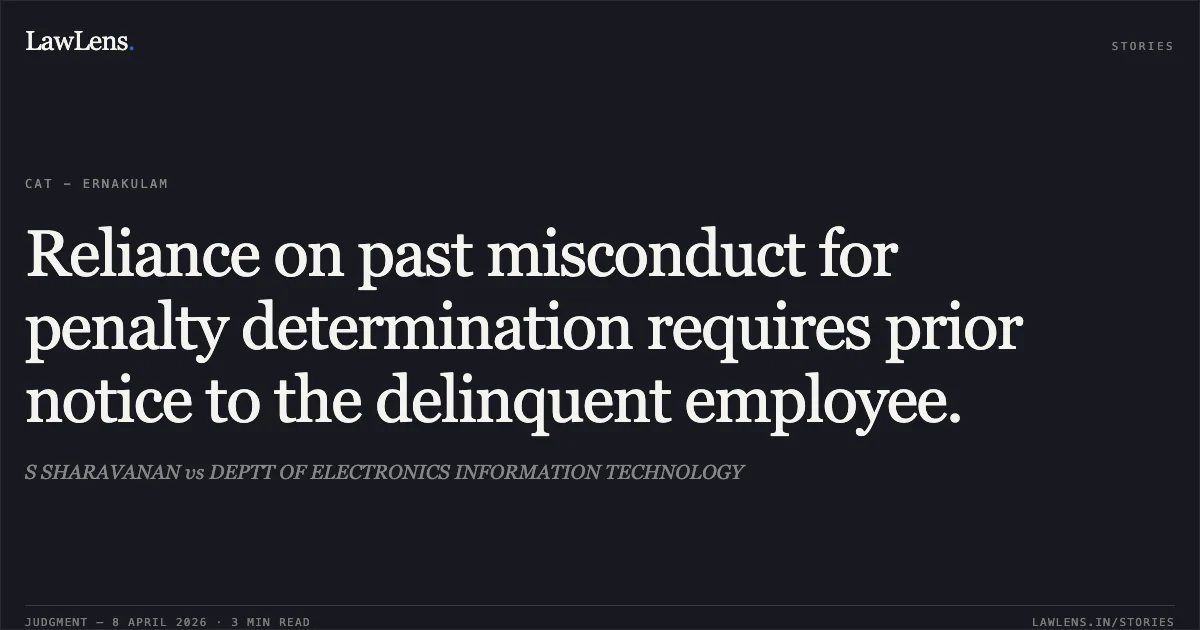
Source reference: p. 21It relied on the precedent set in State of Mysore v. K. Manche Gowda, which establishes that if a Disciplinary Authority intends to rely on a delinquent's past conduct to determine the gravity of punishment, the delinquent must be given a reasonable opportunity to explain said conduct
Source reference: p. 18, 21This principle was further reinforced by Indu Bhushan Dwivedi v. State of Jharkhand, which held that reliance on adverse service records without notice violates the right to a fair hearing
Source reference: p. 18, 20The Tribunal also cited DoP&T OM No. 134/20/68, which mandates that past conduct must either be part of the charge sheet or the subject of a specific notice before being used to enhance a penalty
Source reference: p. 21Reasoning
The Tribunal found that while the act of bypassing official channels was factually established, the Disciplinary Authority’s order (Annexure A9) explicitly relied on the Applicant’s "history of misconduct" and a prior instance of removal from service to justify the harshest penalty
Source reference: p. 19-20However, the records of such past misconduct were neither mentioned in the memorandum of charges nor produced during the inquiry
Source reference: p. 21The Tribunal reasoned that since the Applicant was not given an opportunity to represent against the use of his past record, the DA’s decision-making process was procedurally flawed
Source reference: p. 21The Tribunal noted that the question of proportionality of the punishment could not be definitively addressed while this procedural illegality regarding the reliance on past conduct remained uncorrected
Source reference: p. 21It rejected the Applicant's contention regarding the lack of a second hearing on the proposed penalty itself, noting that there is no absolute proposition that a delinquent must be heard twice unless extraneous materials (like past conduct) are introduced
Source reference: p. 18-19Holding
The Tribunal allowed the Original Application to a limited extent
It set aside the dismissal order (Annexure A9) and the appellate order (Annexure A11) solely on the ground that the authorities relied on the Applicant’s past conduct without prior notice
Source reference: p. 22The matter was remanded to the Disciplinary Authority with a direction to issue a notice to the Applicant within three weeks, specifying why his past conduct should not be considered in the determination of the penalty
Source reference: p. 22-23The Applicant was granted three weeks to respond, after which the DA must pass a fresh order on the penalty based on the materials on record
Source reference: p. 23All other contentions regarding the merits of the inquiry findings were deemed concluded
Source reference: p. 22Acts & Sections Cited
1 provisions across 1 statute referred to in this judgment. Each provision opens on LawLens.
Administrative Tribunals Act, 19851
Original Court PDF
S SHARAVANANvsDEPTT OF ELECTRONICS INFORMATION TECHNOLOGY
Click to open original judgment
Original judgment, available to read, download and summarize on LawLens.in