Facts
The petitioner, a devotee of Akhara No. 1 in Village Hathaura, Siwan, sought a direction to the State authorities to grant a licence for conducting the annual “Mahabiri Julus” through its traditional route and to permit at least 300 devotees to participate.
Source reference: p. 1–2According to the petitioner, licences had been granted since 1958; however, the permitted number of participants was reduced from 200 in 2012–2013 to 150 in 2014, 100 in 2015, and five from 2023 onwards, while the traditional route was also altered.
Source reference: p. 2–3The petitioner alleged that the restrictions were imposed during a Peace Committee meeting and that his representations to the District Magistrate remained unanswered.
Source reference: p. 3The State contended that the restrictions were necessary for maintaining law and order because, despite the sanctioned strength, approximately 1,700–2,000 persons had assembled between 2015 and 2022, resulting in several criminal cases.
Source reference: p. 4–5It further alleged that, in 2024, the petitioner and the accompanying crowd had set fire to a government vehicle and pelted stones at police personnel.
Source reference: p. 4–5The petitioner also alleged discriminatory treatment because the police had recommended permission for a Tazia procession involving 1,000 persons on the same route.
Source reference: p. 4–5Issues
1. Whether the petitioner had a constitutional right under Articles 19(1)(b) and 25 to conduct the Mahabiri Julus along the traditional route with at least 300 devotees.
Source reference: p. 1–3, 6–72. Whether the State authorities could restrict the number of participants and alter the route of the religious procession on grounds of public order and security.
Source reference: p. 4–73. Whether the petitioner’s apprehension that future permissions would be limited to five devotees was sufficiently ripe for adjudication.
Source reference: p. 7Law Applied
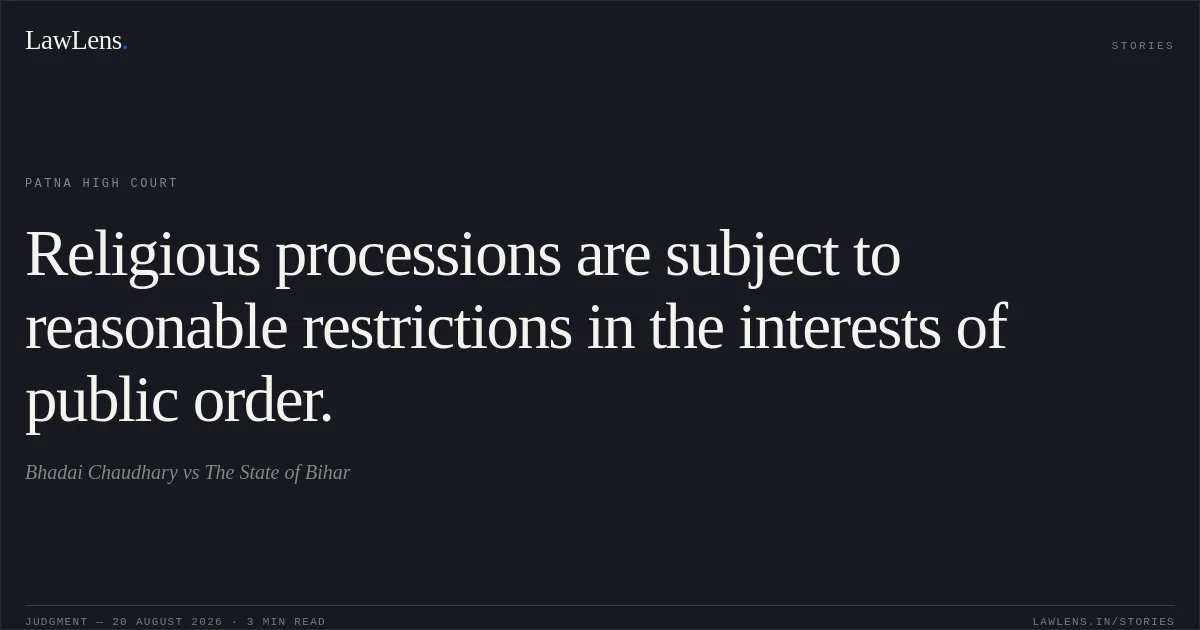
The Court applied the principle that the freedoms guaranteed under Articles 19(1)(b), 25 and 26 of the Constitution are subject to reasonable restrictions, including public order, morality, health, and the rights of others.
Source reference: p. 5–7It relied on Dr. M. Ismail Faruqui v. Union of India, (1994) 6 SCC 360, for the principle that religious protection extends to essential and integral practices, but not necessarily to every place or manner in which worship is performed.
Source reference: p. 5–6It also relied on Church of God v. K.K.R. Majestic Colony Welfare Association, (2000) 7 SCC 282, which held that religious activities cannot be conducted in a manner that disturbs public peace or causes harm to members of the public.
Source reference: p. 6The Court further recognized that religious processions are constitutionally protected but remain subject to reasonable, security-driven regulation by the State.
Source reference: p. 6–7Reasoning
The Court held that the right to profess and practise religion, including taking out religious processions, is not absolute and must be balanced against public order, public safety, and the rights of others.
Source reference: p. 6–7In light of the State’s assertions regarding excessive participation, prior law-and-order incidents, criminal cases, and the alleged violence during the 2024 procession, the Court treated the restrictions as measures connected with maintaining public tranquillity rather than as an impermissible denial of religious freedom.
Source reference: p. 4–5, 7The Court also held that constitutional protection does not extend to every particular mode, route, or numerical strength of a procession where regulation is required for public welfare.
Source reference: p. 6–7The challenge to any future restriction of participation to five devotees was rejected as premature because the permissible number would depend on the prevailing law-and-order situation when permission was actually sought.
Source reference: p. 7Holding
The Court answered the issues against the petitioner.
It held that the petitioner had no absolute constitutional entitlement to conduct the procession along the claimed route with 300 devotees, and that the authorities could impose reasonable restrictions based on the prevailing law-and-order situation.
Source reference: p. 6–7The apprehension of future restriction to five devotees was held to be hypothetical and premature.
Source reference: p. 7Finding no merit in the writ petition, the Court dismissed it and disposed of any pending interlocutory applications.
Source reference: p. 8Original Court PDF
Bhadai ChaudharyvsThe State of Bihar
Click to open original judgment
Original judgment, available to read, download and summarize on LawLens.in