01Facts
The appellant, Muslim Kuzafarosh Jamat Trust, was registered under the Bombay Public Trust Act, 1950 as a “B”-category public charitable trust bearing Registration No. B-276-Ahmedabad. Its stated objects included religious activities, education, welfare of the Muslim community, maintenance of a mosque and graveyard, and burial of members of the community.
¶ 3–7, 30–31After the Waqf Act, 1995 came into force, the Trust’s records were transferred to the Gujarat State Waqf Board under Section 43, and the Trust completed a questionnaire describing itself as a Sunni waqf comprising a mosque and graveyard.
¶ 8–10, 32–33In 2011, the Chief Executive Officer of the Waqf Board issued a communication stating that the Trust was not a waqf under Section 3(r) and directing that its records be returned to the Charity Commissioner.
¶ 11Subsequently, the Waqf Board issued a registration certificate dated 28 November 2017 treating the Trust as a waqf. The Trust challenged the certificate before the Waqf Tribunal in Waqf Application No. 115 of 2019.
¶ 12–16By order dated 13 May 2025, the Tribunal held that the appellant was a waqf and dismissed the application. The present First Appeal challenged that decision.
¶ 1, 35–3602Issues
i.Whether the appellant, despite its registration under the Bombay Public Trust Act, 1950, was a waqf for the purposes of the Waqf Act, 1995 and stood deemed to be registered under Section 43 thereof.
¶ 26, 38–42ii.Whether the matter was governed by Section 40 of the Waqf Act, 1995, requiring an inquiry by the Waqf Board, rather than by Section 43 concerning auqaf registered before the commencement of the Act.
¶ 26–29, 37–39iii.Whether the CEO’s communication dated 27 April 2011 validly determined that the appellant was not a waqf and displaced the appellant’s status under Section 43.
¶ 34, 42–43iv.Whether the Waqf Tribunal had jurisdiction to determine whether the appellant was a trust or a waqf.
¶ 16, 34–3703Law Applied
The Court applied Section 3(r) of the Waqf Act, 1995 concerning the concept of waqf and dedication for religious or charitable purposes.
¶ 4, 40–41Section 40 empowered the Waqf Board to inquire into whether property held by a trust or society was waqf property and to issue appropriate orders after notice and inquiry.
¶ 27–29Section 43 provided that a waqf registered before the commencement of the Waqf Act under any law would be deemed to be registered under the 1995 Act.
¶ 38The Court also considered Section 83 and Section 83(9) concerning the jurisdiction of the Waqf Tribunal under the applicable statutory framework.
¶ 1, 44It referred to Maharashtra State Board of Waqfs v. Shaikh Yusuf Bhai Chawla, 2022 SCC OnLine SC 1653, on the requirement of inquiry where Section 43 is not applicable, and to M.P. Waqf Board v. Subhan Shah, (2006) 10 SCC 696, regarding the Tribunal’s statutory jurisdiction.
¶ 17–18Provisions in the judgment · 3 · Linked ones open on LawLens
Bombay Public Trusts Act, 1950 Section 41Section 70Section 72
04Reasoning
The Court held that the Trust’s registration under the Bombay Public Trust Act did not, by itself, prevent it from being a waqf.
¶ 30Its historical objects and activities were religious and charitable, including maintaining a mosque and graveyard, conducting religious work, offering prayers, and providing burial facilities.
¶ 30, 33, 39–41The Trust’s own questionnaire identified the institution as a Sunni waqf and described its mosque and graveyard as the subject and objects of the waqf.
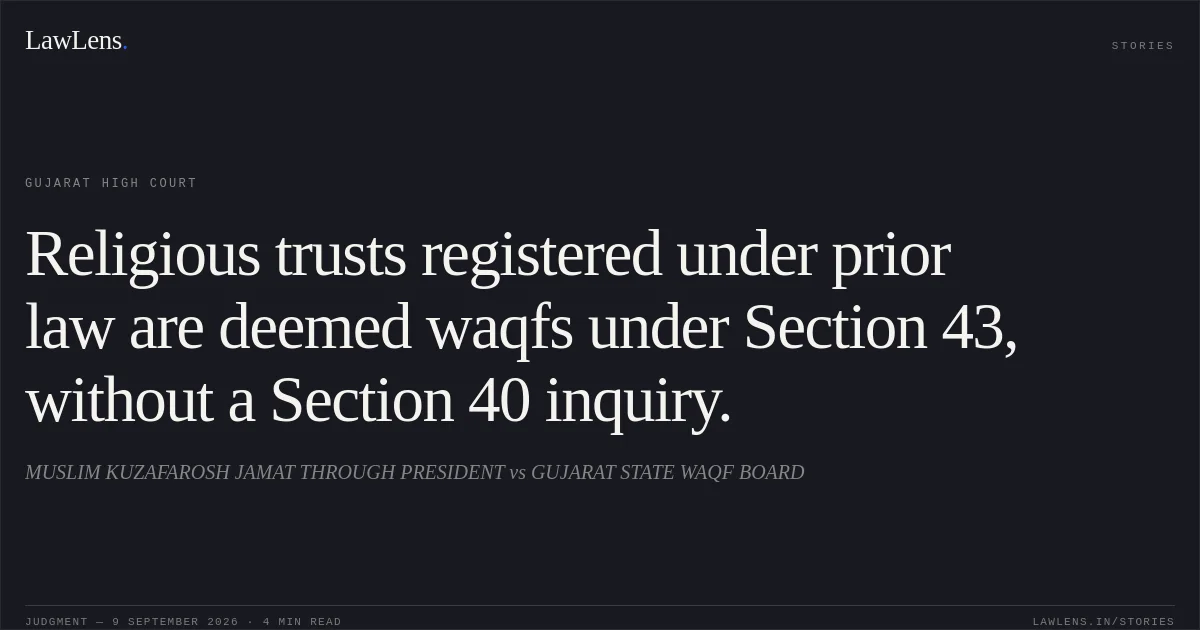
¶ 33On these facts, the Court concluded that the Trust fell within the statutory concept of waqf under Section 3(r), and that its prior registration attracted the deeming provision in Section 43.
¶ 39–42The Court rejected the argument that a fresh Section 40 inquiry was indispensable. Section 40 applied where the Board had to determine whether property of a trust or society was waqf property; however, the Court treated the appellant’s pre-existing registration and religious objects as bringing the case within Section 43.
¶ 37–39The CEO’s letter dated 27 April 2011 was held to be merely a communication and not the result of a formal inquiry or a reasoned order under Section 40. It therefore could not alter the appellant’s status or override the operation of Section 43.
¶ 43The Tribunal’s determination was also upheld because the High Court had expressly directed it to decide whether the appellant was a trust or waqf, and the appellant had participated in those proceedings.
¶ 34–37The subsequent omission of Section 40 under the 2025 legislation did not affect the adjudication of the appeal.
¶ 4405Holding
The High Court held that Muslim Kuzafarosh Jamat Trust was a waqf within the meaning of the Waqf Act, 1995.
¶ 41–43Its registration under the Bombay Public Trust Act, in view of its religious and charitable objects and activities, was deemed to constitute registration under Section 43 of the Waqf Act.
¶ 41–43The CEO’s 2011 communication was not a valid Section 40 determination and did not divest the Waqf Board of jurisdiction.
¶ 41–43The Tribunal had jurisdiction to decide the trust-or-waqf question and correctly upheld the Waqf Board’s registration certificate dated 28 November 2017.
¶ 41–43The First Appeal was dismissed, the Tribunal’s order was confirmed, and the Civil Application for Stay was also dismissed.
¶ 45Original Court PDF
MUSLIM KUZAFAROSH JAMAT THROUGH PRESIDENTvsGUJARAT STATE WAQF BOARD
Click to open original judgment
Original judgment, available to read, download and summarize on LawLens.in