01Facts
The petitioners challenged an order dated 31.03.2016 passed by the Deputy Commissioner, Belagavi, in RB.WTN.AP-01/2013-14.
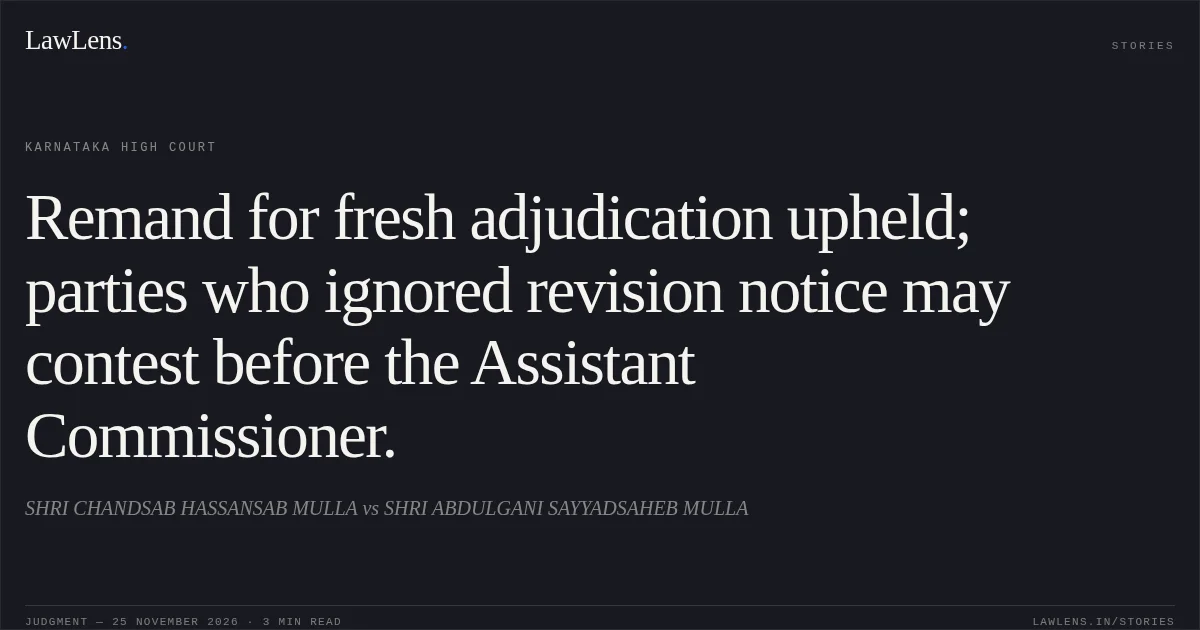
¶ 1That order allowed a revision petition filed by respondent No. 1 and remanded the matter to the Assistant Commissioner for fresh adjudication.
¶ 1The petitioners contended that an order dated 17.08.1987 had been challenged belatedly before the Deputy Commissioner.
¶ 3The respondent justified the remand on the ground that the lands were subject to the Mumbai Service Inam (Useful to Community) Abolition Act, 1953, and had been granted to his predecessors.
¶ 4The Assistant Commissioner had not considered these aspects.
¶ 4The impugned order recorded that notice of the revision had been served on the petitioners, who did not appear or contest the proceedings.
¶ 5This was undisputed before the High Court.
¶ 502Issues
i.1. Whether the Deputy Commissioner's remand order, passed on a revision that was allegedly filed belatedly against a 1987 order, warrants interference under Articles 226 and 227 of the Constitution.
¶ 3 · ¶ 6ii.2. Whether the petitioners' failure to appear before the Deputy Commissioner despite service of notice affects the validity of the remand.
¶ 5 · ¶ 6iii.3. Whether the Assistant Commissioner should be directed to conclude the remanded proceedings within a reasonable time.
order, cl. iv–v03Law Applied
The court exercised its supervisory jurisdiction under Articles 226 and 227 of the Constitution of India, the writ petition being filed under those provisions.
The court referred to the Mumbai Service Inam (Useful to Community) Abolition Act, 1953, as the statute governing the lands, as asserted by the respondent, but made no finding on its application.
¶ 4Where an order is one of remand, all parties must receive adequate opportunity to present their case before the lower authority and contest the proceedings in accordance with law.
¶ 6A writ court will not interfere with a remand order where the proceedings are yet to be decided on merits and the affected parties remain free to raise their grievances.
¶ 6–704Reasoning
The petitioners' delay argument was not adjudicated on merits.
The court noted that the Deputy Commissioner had remanded because the Assistant Commissioner had not considered the Inam Abolition Act and the grants to the respondent's predecessors.
¶ 4Because the petitioners had been served with notice of the revision and chose not to appear, they could not claim prejudice from the remand.
¶ 5The court held that the remand order was an interim procedural step that left all contentions open, including limitation and the applicability of the 1953 Act, for the Assistant Commissioner to decide.
¶ 6Accordingly, there was no jurisdictional error or perversity warranting interference under Articles 226 and 227.
¶ 6–7As the status of the remanded proceedings was unclear and no stay existed, the court sought to prevent indefinite delay by expecting the Assistant Commissioner to conclude proceedings within a reasonable period.
order, cl. v05Holding
The remand order required no interference, as the petitioners had been given notice and had failed to contest the revision.
¶ 5–7The writ petition was dismissed and the Deputy Commissioner's remand order was upheld.
¶ 7 · order, cl. i–iiThe Assistant Commissioner was directed to afford adequate opportunity to all parties and decide the matter strictly in accordance with law.
order, cl. iiiThe court noted the Deputy Commissioner's direction for decision within three months, and expected conclusion within a reasonable time if not already done.
order, cl. iv · order, cl. vNo order as to costs was made.
orderOriginal Court PDF
SHRI CHANDSAB HASSANSAB MULLAvsSHRI ABDULGANI SAYYADSAHEB MULLA
Click to open original judgment
Original judgment, available to read, download and summarize on LawLens.in