Facts
The applicant was appointed as a Fitter with the DTC in 1979
Source reference: para. 1Following the death of his son in 2005, he repeatedly applied for voluntary retirement (VRS) between 2005 and 2010, citing personal hardship and the subsequent death of his wife in 2010
Source reference: para. 1The respondents, asserting that no VRS scheme was in effect, did not formally communicate the unavailability of the scheme or suggest resignation as an alternative
Source reference: para. 2, 5Due to the applicant's continued absence from duty, the respondents issued a charge memo in 2012
Source reference: para. 2Despite the applicant having served for over 26 years and being eligible for a pension, the respondents imposed the punishment of removal from service via order dated 26.06.2013, which was upheld on appeal on 05.12.2013
Source reference: para. 2, 5The applicant challenged these orders seeking reinstatement and pensionary benefits
Source reference: para. 2Issues
1. Whether the punishment of removal from service for unauthorized absence was disproportionate given the applicant's personal circumstances and his repeated requests for voluntary retirement
Source reference: para. 62. Whether the respondents’ failure to communicate the non-existence of a VRS scheme and the alternative of resignation invalidated the punitive action for unauthorized absence
Source reference: para. 5Law Applied
The Tribunal relied on the principle of proportionality in service law and the necessity of a "humane approach" in disciplinary matters involving personal distress
Source reference: para. 3, 6It cited the Hon’ble High Court of Calcutta’s decision in Gour Hari Kayal and Anr. v. State of West Bengal and Ors. (2005), which held that in cases of unauthorized absence stemming from illness or requests for voluntary retirement, authorities should exercise restraint and avoid harsh punishments like dismissal that result in loss of livelihood
Source reference: para. 3Reasoning
The Tribunal found that the respondents acted on an uncommunicated presumption that the applicant should have resigned since no VRS scheme existed
Source reference: para. 5The Tribunal noted that the respondents failed to consider the applicant's 26 years of service and his eligibility for the pension scheme, which he would lose upon removal
Source reference: para. 5Critically, the respondents disregarded the "acute mental stress" caused by the deaths of the applicant's son and wife, which the Tribunal identified as the primary reason for his absence
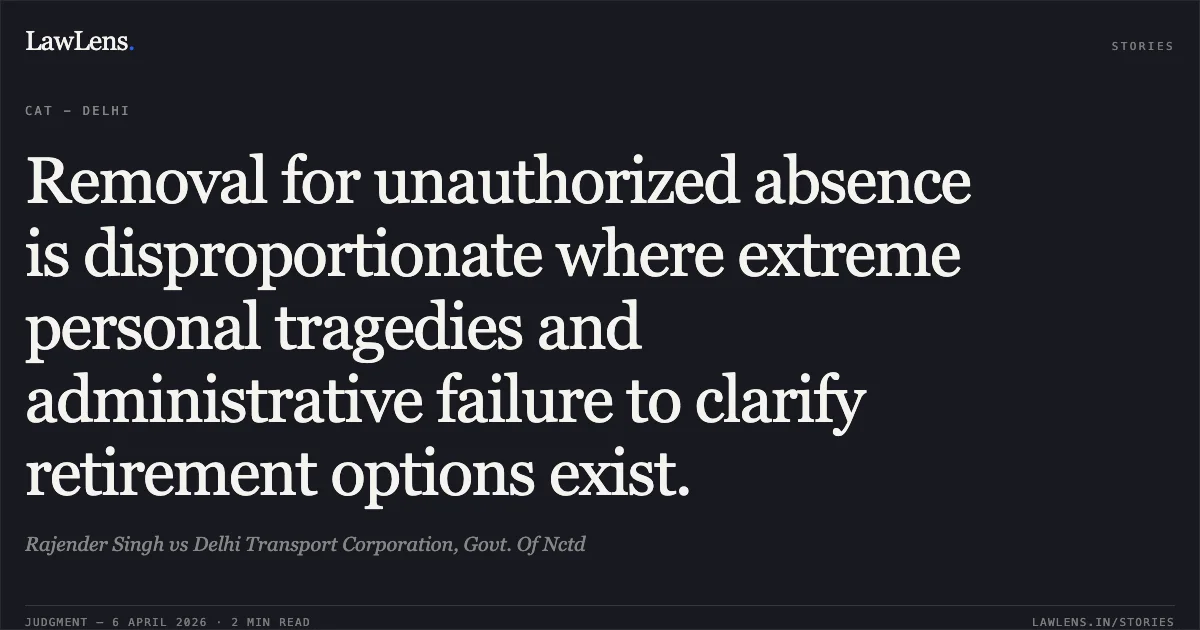
Source reference: para. 5, 6Applying the rule of proportionality, the Tribunal determined that the respondents' decision to impose the "harshest punishment" without acknowledging the attendant family tragedies was untenable and legally flawed
Source reference: para. 6Holding
The Tribunal quashed the impugned orders of removal dated 26.06.2013 and the appellate order dated 05.12.2013
It held that the punishment was completely disproportionate to the alleged offense
Source reference: para. 6The Tribunal directed the respondents to reinstate the applicant, fix his notional pay for the period of absence for the purpose of computing retiral benefits, and grant him all applicable pensionary benefits
Source reference: para. 6(ii)Compliance and payments were ordered to be completed within six weeks
Source reference: para. 6(iii)Original Court PDF
Rajender SinghvsDelhi Transport Corporation, Govt. Of Nctd
Click to open original judgment
Original judgment, available to read, download and summarize on LawLens.in


