01Facts
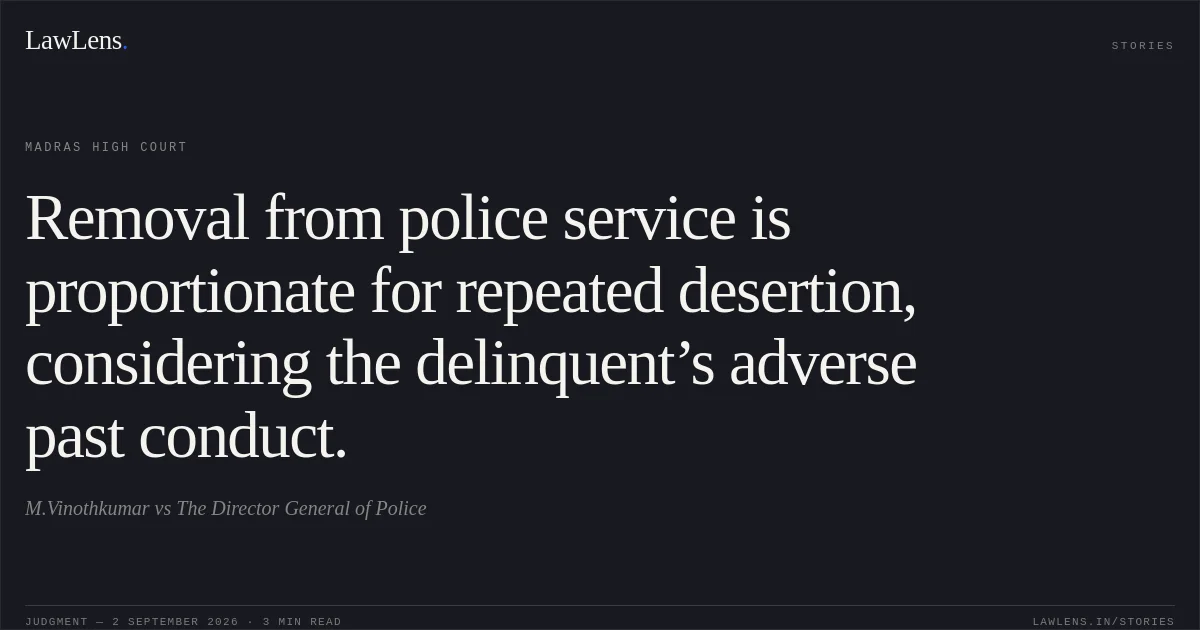
The petitioner, a Police Constable, was charged with unauthorised absence from duty for 21 days commencing from 01.11.2018.
¶ 1–4 · pp. 2–5Following enquiry proceedings and issuance of a second show-cause notice, the disciplinary authority imposed the punishment of withholding one increment without cumulative effect on 07.09.2019.
¶ 1–4 · pp. 2–5The petitioner did not challenge that order.
¶ 1–4 · pp. 2–5Subsequently, the second respondent, exercising suo motu review powers under Section 15-A(1)(iii) of the Tamil Nadu Police Subordinate Service (Discipline and Appeal) Rules, 1955, issued a notice dated 16.03.2020 proposing enhancement of punishment.
¶ 1–4 · pp. 2–5After receiving the petitioner’s explanation dated 10.04.2020, the authority enhanced the punishment to removal from service on 13.05.2020.
¶ 1–4 · pp. 2–5The first respondent thereafter confirmed the punishment in review on 10.11.2021.
¶ 1–4 · pp. 2–5The petitioner challenged both orders, alleging violation of natural justice and disproportionality of punishment.
¶ 1–4 · pp. 2–502Issues
i.Whether the suo motu enhancement of the petitioner’s punishment from withholding of increment to removal from service was made in violation of the principles of natural justice for want of a prior opportunity of hearing.
¶ 6 · p. 5ii.Whether the punishment of removal from service was disproportionate to the proved misconduct of unauthorised absence for 21 days, particularly in light of the petitioner’s past service record.
¶ 7–9, 12–16 · pp. 6–9iii.Whether the impugned orders suffered from perversity, non-compliance with the applicable statutory rules, or any other ground warranting interference under Article 226 of the Constitution.
¶ 10 · p. 703Law Applied
The Court applied Section 15-A(1)(iii) of the Tamil Nadu Police Subordinate Service (Discipline and Appeal) Rules, 1955, which empowers the competent appellate authority to review disciplinary punishment and enhance it after following the prescribed procedure.
¶ 2 · p. 3The Court relied on the principles of natural justice, particularly the requirement that a delinquent employee be informed of the proposed enhancement and given a reasonable opportunity to submit an explanation.
¶ 6 and 9 · pp. 5–7It also applied the settled limits of judicial review in disciplinary matters: the Court may examine compliance with natural justice and statutory rules, the existence of evidence, perversity of findings, and whether the penalty is disproportionate to the proved misconduct, but it does not ordinarily reappreciate the evidence or substitute its own penalty.
¶ 10 · p. 7Relying on Union of India and Others, 2009 (13) SCC 102, the Court held that the past conduct of a delinquent employee is a material consideration in determining the appropriate punishment.
¶ 13 · p. 8It further recognised that strict discipline is of particular importance in uniformed services and that repeated misconduct may justify a severe penalty.
¶ 8–9 and 14–15 · pp. 6–904Reasoning
The Court rejected the petitioner’s natural-justice challenge because the record and the impugned order established that a specific show-cause notice had been issued on 16.03.2020, expressly notifying him of the proposed enhancement, and that his explanation had been received and considered before the punishment was enhanced.
¶ 6 · p. 5On proportionality, the Court treated unauthorised absence as serious misconduct in the police force, where discipline is paramount.
¶ 8 · p. 6The petitioner’s absence constituted his seventh misconduct within seven years, with six earlier adverse entries or punishments for similar conduct.
¶ 9 and 13 · pp. 7–8Since the past record had been disclosed to him and considered by the appellate authority, the enhanced punishment was not based on undisclosed material or an arbitrary exercise of power.
¶ 9 and 13 · pp. 7–8Given the repeated nature of the misconduct and the petitioner’s membership of a disciplined uniformed service, the Court found no perversity or disproportionality warranting judicial intervention.
¶ 14–16 · pp. 8–905Holding
The Court held that the petitioner had been afforded a reasonable opportunity before the punishment was enhanced and that the punishment of removal from service was not disproportionate, considering the seriousness of desertion from duty and his six previous instances of similar misconduct.
¶ 6, 14–16 · pp. 5–9The writ petition was dismissed, the orders dated 13.05.2020 and 10.11.2021 were left undisturbed, and the connected miscellaneous petition was closed.
¶ 17 · p. 9No costs were awarded.
¶ 17 · p. 9Original Court PDF
M.VinothkumarvsThe Director General of Police
Click to open original judgment
Original judgment, available to read, download and summarize on LawLens.in