Facts
The petitioner, appointed in the South Eastern Railway in 1980 and regularised in 1984, was proceeded against on allegations that he had submitted a false date-of-birth and educational certificate and had altered his father’s name to secure employment.
Source reference: paras. 2(i)–(iv)The first departmental inquiry culminated in his removal from service, which was quashed by the Central Administrative Tribunal on 1 August 2011 on the ground that the inquiry was perverse; the Tribunal directed reinstatement while permitting a de novo inquiry.
Source reference: para. 2(xiv)The petitioner was reinstated, but the subsequent de novo inquiry again relied upon the alleged school certificate and vigilance material without examining the complainant or the headmaster who purportedly verified that the certificate had not been issued by the school.
Source reference: paras. 2(xvi)–(xxii); paras. 18–21The disciplinary authority removed him from service on 13 February 2015, and the appellate authority dismissed his appeal on 28 July 2015.
Source reference: paras. 2(xxii)–(xxiii)The Tribunal dismissed his challenge on 17 May 2017, leading to the present writ petition under Article 226.
Source reference: paras. 1, 3–4Issues
Whether the departmental inquiry was vitiated by violation of natural justice because the complainant and the headmaster, whose evidence was relied upon, were not examined and made available for cross-examination.
Source reference: paras. 19–20, 27–30, 35–36Whether reliance on the school certificate/verification letter and vigilance fact-finding material, without proper proof in the regular inquiry, was legally permissible under Rule 9 of the Railway Servants (Discipline and Appeal) Rules, 1968.
Source reference: paras. 22–24, 28–31Whether the Tribunal’s refusal to interfere with the disciplinary and appellate orders disclosed perversity or an error warranting judicial review under Article 226.
Source reference: paras. 11–15, 36–38Law Applied
The Court applied Article 226 judicial-review principles, holding that interference is warranted where the impugned decision suffers from an error apparent on the face of the record, lack of jurisdiction, or perversity, while the High Court does not ordinarily reappreciate evidence.
Source reference: para. 11; para. 13Rule 9 of the Railway Servants (Discipline and Appeal) Rules, 1968 requires a fair major-penalty inquiry, disclosure of relied-upon documents and witnesses, and an adequate opportunity to defend and cross-examine.
Source reference: paras. 22–23The principles of natural justice require that adverse evidence be taken in the delinquent employee’s presence, that the employee be permitted to cross-examine opposing witnesses, and that no material be relied upon without an opportunity to explain it.
Source reference: para. 24A preliminary or vigilance inquiry is only for determining whether a regular disciplinary proceeding should be initiated; material collected therein cannot ordinarily establish guilt in the regular inquiry unless properly introduced and proved.
Source reference: para. 31Departmental findings must be based on relevant, cogent material and cannot rest on conjecture, suspicion, or unproved evidence.
Source reference: paras. 25, 33Reasoning
The Court found that the charges substantially rested on the alleged falsity of the school certificate and the complaint/vigilance material.
Source reference: no citationHowever, the complainant was not examined, and the headmaster—the person said to have issued or verified the relevant certificate/letter—was neither examined nor made available for cross-examination.
Source reference: paras. 19–21, 27–29The certificate’s contents were instead sought to be proved through K.K. Ganguly, a vigilance officer involved in the fact-finding process, who was not the author or competent person to establish the document’s authenticity.
Source reference: paras. 29–30, 36(iii)The Court held that this deprived the petitioner of an effective opportunity to challenge the principal evidence against him and violated Rule 9 and the principles of natural justice.
Source reference: paras. 23–24, 35–37Further, reliance on the preliminary vigilance inquiry as substantive proof of guilt was impermissible because the petitioner had not participated in that fact-finding process or cross-examined the persons whose statements were relied upon.
Source reference: para. 31These defects were material, not technical, and rendered the inquiry findings perverse, thereby justifying interference under Article 226 despite the normally limited scope of review in disciplinary matters.
Source reference: paras. 32, 36–38Holding
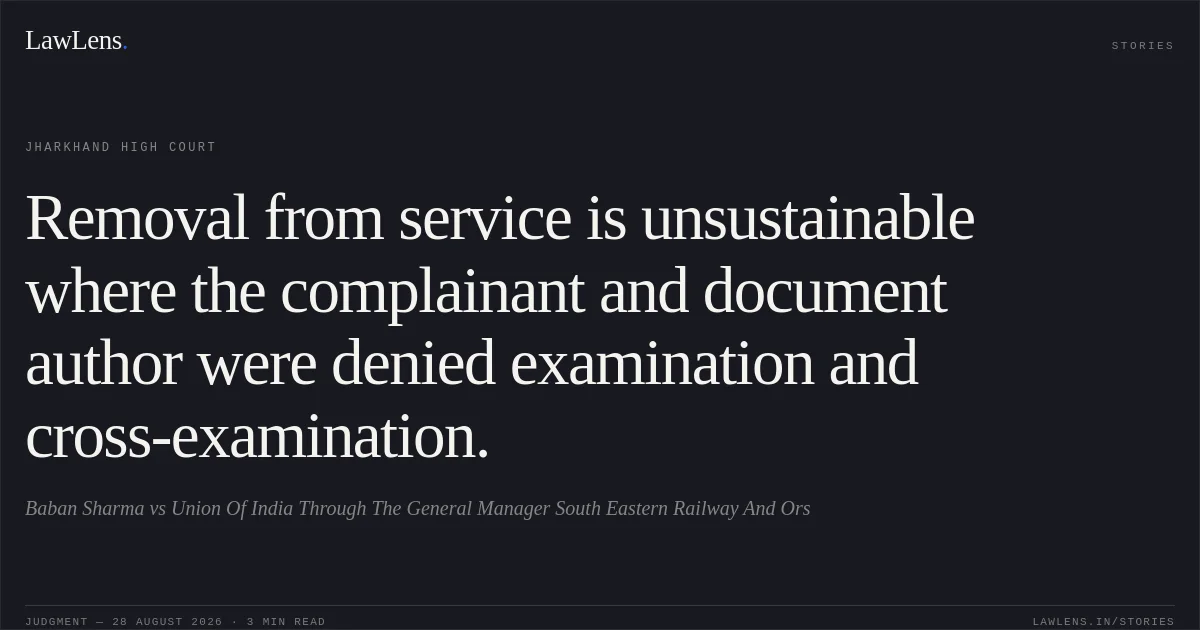
The Court held that the de novo departmental inquiry was procedurally unfair and legally unsustainable because material witnesses were not examined, the principal document was not properly proved, and preliminary vigilance material was relied upon without affording the petitioner an opportunity of cross-examination.
The order of the Central Administrative Tribunal dated 17 May 2017, the disciplinary authority’s removal order dated 13 February 2015, and the appellate order dated 28 July 2015 were quashed and set aside.
Source reference: paras. 39–40The writ petition was allowed, with consequential relief directed to follow.
Source reference: paras. 41–42Acts & Sections Cited
2 provisions across 1 statute referred to in this judgment. Each provision opens on LawLens.
Administrative Tribunals Act, 19852
Original Court PDF
Baban SharmavsUnion Of India Through The General Manager South Eastern Railway And Ors
Click to open original judgment
Original judgment, available to read, download and summarize on LawLens.in
![Courts will not interfere with transfers absent mala fides or violation of statutory rules.. M Ramya vs EMPLOYEES STATE INSURANCE CORPORATION (ESIC). CAT - ['Chennai']. LawLens](/stories/thumbnails/courts-will-not-interfere-with-transfers-absent-mala-fides-or-violation-of-statutory-rules-a6845e9ca6f548fca284c51c8351957f.webp)
![Courts cannot direct one-time recruitment age relaxation absent authority in the governing rules or advertisement.. UT OF PUDUCHERRY vs M ANDAL. CAT - ['Chennai']. LawLens](/stories/thumbnails/courts-cannot-direct-one-time-recruitment-age-relaxation-absent-authority-in-the-governing-895d78fde47143e2a8ed0207c4b6a44f.webp)
![A review cannot correct an allegedly erroneous decision absent an error apparent on the record.. Ajit Kumar Jha vs RAILWAY BOARD. CAT - ['Delhi']. LawLens](/stories/thumbnails/a-review-cannot-correct-an-allegedly-erroneous-decision-absent-an-error-apparent-on-the-re-8ac952fd4eba470c92f7da20af72a220.webp)