Facts
Tmt. K. Sakuntala was elected as the Councillor of the 11th Ward of Usilampatti Municipal Council on 22 February 2022 and was subsequently elected Chairperson on 4 March 2022
Source reference: p.3, para.4.1The State Government issued a show-cause notice dated 22 October 2024 under Section 52(2) of the Tamil Nadu Urban Local Bodies Act, 1998, alleging, inter alia, unauthorised collection and non-collection of rent, causing financial loss to the Municipality, interference with municipal staff, improper conduct of Council meetings, unauthorised approval of works, and cancellation of a solid-waste-management contract
Source reference: pp.9–11, paras.8–9After considering her explanation and the para-wise remarks obtained from the Director of Municipal Administration, the Government removed her from both the offices of Chairperson and Ward Councillor by G.O.(N) No.41 dated 26 March 2025
Source reference: pp.3–4, para.4.2In W.P. No.12614 of 2025, the High Court set aside the removal order for violation of natural justice, non-supply of the para-wise remarks, failure to pass a speaking order, and non-application of mind in removing her as Councillor when the original notice concerned only her office as Chairperson
Source reference: pp.4–5, para.4.3On remand, a fresh show-cause notice dated 2 September 2025 was issued concerning removal from both offices. The petitioner submitted explanations and sought, inter alia, an opportunity to cross-examine the Municipal Commissioner
Source reference: p.5, para.4.4The Government nevertheless removed her from both posts by G.O.(N) No.375 dated 7 November 2025. A learned Single Judge set aside that order and remitted the matter for fresh consideration. The State authorities challenged that decision in the present writ appeal
Source reference: pp.5–6, paras.4.5–4.6Issues
Whether the fresh show-cause notice could validly contemplate removal of the petitioner from both the offices of Chairperson and Ward Councillor, although the underlying allegations arose principally from her conduct as Chairperson?
Source reference: pp.15–17, paras.12–12.2Whether the Government’s removal order was vitiated by non-application of mind and failure to disclose sufficient evidentiary material and reasons under Section 52 of the Tamil Nadu Urban Local Bodies Act, 1998?
Source reference: pp.17–20, paras.12.3–14Whether the petitioner was denied a reasonable opportunity of hearing by the Government’s failure to grant her request to cross-examine the Municipal Commissioner?
Source reference: pp.20–22, para.15.1Whether, in the circumstances involving serious and disputed allegations against an elected local-government representative, a proper enquiry was necessary before ordering removal?
Source reference: pp.26–31, paras.17–18Law Applied
The Court applied Section 52(1) and (2) of the Tamil Nadu Urban Local Bodies Act, 1998, under which the Government may remove a Councillor, Deputy Chairperson or Chairperson for wilful disobedience of the Act, rules, bye-laws or lawful orders, or abuse of power, but must provide an opportunity to explain and record the reasons for removal
Source reference: pp.17–19, para.12.3The statutory opinion under Section 52 must be rational, evidence-based and supported by disclosed materials; mere rejection of an explanation or reliance on unsubstantiated allegations is insufficient
Source reference: pp.19–20, paras.13–14Section 102 places the grant of municipal licences and collection of licence fees primarily upon the Municipal Commissioner, read with Section 114-A concerning action against unauthorised occupants
Source reference: pp.22–25, paras.16–16.1The Court relied on the principles in Tarlochan Dev Sharma v. State of Punjab, (2001) 6 SCC 260, that removal of an elected office-bearer is a serious action affecting both the office-holder and the represented constituency, and therefore requires strict adherence to statutory procedure, natural justice, and a clear, reasoned finding
Source reference: pp.27–30, para.17It also relied on Umesh Baijal v. State of U.P., 2003 SCC OnLine All 1560, recognising that while a full-fledged enquiry is not indispensable in every case, it is ordinarily necessary where serious allegations are disputed and require proof through documentary and oral evidence
Source reference: pp.26–31, para.17The Court further invoked the constitutional principle of local self-government under Articles 243P(e) and 243Q
Source reference: p.25, para.16.3Reasoning
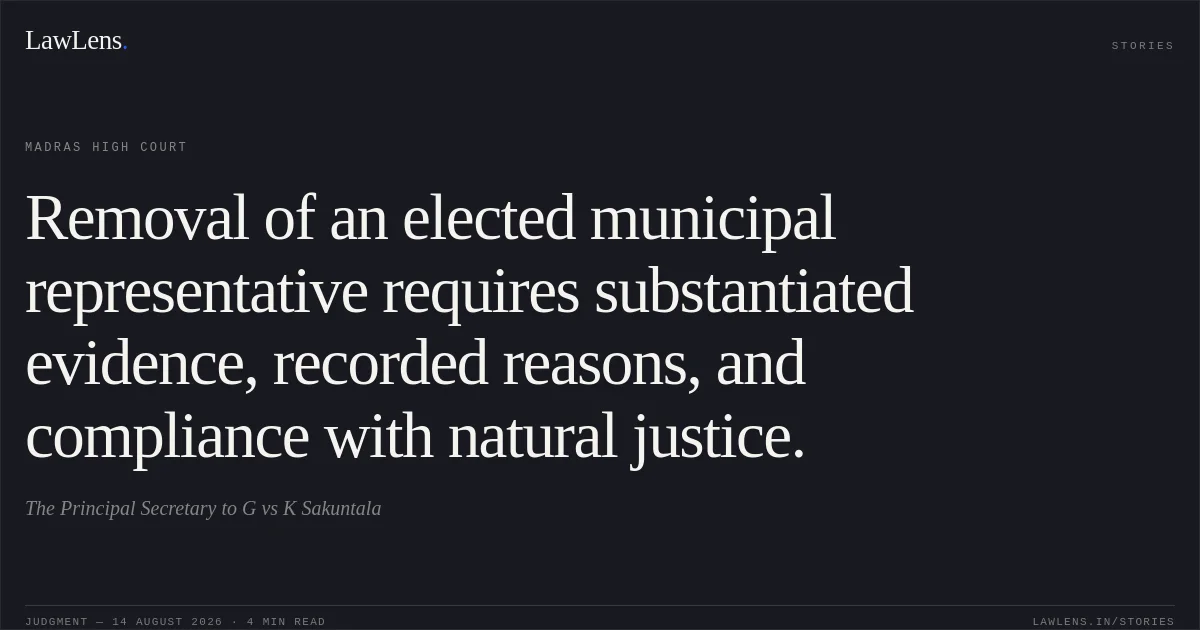
The Court held that the fresh notice could legally cover both posts because the allegations—financial loss, alleged misappropriation, unauthorised sanction of works and related misconduct—were sufficiently grave to potentially render the petitioner unfit to continue as Councillor as well as Chairperson
Source reference: pp.15–17, paras.12–12.2However, the validity of the notice did not establish the allegations. The impugned Government Order merely stated that the petitioner’s explanation and the para-wise remarks had been considered and that the allegations stood proved; it disclosed no supporting evidence, evaluation of the competing versions, or rational basis for the statutory opinion under Section 52
Source reference: pp.17–20, paras.12.3–14The Court also noted that the alleged rent-related misconduct primarily concerned functions assigned to the Municipal Commissioner under Section 102, while the record did not establish that the petitioner had prevented the Commissioner from acting lawfully
Source reference: pp.22–25, paras.16–16.1Similarly, the Council meeting had been held in the Chairperson’s chamber because the meeting hall was recorded as unfit, and there was no conclusive evidence that her son interfered with the proceedings
Source reference: p.25, para.16.2The Government additionally failed to address the petitioner’s specific request to cross-examine the Municipal Commissioner, thereby violating natural justice
Source reference: pp.20–22, para.15.1Given the seriousness of the allegations, their factual dispute, and the petitioner’s status as an elected representative, the Court found that a proper enquiry with disclosure of materials and an effective opportunity of defence was required
Source reference: pp.26–31, paras.17–18Holding
The writ appeal was dismissed.
The Court set aside G.O.(N) No.375 dated 7 November 2025, by which the petitioner had been removed as Chairperson and Ward Councillor, and remitted the matter to the State Government for fresh consideration
Source reference: pp.31–32, para.19The Government was directed to grant the petitioner an opportunity to cross-examine the Municipal Commissioner, comply fully with the principles of natural justice, and pass a reasoned order supported by sufficient materials and disclosed reasons
Source reference: p.32, para.19No order as to costs was made, and the connected miscellaneous petition was closed
Source reference: p.32, para.19Acts & Sections Cited
4 provisions across 2 statutes referred to in this judgment. Linked provisions open on LawLens.
Tamil Nadu Urban Local Bodies Act, 19983
Punjab Municipal Act, 19111
Original Court PDF
The Principal Secretary to GvsK Sakuntala
Click to open original judgment
Original judgment, available to read, download and summarize on LawLens.in