Facts
The petitioner, a court employee appointed in 1977 and later serving as Deputy Nazir, was charged over an incident near a judicial officer’s residence in November 1994.
Source reference: paras. 3–8The inquiry officer found Charge No. 1 not proved but found Charges Nos. 2–4 proved; the District Judge removed the petitioner from service on 21 December 1998, and the departmental appeal was rejected on 1 December 1999.
Source reference: paras. 3–8The petitioner challenged both orders, alleging procedural defects, insufficient evidence, inadequate appellate consideration and disproportionate punishment.
Source reference: paras. 2, 9–10He died during the writ proceedings in 2006, and his legal heirs were substituted.
Source reference: paras. 2, 9–10Issues
Whether the inquiry and findings on Charges Nos. 2–4 suffered from procedural or jurisdictional error
Source reference: para. 12Whether the disciplinary and appellate orders disclosed due application of mind, including compliance with Rule 7(4)
Source reference: paras. 12, 21–22Whether removal from service was an excessive penalty and, if so, what relief should be granted
Source reference: paras. 12, 23–28Law Applied
Rule 5 of the Uttar Pradesh Subordinate Courts Staff (Punishment and Appeals) Rules, 1976 requires definite charges, an adequate opportunity to defend, a record of evidence, and reasoned findings; Rule 7(4) requires the appellate authority to consider whether the facts are established, whether they justify action, and whether the penalty is excessive, adequate or inadequate.
Source reference: para. 13Under State of Karnataka v. N. Gangaraj, (2020) 3 SCC 423, and Union of India v. P. Gunasekaran, (2015) 2 SCC 610, judicial review examines the legality of the decision-making process, not the sufficiency or comparative weight of evidence, and permits interference for procedural illegality, no evidence, or an unreasonable conclusion.
Source reference: para. 14State of Haryana v. Rattan Singh, (1977) 2 SCC 491, establishes that strict rules of the Evidence Act do not apply to departmental inquiries, but evidence must have a reasonable nexus and credibility, be fairly evaluated, and be open to challenge by the employee.
Source reference: para. 15Under B.C. Chaturvedi v. Union of India, (1995) 6 SCC 749, and S.R. Tewari v. Union of India, (2013) 6 SCC 602, a court may mould relief in an exceptional case involving a disproportionate penalty; Brijesh Chandra Dwivedi (Dead) through Legal Representatives v. Sanya Sahayak, (2022) 4 SCC 189, supports moulding relief to protect terminal benefits and family pension in light of long service and the employee’s death during proceedings.
Source reference: paras. 25–26Reasoning
The Court found that the petitioner had an opportunity to defend himself and cross-examine witnesses.
Source reference: paras. 16–18Although the medical officer and police officer were not examined, the medical and police records could not be relied upon; nevertheless, the oral testimony and the petitioner’s admissions independently supported the findings on Charges Nos. 2–4.
Source reference: paras. 16–18The failure of Charge No. 1 did not invalidate the remaining findings because the charges concerned distinct acts and the inquiry officer considered them separately.
Source reference: para. 19The disciplinary order showed application of mind, but the appellate order failed to address the failed charge, the petitioner’s service record and whether removal was excessive, contrary to Rule 7(4).
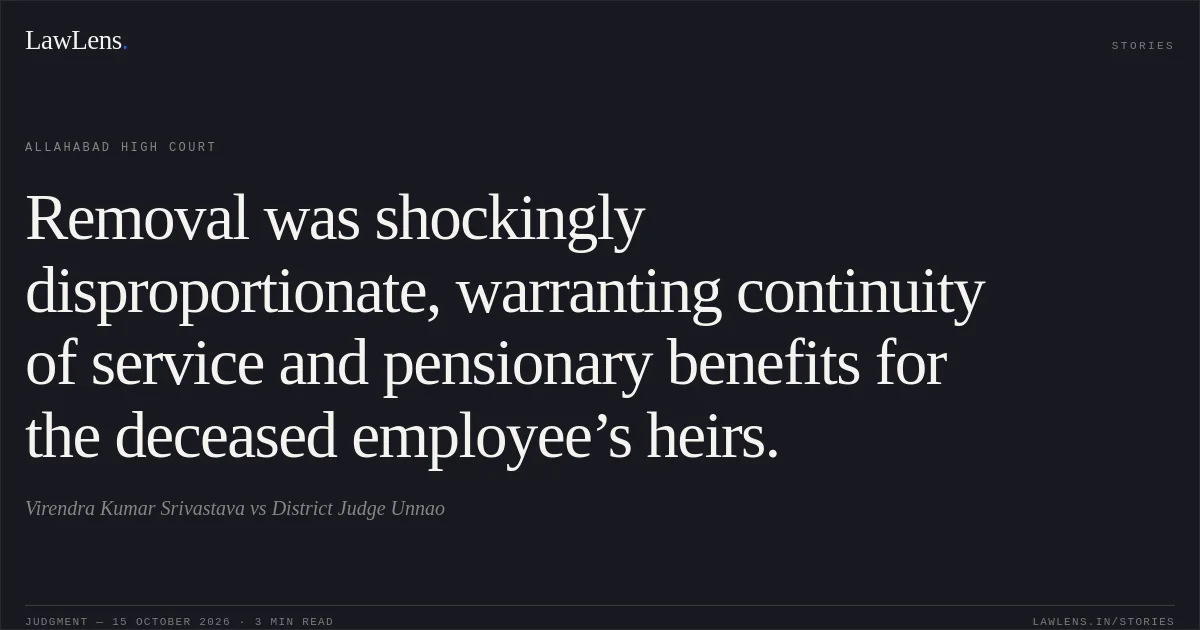
Source reference: paras. 21–22Given the petitioner’s long service, the circumstances of the incident, the absence of any earlier adverse record and his death during the proceedings, the Court held removal shockingly disproportionate.
Source reference: paras. 23–28It considered remand impractical and moulded relief itself, while retaining the misconduct findings and denying most back wages.
Source reference: paras. 23–28Holding
The writ petition was partly allowed.
The removal order and appellate order were set aside to the extent of the penalty, while the findings of misconduct remained undisturbed.
Source reference: paras. 28–29The petitioner was to be treated as having continued in service from 21 December 1998 until his death on 7 April 2006 for continuity, pay fixation, terminal benefits and pension; his heirs were awarded 25% of back wages for that period.
Source reference: para. 29His widow was granted family pension from the date of his death with full admissible arrears, without reduction due to the limited back-wage award, and other admissible terminal and death-cum-retirement benefits were directed to be released within three months of production of the judgment.
Source reference: para. 30The request for compassionate appointment was rejected, with no order as to costs.
Source reference: para. 31Acts & Sections Cited
1 provisions across 1 statute referred to in this judgment. Each provision opens on LawLens.
Police Act, 18611
Original Court PDF
Virendra Kumar SrivastavavsDistrict Judge Unnao
Click to open original judgment
Original judgment, available to read, download and summarize on LawLens.in