Facts
The original plaintiffs filed a suit for eviction against the applicant (tenant) under the Rent Act on grounds of unauthorized construction, subletting, change of user, bona fide requirement, and arrears of rent
Source reference: para. 3The Trial Court dismissed the suit on June 30, 2009
Source reference: para. 3On appeal, the Appellate Bench set aside the Trial Court’s order and passed an eviction decree on May 3, 2014
Source reference: para. 4-5The applicant challenged this before the High Court under Section 115 of the CPC.
Source reference: para. 6During the pendency of this revision, the applicant purchased a 50% share of the suit property from the legal heirs of the deceased Plaintiff No. 2 via a conveyance deed dated April 22, 2016
Source reference: para. 6Furthermore, the surviving original plaintiff (Respondent No. 2) expressed a desire to withdraw the eviction proceedings
Source reference: para. 7.1Additionally, the applicant had been depositing market rent in the High Court as per an interim order
Source reference: para. 20-21Issues
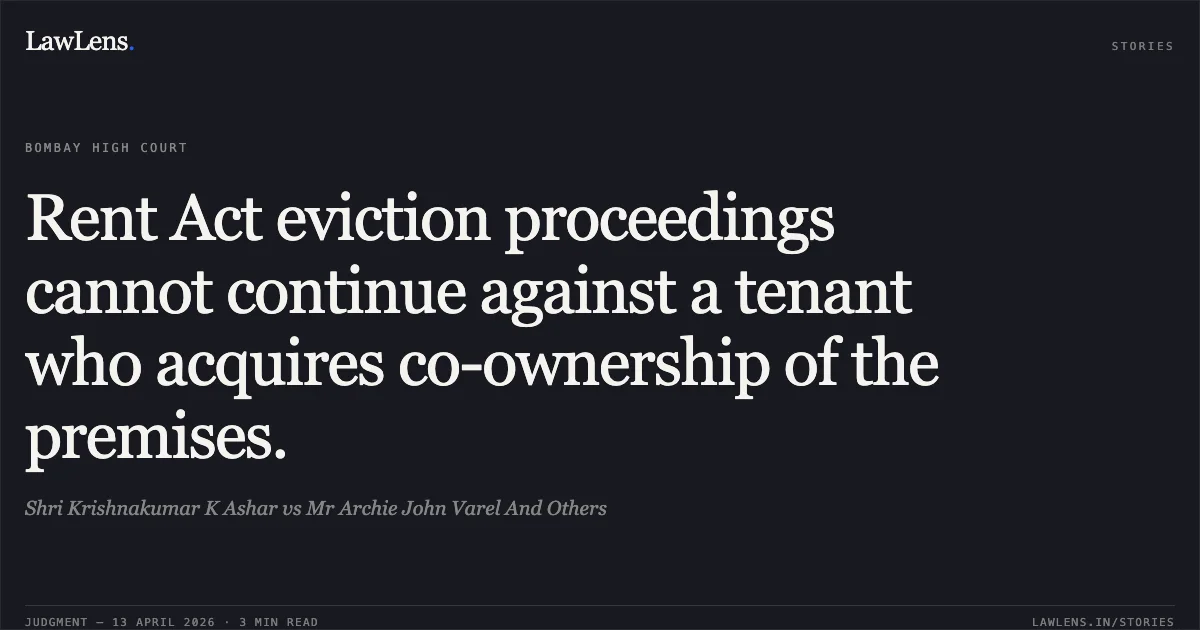
1. Whether an eviction proceeding under the Rent Act can be maintained or continued against a tenant who subsequently acquires a co-ownership share in the suit premises.
Source reference: para. 9.1-9.42. Whether the objection of a co-owner to the continuation of eviction proceedings is fatal to the suit.
Source reference: para. 8-93. Whether the applicant is entitled to a refund of the market rent deposited during the pendency of the revision after the eviction decree is set aside.
Source reference: para. 23-24Law Applied
The Court primarily applied the doctrine of agency in co-ownership as interpreted in India Umbrella Mfg. Co. v. Bhagabandei Agarwalla (2004) 3 SCC 178, which holds that one co-owner acts as an agent for others, but this entitlement ends if subsequent events terminate the body of co-owners' right to eject
Source reference: para. 8It further relied on Mohinder Prasad Jain v. Manohar Lal Jain (2006) 2 SCC 724, establishing that while one co-owner can file a suit, the objection of another co-owner is a relevant fact that can bring eviction proceedings to an end
Source reference: para. 8-9Regarding the refund of deposits, the court considered the principles from Atmaram Properties v. Federal Motors (2005) SCC (1) 705 in light of the Supreme Court’s specific directions in the SLP arising from this matter
Source reference: para. 17, 21Reasoning
The Court reasoned that when a tenant purchases a portion of the ownership rights, their status is elevated to a dual capacity—part-owner and tenant
Source reference: para. 9.4In such a scenario, another co-owner cannot continue eviction proceedings under the Rent Act against a fellow co-owner
Source reference: para. 9.4The Court identified three critical scenarios where eviction must stop: (a) if a co-owner withdraws consent, (b) if a third party who purchased a share objects, or (c) if the tenant purchases a share
Source reference: para. 9.1Applying these to the facts, the Court noted that since the applicant is now a 50% owner and the other co-owner (Respondent No. 2) also objects to the eviction, the proceedings cannot continue
Source reference: para. 9.5Regarding the monetary deposits, the Court noted the Supreme Court's observation that the deposits were subject to "final realization" of the revision.
Source reference: para. 22-24Since the eviction decree was set aside, the basis for paying "market rent" (use and occupation charges) vanished, entitling the successful applicant to a refund
Source reference: para. 22-24Holding
The High Court allowed the Civil Revision Application and quashed the Appellate Court's judgment and decree
The Trial Court’s judgment dismissing the eviction suit was confirmed
Source reference: para. 16The Court held that once a tenant becomes a co-owner, the landlord-tenant relationship is modified such that eviction under the Rent Act is no longer maintainable if any co-owner objects
Source reference: para. 9.5The Registry was directed to refund the entire deposited amount (approximately Rs. 60,00,000) along with accrued interest to the applicant
Source reference: para. 24-25All pending interim applications were disposed of accordingly
Source reference: para. 26Acts & Sections Cited
2 provisions across 1 statute referred to in this judgment. Each provision opens on LawLens.
Code of Civil Procedure, 19082
Original Court PDF
Shri Krishnakumar K AsharvsMr Archie John Varel And Others
Click to open original judgment
Original judgment, available to read, download and summarize on LawLens.in


