Facts
The petitioner filed its return for AY 2012–13 on 22 September 2012 declaring total income of ₹21,32,370 and subsequently filed a revised return on 31 March 2014. The return disclosed the purchase and sale of 3,10,000 shares of Prissm Remedies Pvt. Ltd., including the relevant capital-gain computation and investment details in the audit report.
Source reference: p.1; para. 9During scrutiny assessment under Section 143(3) of the Income Tax Act, 1961, the Assessing Officer issued notices under Section 142(1), specifically seeking details and supporting documents concerning the purchase and sale of those shares, their pricing, valuation, and the resulting capital gain/loss.
Source reference: pp.1–2; paras. 10–11The petitioner furnished the requested documents, including bank statements, share certificates, allotment forms, board resolutions, and valuation reports. The assessment was thereafter completed under Section 143(3) on 9 March 2015.
Source reference: pp.2, 6; paras. 3, 12Subsequently, on 29 March 2019, the Assessing Officer issued a notice under Section 148, relying on information from the DDIT (Investigation) that the shares had been split in the ratio of 1:10, allegedly reducing their value from ₹110 to ₹11 per share. The Department contended that the petitioner had wrongly claimed a loss of ₹3,06,60,000 by using the pre-split purchase price and had thereby understated taxable income.
Source reference: pp.3–5; paras. 4, 6–7The petitioner challenged the notice and the order dated 4 October 2019 disposing of its objections, asserting that the reopening was based on a mere change of opinion on an issue already examined during scrutiny.
Source reference: p.3; para. 5Issues
1. Whether the notice issued under Section 148 for AY 2012–13 was valid when the underlying share transactions and valuation had already been examined during the original scrutiny assessment under Section 143(3).
Source reference: pp.6–7; paras. 10–122. Whether the subsequent information regarding the 1:10 share split constituted fresh tangible material sufficient to justify reopening, or whether the reopening amounted to an impermissible change of opinion.
Source reference: pp.4–5, 7; paras. 6–7, 12–133. Whether the statutory requirement of failure by the petitioner to disclose fully and truly all material facts necessary for assessment was satisfied.
Source reference: p.7; para. 13Law Applied
The Court applied Sections 147 and 148 of the Income Tax Act, 1961, governing reassessment where the Assessing Officer has reason to believe that income has escaped assessment, subject to the requirement—particularly where applicable due to the lapse of time—that such escapement resulted from the assessee’s failure to disclose fully and truly all material facts necessary for assessment.
Source reference: pp.4–5, 7; paras. 6–7, 13It also considered Section 143(3), under which the original scrutiny assessment had been completed, and Section 142(1), under which the Assessing Officer had specifically examined the share transactions and their valuation.
Source reference: pp.1–2, 6; paras. 2–3, 10–11The governing principle applied was that reassessment cannot be founded on a mere change of opinion on an issue already examined during the original assessment; reopening requires fresh tangible material indicating escapement of income and cannot be used to review an assessment already completed.
Source reference: p.7; para. 13Reasoning
The Court found that the petitioner had disclosed the Prissm Remedies shares and the related capital-gain/loss computation in its return and audit report.
Source reference: p.1; para. 2More significantly, the Assessing Officer had expressly called for details of the purchase and sale transactions, broker invoices, Demat entries, share rates, valuation, and an explanation for the substantially lower sale price during the scrutiny proceedings.
Source reference: p.6; para. 11The petitioner supplied detailed documentary evidence, after which the assessment was completed under Section 143(3).
Source reference: pp.2, 6; paras. 3, 12The reasons for reopening relied on the same share transactions and merely presented the Department’s subsequent view that, after the 1:10 split, the purchase cost should be treated as ₹11 rather than ₹110 per share.
Source reference: p.7; para. 12Since the transaction, valuation, and capital loss had already been examined, the Court held that the reassessment attempt represented a change of opinion. The record did not establish either genuinely fresh tangible material relating to undisclosed facts or any failure by the petitioner to make a full and true disclosure.
Source reference: p.7; para. 13Holding
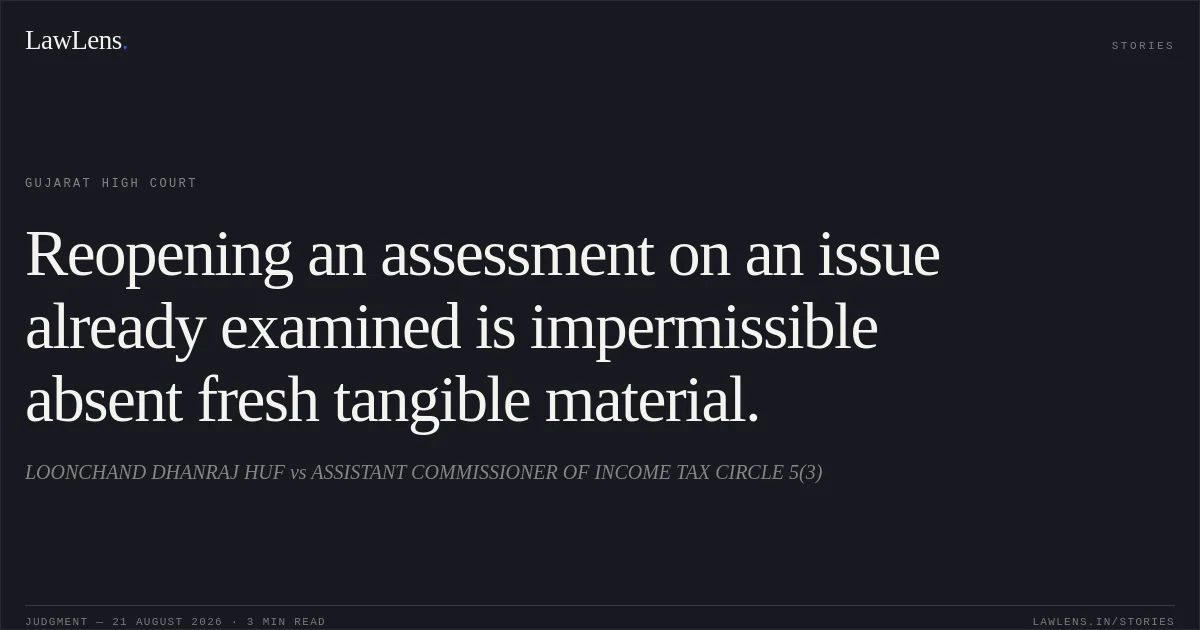
The Court answered the issues in favour of the petitioner and held that the reopening was impermissible because it was based on a change of opinion concerning an issue already examined in the original scrutiny assessment.
The notice dated 29 March 2019 issued under Section 148 and the order dated 4 October 2019 disposing of the petitioner’s objections were quashed and set aside. The writ petition was allowed and the Rule was made absolute.
Source reference: p.8; para. 14Acts & Sections Cited
4 provisions across 1 statute referred to in this judgment. Linked provisions open on LawLens.
Income Tax Act, 19614
Original Court PDF
LOONCHAND DHANRAJ HUFvsASSISTANT COMMISSIONER OF INCOME TAX CIRCLE 5(3)
Click to open original judgment
Original judgment, available to read, download and summarize on LawLens.in