Facts
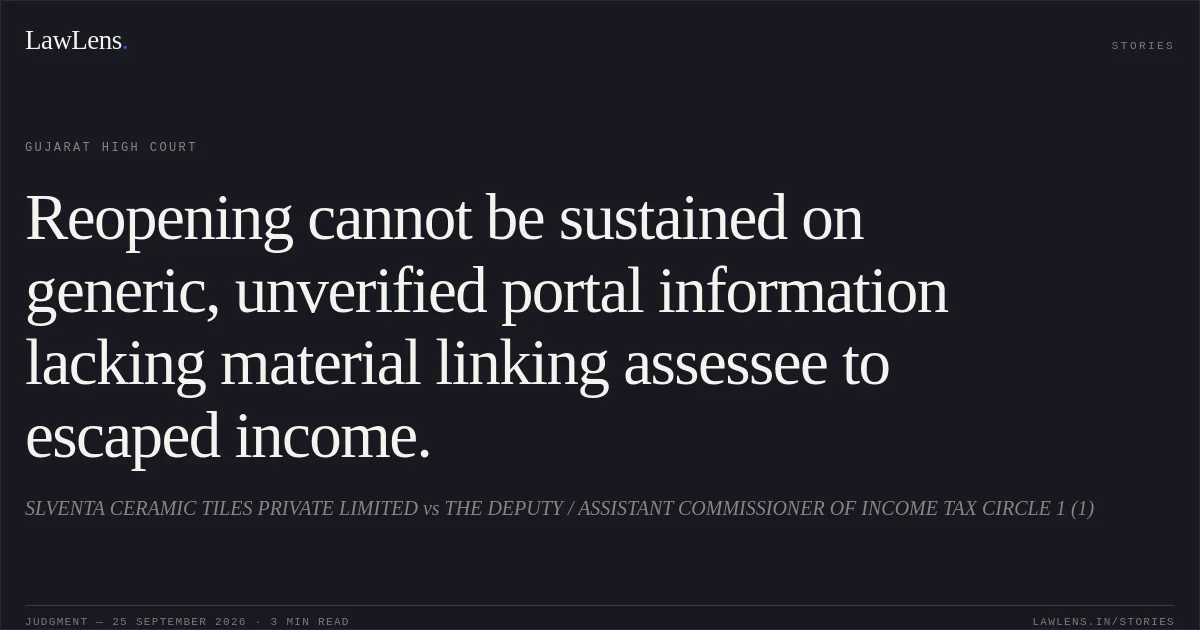
The petitioner, a ceramic-business entity operating in Morbi, challenged the notice issued under Section 148 of the Income Tax Act, 1961 (“IT Act”) and the order passed under Section 148A(3) for Assessment Year 2019–20, both dated 29 June 2025.
Source reference: p.2, paras. 2–4The proceedings were based on information available on the Income Tax Department’s Insight portal and a statement of an angadiya, Shri Nilesh Pranjivan Bhatia, allegedly indicating that the petitioner had received or participated in transactions aggregating to ₹2,14,42,208, resulting in alleged escapement of income.
Source reference: p.2, paras. 2–4The petitioner contended that the notice and order did not disclose any material connecting it with the alleged angadiya transaction, and that several similarly situated ceramic dealers had received notices involving the identical amount of ₹2,14,42,208.
Source reference: pp.2–4, paras. 3–4The Revenue opposed the petition, maintaining that the Insight portal information and the angadiya’s statement constituted sufficient material to initiate reassessment proceedings.
Source reference: p.3, para. 5Issues
Whether the notice under Section 148 and the order under Section 148A(3) of the IT Act were legally sustainable when they did not disclose specific material linking the petitioner to the alleged angadiya transaction or identify the petitioner-specific amount of escaped income.
Source reference: pp.4–5, para. 6Whether the Assessing Officer could initiate reassessment proceedings solely on the basis of unverified information from the Insight portal, without supplying the underlying material and demonstrating independent application of mind.
Source reference: pp.4–5, paras. 6–7Law Applied
The Court applied Sections 148, 148A(1), and 148A(3) of the IT Act, which require the Assessing Officer, before issuing a reassessment notice, to consider the available information, provide the assessee an opportunity of being heard, and pass a reasoned order determining whether issuance of notice under Section 148 is warranted.
Source reference: pp.2, 4–5The Court relied on the principle stated in Vasuki Global Industrial Limited v. Principal Chief Commissioner of Income Tax, [2025] 180 taxmann.com 16 (Gujarat), that the Assessing Officer must apply independent mind and verify information obtained from sources such as the Insight portal, rather than relying upon it mechanically.
Source reference: p.2, para. 4It further applied the settled rule that reassessment proceedings cannot be founded on a mere roving or fishing inquiry unsupported by specific, assessee-related material.
Source reference: p.5, para. 7Reasoning
The Court found that the notice under Section 148A(1) was devoid of material linking the petitioner to the alleged transaction with Shri Nilesh Pranjivan Bhatia and did not explain how ₹2,14,42,208 represented income that had escaped assessment in the petitioner’s case.
Source reference: p.4, para. 6The fact that identical amounts appeared in notices issued to several ceramic dealers, without identifying the petitioner-specific transaction or amount, demonstrated that the information had been used generically rather than after individual verification.
Source reference: pp.4–5, para. 6Although the Section 148A(3) order referred to a chart of alleged beneficiaries, it neither disclosed the relevant material to the petitioner nor contained the petitioner’s transaction amount.
Source reference: pp.4–5, paras. 6–8The Assessing Officer also failed to verify the information obtained from the Insight portal or demonstrate independent application of mind.
Source reference: pp.4–5, paras. 6–8Consequently, the statutory preconditions for reassessment were not satisfied, and the proceedings amounted to an impermissible fishing inquiry.
Source reference: pp.4–5, paras. 6–8Holding
The Court answered the issues in favour of the petitioner.
It held that the reassessment action was unsustainable because the notice and order lacked specific material connecting the petitioner with the alleged transaction, failed to disclose the petitioner-specific amount of escaped income, and reflected no meaningful verification or independent application of mind.
Source reference: pp.4–5, para. 8The writ petition was accordingly allowed, and the notice dated 29 June 2025 issued under Section 148 and the order dated 29 June 2025 passed under Section 148A(3) of the IT Act were quashed and set aside.
Source reference: p.5, para. 8Acts & Sections Cited
2 provisions across 1 statute referred to in this judgment. Linked provisions open on LawLens.
Income Tax Act, 19612
Original Court PDF
SLVENTA CERAMIC TILES PRIVATE LIMITEDvsTHE DEPUTY / ASSISTANT COMMISSIONER OF INCOME TAX CIRCLE 1 (1)
Click to open original judgment
Original judgment, available to read, download and summarize on LawLens.in