Facts
The wife, a doctor, petitioned for divorce under Sections 13(1)(i-a) and 13(1)(iii) of the Hindu Marriage Act, 1955, alleging cruelty and that her husband had concealed a pre-existing paranoid-schizophrenia diagnosis.
Source reference: pp. 3–5The Family Court dissolved the marriage on the ground of cruelty but rejected the mental-disorder ground, finding the medical documents insufficient without the psychiatrist’s evidence.
Source reference: pp. 8–10, 19–23The husband appealed.
Source reference: p. 8At trial, he did not cross-examine the wife or lead evidence; on appeal, his principal challenge concerned the validity of the wife’s GPA in favour of her father.
Source reference: pp. 10–11, 16–18The wife also relied on numerous proceedings and complaints instituted by the husband and his father against her and her family.
Source reference: pp. 11–15Issues
Whether the husband had established grounds to interfere with the Family Court’s decree of divorce on the ground of cruelty.
Source reference: p. 16, para. 25Whether the wife had proved that the husband’s mental disorder met the statutory threshold for divorce under Section 13(1)(iii) of the Hindu Marriage Act.
Source reference: pp. 19–23, paras. 31–39Law Applied
Section 13(1)(i-a) of the Hindu Marriage Act permits divorce where a spouse has treated the petitioner with cruelty; cruelty is assessed on the evidence and circumstances of the case, and the court stated that it is proved on a preponderance of probabilities.
Source reference: pp. 19, 25–26, paras. 31, 44Under Section 13(1)(iii), the existence or label of a mental disorder alone is insufficient: the disorder must be incurable, or be of such kind and extent that the petitioner cannot reasonably be expected to live with the respondent.
Source reference: pp. 21–23, paras. 36–38The court relied on Sharda v. Dharmpal, (2003) 4 SCC 493, regarding the relevance of expert medical evidence and the court’s obligation to assess the statutory threshold, and Ram Narain Gupta v. Rameshwari Gupta, (1988) 4 SCC 247, for the principle that “schizophrenia” must be evaluated by its effects.
Source reference: pp. 21–23, paras. 36–38The court relied on K. Srinivas Rao v. D.A. Deepa, (2013) 5 SCC 226, for the principle that multiple proceedings instituted to harass a spouse may amount to cruelty, and Narendra v. K. Meena, (2016) 9 SCC 455, concerning the cruelty of unsubstantiated allegations of extramarital affairs.
Source reference: pp. 26–27, paras. 46–47It also referred to Section 85 of the Indian Evidence Act, 1872, in connection with the evidentiary validity of the GPA, and Section 119 of the Bharatiya Sakshya Adhiniyam, 2023, in relation to adverse inference.
Source reference: pp. 17, 25–26, paras. 26, 44Reasoning
The husband’s challenge to the GPA had already been rejected in earlier proceedings, and he produced no material showing that the relevant finding had been overturned; the Court therefore declined to revisit it.
Source reference: pp. 16–18, paras. 26–30On the mental-disorder ground, the medical certificate and hospital registration card were not supported by expert testimony or evidence that the condition had reached the statutory threshold; the Court upheld the rejection of that ground.
Source reference: pp. 20–23, paras. 32–39On cruelty, the wife’s evidence of abuse, degrading conduct, accusations of infidelity and the husband’s and his father’s repeated proceedings remained uncontroverted.
Source reference: pp. 23–27, paras. 40–50The Court considered the pattern of litigation, including proceedings that had been quashed or dismissed, together with the husband’s failure to cross-examine or lead evidence, and concluded that the conduct caused serious mental suffering and constituted cruelty.
Source reference: pp. 23–27, paras. 40–50Holding
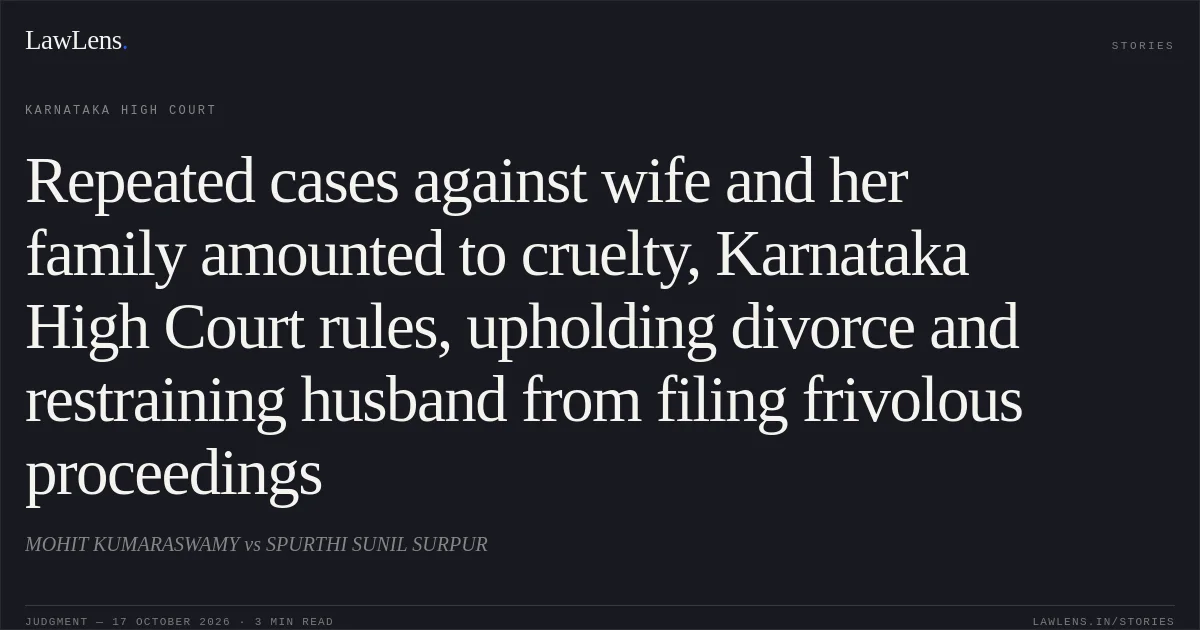
The Court dismissed the husband’s appeal and affirmed the Family Court’s decree dissolving the marriage under Section 13(1)(i-a) of the Hindu Marriage Act; it also upheld rejection of the wife’s claim under Section 13(1)(iii).
In view of the pattern of proceedings, the Court further directed that the husband be restrained from interfering with the wife’s life by instituting or causing the institution of frivolous proceedings against her or her family.
Source reference: p. 28, para. 52(ii)Acts & Sections Cited
5 provisions across 4 statutes referred to in this judgment. Each provision opens on LawLens.
Family Courts Act, 19841
Hindu Marriage Act, 19552
Negotiable Instruments Act, 18811
Bharatiya Sakshya Adhiniyam, 20231
Original Court PDF
MOHIT KUMARASWAMYvsSPURTHI SUNIL SURPUR
Click to open original judgment
Original judgment, available to read, download and summarize on LawLens.in