Facts
The petitioners, sellers registered on the Government e-Marketplace (GeM), were alleged to have participated in 28 common bids and shared a mobile number associated with their respective seller IDs.
Source reference: pp. 2–3GeM considered this a violation of Clause 29 of its General Terms and Conditions (GTC), which requires a bidder to submit only one bid in a bidding process.
Source reference: p. 2After issuing show-cause notices and rejecting the petitioners’ responses, GeM suspended each petitioner for 365 days—on 2 March 2026 and 9 March 2026, respectively.
Source reference: pp. 2–3The petitioners confined their challenge to the duration of suspension and submitted that they would not press their challenge to the merits if the suspension were reduced to 90 days under GeM’s Incident Management Policy.
Source reference: p. 3Issues
1. Whether the 365-day suspensions imposed for the alleged violation of Clause 29 warranted interference, given the Incident Management Policy’s classification and prescribed suspension periods for that violation.
Source reference: pp. 4–5, paras. 13–152. Whether Clause 14 of the Incident Management Policy applied so as to justify treating the alleged violation as a “grave deviation” and imposing a 365-day suspension.
Source reference: pp. 5–6, paras. 16–19Law Applied
Clause 29 of the GeM GTC requires a bidder to submit only one bid in a particular bidding process.
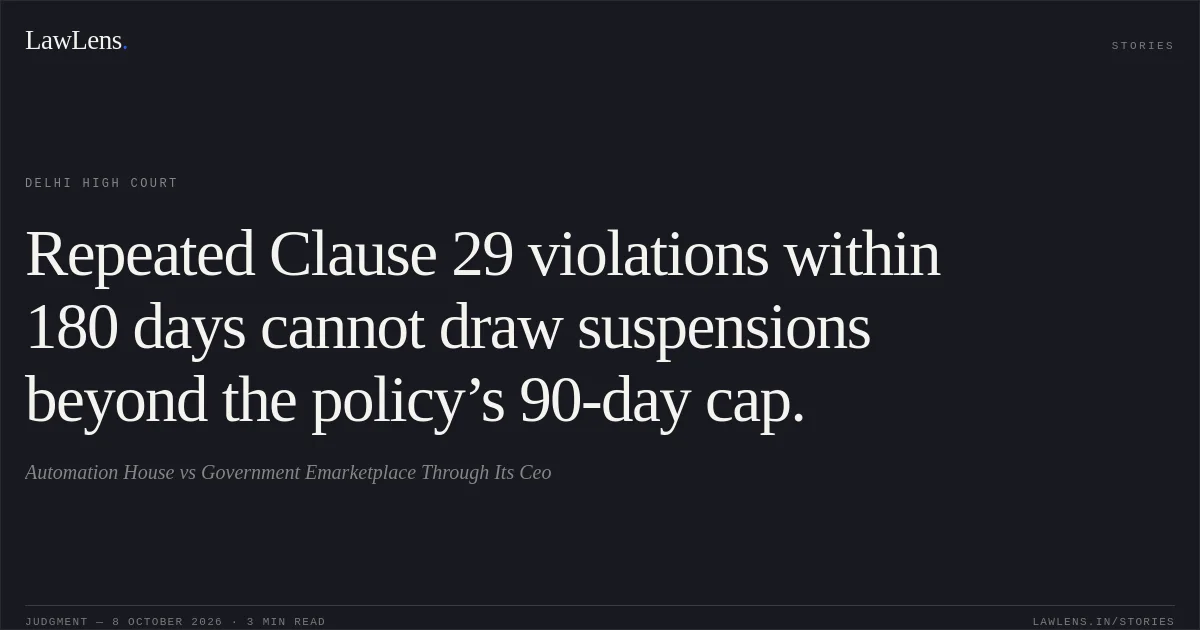
Source reference: p. 2, para. 2Under Serial No. 55 of Annexure 1 to the Incident Management Policy, a violation of Clause 29 is classified as a “severe” deviation; Clause 3.4 prescribes suspension for 60 days for the first and second deviations within 180 calendar days, and 90 days for the third and subsequent deviations within that period.
Source reference: p. 4, para. 14Clause 14 addresses specified incidents, including reports or escalations concerning false or forged documents, false statements, incorrect information, or other supplier conduct amounting to a deviation; it permits incidents to be created and action taken in the circumstances described there.
Source reference: pp. 5–6, para. 17The Court identified no statutory provision or judicial precedent as the basis for its decision.
Source reference: no citationReasoning
The Court confined its consideration to the penalty’s duration, noting both the petitioners’ limited challenge and GeM’s responsibility to protect fairness in the bidding process.
Source reference: p. 4, paras. 7–13The policy expressly classified a Clause 29 violation as severe and capped suspension for a third or subsequent deviation within 180 days at 90 days; GeM did not contend that the deviations fell outside that period.
Source reference: pp. 4–5, paras. 14–15Clause 14 did not, on its plain reading, convert an ordinary Clause 29 violation identified through bidding data into a grave deviation, and GeM produced no material showing that the circumstances covered by Clause 14 applied.
Source reference: pp. 5–6, paras. 16–18In those circumstances, the 365-day suspensions were inconsistent with the applicable policy classification and prescribed period.
Source reference: p. 6, para. 19Holding
The Court modified each 365-day suspension to 90 days, to run from the respective commencement date of 2 March 2026 and 9 March 2026.
As the 90-day periods had already elapsed, the suspensions were treated as completed, and GeM was directed to take appropriate steps under its policies to restore the petitioners’ Seller IDs.
Source reference: p. 6, paras. 22–23The Court expressly did not decide the merits of the alleged Clause 29 violation, including whether the petitioners were allied entities, whether the shared mobile number established a relationship, or whether their participation in the common bids amounted to collusion.
Source reference: p. 7, para. 24The petitions were partly allowed and disposed of.
Source reference: p. 7, para. 25Original Court PDF
Automation HousevsGovernment Emarketplace Through Its Ceo
Click to open original judgment
Original judgment, available to read, download and summarize on LawLens.in