Facts
The deceased, Priya Chaudhary, married the respondent, Manoj Kumar, on 20.02.2022. On 12.12.2022, within ten months of marriage, she died after falling from her matrimonial home's balcony
Source reference: p.2-3Her father (complainant) alleged that she was subjected to continuous harassment and taunts by the respondent and his family regarding insufficient dowry, specifically concerning a car and gold articles
Source reference: p.3-4He further alleged she was forcibly taken to IHBAS for psychiatric treatment
Source reference: p.4The respondent contended the deceased suffered from schizophrenia (ICD F-20), a fact supported by medical records indicating symptoms of self-muttering and auditory hallucinations
Source reference: p.7, 13-14The Sessions Court discharged the respondent of all charges under Sections 498A and 304B of the IPC
Source reference: p.2, 9Issues
1. Whether the allegations and material on record disclose a prima facie case of cruelty under Section 498A of the IPC to warrant framing of charges.
Source reference: p.10/para. 122. Whether there exists a "proximate and live link" between the alleged dowry harassment and the death of the deceased to attract Section 304B (Dowry Death) of the IPC.
Source reference: p.18/para. 32; p.22/para. 38Law Applied
The Court applied Section 498A of the IPC, which defines "cruelty" as wilful conduct likely to drive a woman to suicide/injury or harassment to coerce meeting unlawful property demands
Source reference: p.10It relied on Aluri Venkata Ramana v. Aluri Thirupathi Rai to establish that Section 498A covers both physical/mental harm and dowry-related harassment independently
Source reference: p.11For Section 304B, the Court applied the four essential ingredients: death by injury/unnatural causes within seven years of marriage, preceded "soon before" by dowry-related cruelty
Source reference: p.18-19Relying on Satbir Singh v. State of Haryana, the Court held that "soon before" requires a "proximate and live link" between the cruelty and death, rather than a rigid time limit
Source reference: p.21-22Regarding the stage of framing charges, it followed Manendra Prasad Tiwari v. Amit Kumar Tiwari, holding that the Court must only determine if there is a "grave suspicion" rather than proof of guilt
Source reference: p.17Reasoning
Regarding Section 498A, the Court held that despite the respondent’s claim that the marriage was for childcare, the Sessions Court erred in using this inference to dismiss allegations of cruelty
Source reference: p.17-18The complainant's specific statements regarding repeated taunts about the car and gold satisfy the prima facie threshold for harassment linked to dowry demands
Source reference: p.15-16However, the claim of "forcible" medical treatment was belied by IHBAS records showing the deceased was symptomatic of schizophrenia for two years, and the hospital visit occurred after the alleged disclosure to her father
Source reference: p.13-14Regarding Section 304B, the Court found that although death occurred within seven years, there was no evidence of a specific dowry-related incident "soon before" the death to establish a proximate link
Source reference: p.20, 22The respondent’s absence from the scene (being at work) and the deceased’s documented mental health condition (schizophrenia) further weakened the nexus required for dowry death
Source reference: p.20, 23Holding
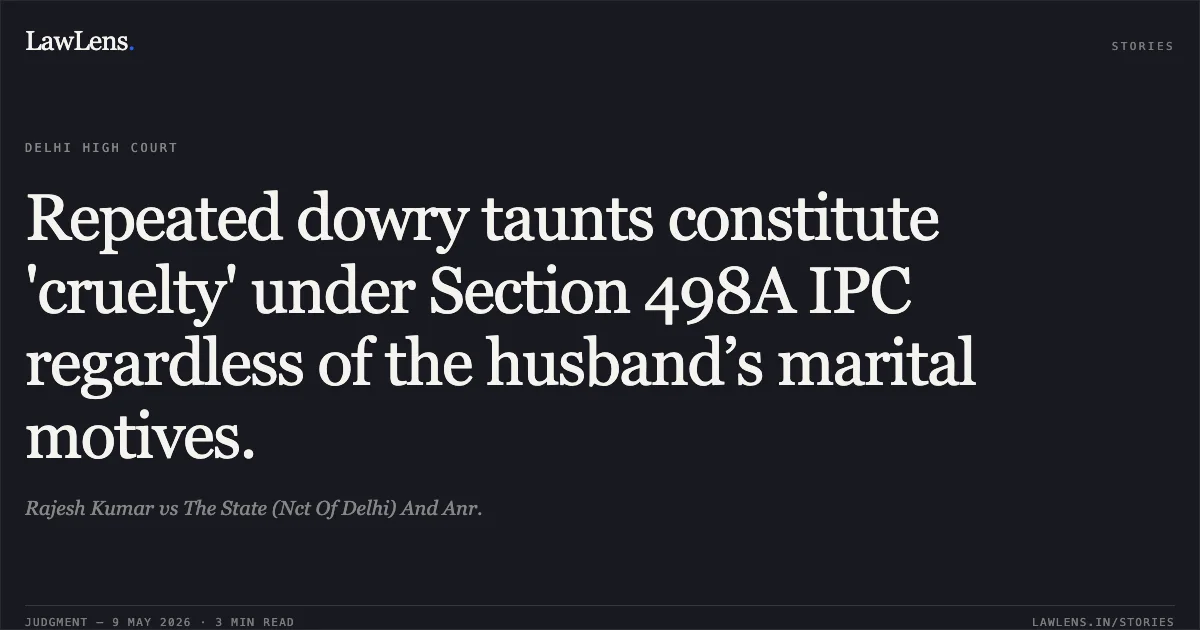
The Court held that a prima facie case under Section 498A IPC exists based on repeated dowry-related taunts which the trial court wrongly dismissed as mere "casual remarks"
It held that the charge under Section 304B IPC was not made out as the "soon before" requirement and proximate link were absent
Source reference: p.22-23The Court ordered the setting aside of the discharge for Section 498A IPC and directed the Sessions Court to frame charges and proceed with the trial for that offence only. The discharge under Section 304B IPC was upheld
Source reference: p.24Acts & Sections Cited
4 provisions across 3 statutes referred to in this judgment. Each provision opens on LawLens.
Indian Penal Code, 18601
Code of Criminal Procedure, 19732
Dowry Prohibition Act, 19611
Original Court PDF
Rajesh KumarvsThe State (Nct Of Delhi) And Anr.
Click to open original judgment
Original judgment, available to read, download and summarize on LawLens.in


