Facts
The parties married on 25 April 2018 according to their social customs.
Source reference: paras. 1–2, 14The husband alleged that the wife subjected him and his family to repeated quarrels, neglected matrimonial responsibilities, made allegations of his illicit relationship with another woman, permitted interference by her parental family, made allegations of witchcraft against his parents, and refused to resume cohabitation.
Source reference: paras. 1–2, 14He further alleged that she left the matrimonial home on 8 December 2019 and thereafter remained separate despite counselling and reconciliation efforts.
Source reference: paras. 1–2, 14The wife denied the allegations and asserted that she was willing to reside with the husband, but that the husband was unwilling to maintain her and their child.
Source reference: para. 3She claimed that she apprehended danger to her life and property in the matrimonial home.
Source reference: para. 3The husband approached the police and participated in counselling proceedings.
Source reference: paras. 14, 17, 19He subsequently filed proceedings under Section 9 of the Hindu Marriage Act, 1955, for restitution of conjugal rights.
Source reference: paras. 14, 17, 19The wife admitted that she had expressed unwillingness to return during counselling and had refused to reside with the husband during the Section 9 proceedings.
Source reference: paras. 14, 17, 19The Family Court, Durg, allowed the husband’s petition under Sections 13(1)(i-a) and 13(1)(i-b) of the Hindu Marriage Act and granted divorce on the grounds of cruelty and desertion.
Source reference: paras. 1, 5–6The wife challenged that decree in the present appeal.
Source reference: paras. 1, 5–6Issues
Whether the wife had treated the husband with cruelty within the meaning of Section 13(1)(i-a) of the Hindu Marriage Act, 1955?
Source reference: paras. 4, 10–13, 23, 28Whether the wife had deserted the husband for the statutory period and without reasonable or sufficient cause under Section 13(1)(i-b) of the Hindu Marriage Act, 1955?
Source reference: paras. 4, 11, 19–22, 28Whether statements made during counselling and reconciliation proceedings could be considered for assessing the parties’ conduct and refusal to resume cohabitation?
Source reference: paras. 6, 20Whether the Family Court’s decree of divorce suffered from perversity, illegality, or any error warranting appellate interference?
Source reference: paras. 28–30Law Applied
The Court applied Sections 13(1)(i-a) and 13(1)(i-b) of the Hindu Marriage Act, 1955: cruelty, including mental cruelty, is a ground for divorce, while desertion requires withdrawal from the society of the other spouse without reasonable cause for a continuous period of at least two years immediately preceding the petition.
Source reference: paras. 10–11Relying on Samar Ghosh v. Jaya Ghosh, (2007) 4 SCC 511, the Court held that mental cruelty must be assessed from the cumulative effect of the parties’ conduct and may include sustained humiliating or reprehensible behaviour, conduct making matrimonial life intolerable, and prolonged separation; however, ordinary quarrels and normal wear and tear do not ordinarily constitute cruelty.
Source reference: para. 13Under Savitri Pandey v. Prem Chandra Pandey, (2002) 2 SCC 73, desertion involves withdrawal from an existing state of matrimonial cohabitation, and a party seeking relief must not take advantage of his or her own wrong.
Source reference: para. 24Raj Talreja v. Kavita Talreja, (2017) 14 SCC 194, was relied upon for the principle that reckless, false, and defamatory allegations may constitute mental cruelty, though the mere filing of complaints is not by itself cruelty.
Source reference: para. 25The Court also referred to K. Srinivas Rao v. D.A. Deepa, (2013) 5 SCC 226, and Sonal Talpada v. Veerbhan Singh, Civil Appeal arising from SLP (C) No. 10422 of 2025, decided on 2 June 2026, concerning mental cruelty arising from prolonged matrimonial discord and the futility of continuing a dead relationship.
Source reference: paras. 26–27Reasoning
The Court held that the wife’s repeated refusal to resume cohabitation was established by her own admissions regarding the counselling proceedings and the Section 9 restitution proceedings.
Source reference: paras. 17, 19Although statements made during counselling could not be treated as substantive proof of the truth of allegations made therein, they were relevant for the limited purpose of showing the parties’ conduct, particularly the wife’s continuing refusal to return.
Source reference: para. 20The wife’s explanation that she feared danger to her life and property was not supported by any complaint to the police, court, community, or other competent authority; her own witnesses also confirmed the absence of such complaints.
Source reference: paras. 17–18, 21In the Court’s view, the separation from 8 December 2019, the husband’s police complaint, counselling efforts, and institution of proceedings for restitution, coupled with the wife’s sustained refusal to cohabit, established desertion without sufficient cause.
Source reference: paras. 19–22As to cruelty, the Court considered the allegations of repeated quarrels, accusations concerning the husband’s alleged relationship with another woman, allegations against the husband’s family, and the wife’s sustained refusal to resume matrimonial life cumulatively rather than in isolation.
Source reference: paras. 15, 23, 28–29It concluded that the conduct caused mental agony and demonstrated the deterioration of the matrimonial relationship.
Source reference: paras. 15, 23, 28–29The Court found no material contradiction or discrediting admission in the husband’s evidence and held that the Family Court had properly appreciated the evidence.
Source reference: paras. 15, 23, 28–29Holding
The High Court answered the issues in favour of the husband.
It held that the wife had subjected him to mental cruelty and had deserted him without reasonable or sufficient cause for the statutory period under Sections 13(1)(i-a) and 13(1)(i-b) of the Hindu Marriage Act, 1955.
Source reference: para. 28The Court found no perversity, illegality, or error of law in the Family Court’s judgment and decree dated 6 May 2024.
Source reference: para. 29Accordingly, the appeal was dismissed, the decree of divorce was affirmed, and the Court directed that a decree be drawn accordingly.
Source reference: paras. 30–31Acts & Sections Cited
6 provisions across 4 statutes referred to in this judgment. Each provision opens on LawLens.
Family Courts Act, 19841
Hindu Marriage Act, 19553
Code of Criminal Procedure, 19731
Indian Penal Code, 18601
Original Court PDF
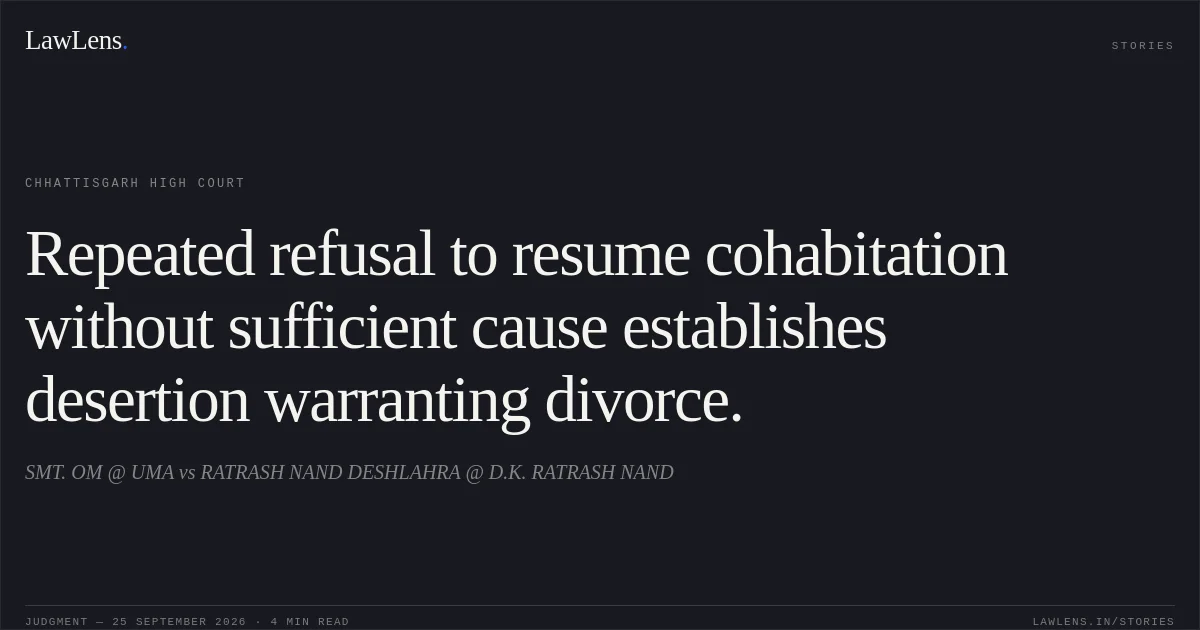
SMT. OM @ UMAvsRATRASH NAND DESHLAHRA @ D.K. RATRASH NAND
Click to open original judgment
Original judgment, available to read, download and summarize on LawLens.in