Facts
The four Petitioners were appointed by TRIFED in July 2010 as Assistant Grade-I and Clerk-level employees pursuant to a public advertisement inviting applications for 47 contractual vacancies.
Source reference: paras. 1–7They were selected through a Selection Committee and interview, but their appointment letters expressly provided that the engagements were contractual for two years or until regular appointments were made, whichever was earlier, and conferred no right to regularisation or absorption.
Source reference: paras. 1–7Despite the contractual terms, TRIFED repeatedly extended their engagements for nearly fifteen years, subject to performance and conduct assessments.
Source reference: paras. 8–10They were assigned institutional responsibilities and were included in TRIFED’s 2024 post-based reservation roster as employees “In Service On Contract”.
Source reference: paras. 16–20The Petitioners’ earlier writ petition seeking regularisation from the dates of their initial appointments was dismissed by the High Court in 2021, and the Supreme Court dismissed their speaking Special Leave Petition, holding that their contractual appointments and the advertisement did not confer any right to regularisation.
Source reference: paras. 12–15, 31TRIFED nevertheless continued their contractual engagements until May/July 2025, when their contracts expired and their access to work was blocked.
Source reference: paras. 20–24In the present proceedings, the Petitioners challenged the discontinuance as arbitrary and again sought regularisation, relying on subsequent Supreme Court decisions concerning long-serving contractual employees.
Source reference: paras. 26–30Issues
Whether the Petitioners’ challenge to the cessation of their contractual engagements in May/July 2025 was barred by the earlier judgment concerning regularisation, or constituted a distinct cause of action arising from subsequent events?
Source reference: paras. 31, 36–37Whether TRIFED’s discontinuance of the Petitioners after nearly fifteen years of repeated extensions, performance assessments and continued institutional service was arbitrary and liable to be set aside?
Source reference: paras. 39–42Whether the Petitioners were entitled to fresh consideration for prospective regularisation, notwithstanding the finality of the earlier rejection of regularisation from their initial appointments?
Source reference: paras. 43–47Law Applied
The Court applied the principles of res judicata and constructive res judicata, holding that an issue finally adjudicated between the parties cannot ordinarily be reopened, although a subsequent proceeding based on materially different facts or a distinct cause of action may remain maintainable.
Source reference: paras. 31, 37–38; Kunhayammed v. State of KeralaIt relied on Secretary, State of Karnataka v. Umadevi and Official Liquidator v. Dayanand for the principle that regularisation is not an alternative mode of initial appointment and must be considered within constitutional and recruitment-law requirements.
Source reference: paras. 29, 34–35At the same time, Vinod Kumar v. Union of India, Jaggo v. Union of India, Shripal v. Nagar Nigam, Ghaziabad, Bhola Nath v. State of Jharkhand, Pawan Sharma v. State (NCT of Delhi) and Om Prakash Gaur v. Delhi Technological University establish that prolonged contractual service must be assessed beyond contractual nomenclature, having regard to the manner of entry, sanctioned posts, continuity and nature of work, employer conduct and enduring institutional need.
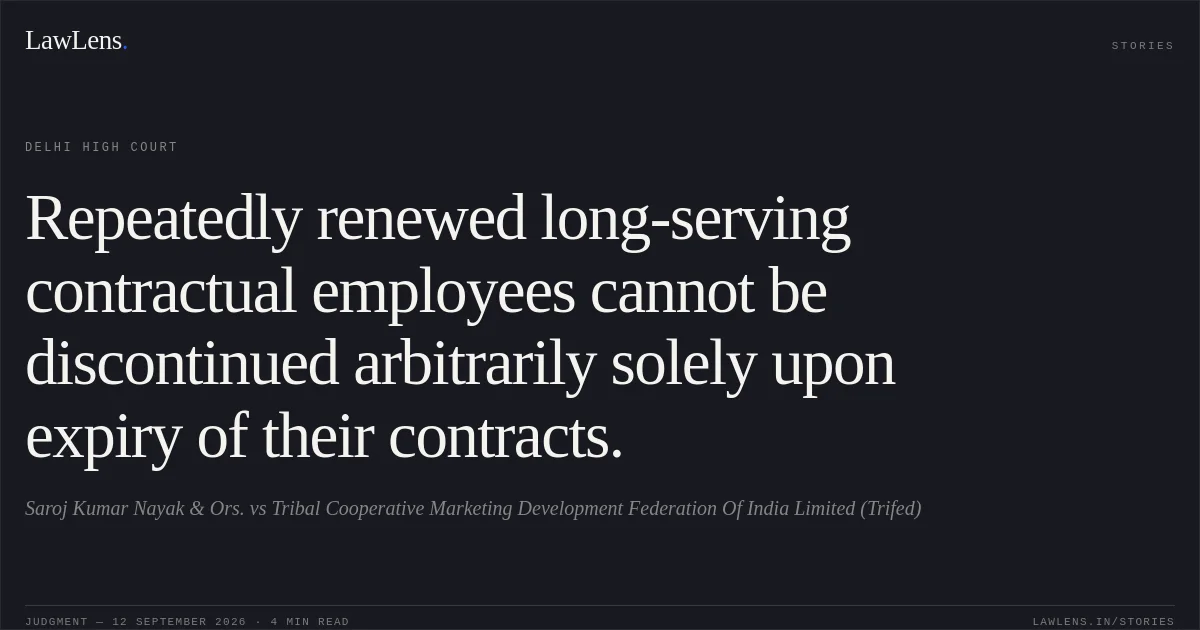
Source reference: paras. 32, 41, 44The Court further applied the principle that a public employer cannot arbitrarily discontinue a long-standing contractual arrangement, without cogent reasons or a reasoned decision, merely by relying on the formal expiry of the contract.
Source reference: paras. 41–42It also held, following B.S. Lalitha v. Bhuvanesh, that a later declaration of law does not ordinarily displace a final adjudication unless it undermines the legal basis of the earlier decision.
Source reference: para. 33Reasoning
The Court held that the earlier proceedings conclusively determined the Petitioners’ entitlement to regularisation from their initial appointments in 2010, particularly because the Supreme Court’s speaking order affirmed that their appointments were contractual and that the advertisement excluded any right to regularisation.
Source reference: para. 31However, the 2025 cessation occurred after several years of further extensions, performance reviews and continued entrustment of institutional duties, and therefore generated a distinct cause of action not adjudicated earlier.
Source reference: paras. 36–39TRIFED’s 2024 roster and its repeated post-2021 extensions demonstrated that the Petitioners’ services continued to be treated as necessary, while no petitioner-specific decision explained why their services were no longer required or why the established course of engagement was being discontinued.
Source reference: paras. 39–42Accordingly, expiry of the contractual periods explained the formal mechanism of cessation but did not justify the decision under Article 14.
Source reference: paras. 42–47The Court therefore set aside the discontinuance, while distinguishing the barred claim for retrospective regularisation from the permissible claim for fresh, prospective consideration based on post-2021 developments and the current legal position.
Source reference: paras. 42–47Holding
The Court partly allowed the petition.
It set aside the cessation of the Petitioners’ engagements and directed TRIFED to restore them within four weeks to their former contractual posts, or corresponding posts under the current nomenclature, on the same contractual terms.
Source reference: para. 49(a)Their restored engagements were directed to continue until TRIFED decided their claim for prospective regularisation.
Source reference: para. 49(b)TRIFED was required, within three months, to place their cases before the competent authority and pass a reasoned decision after considering their post-2021 service, performance assessments, institutional responsibilities, the 2024 roster, enduring work requirements and length of service.
Source reference: para. 49(c)If regularisation was granted, it would operate prospectively and would not disturb the seniority or accrued rights of persons regularly appointed in the meantime; if rejected, the contractual engagement would continue for four further weeks after communication of the decision.
Source reference: paras. 49(d)–(e)No back wages were awarded for the period between discontinuance and restoration, although that period would not be treated as a break in service for considering prospective regularisation.
Source reference: para. 49(f)The claim for regularisation from the original 2010 appointment dates was rejected as finally concluded by the earlier adjudication.
Source reference: para. 49(g)Original Court PDF
Saroj Kumar Nayak & Ors.vsTribal Cooperative Marketing Development Federation Of India Limited (Trifed)
Click to open original judgment
Original judgment, available to read, download and summarize on LawLens.in