Facts
The petitioner, an Assistant Sub-Inspector in the J&K Police, was transferred from Kathua to Rajouri on 09.07.2014
Source reference: p. 3Citing domestic issues regarding his bedridden mother, the petitioner submitted an application for premature retirement on 18.10.2014, supported by an affidavit
Source reference: p. 6On 10.11.2014, he clarified his desired retirement date as 31.01.2015
Source reference: p. 7Subsequently, his wife submitted a representation to the Deputy Inspector General of Police (DIG) requesting the withdrawal of his retirement application
Source reference: p. 4, 13Despite this, the respondents issued Order No. 44 of 2015 on 30.01.2015, accepting his voluntary retirement effective 31.01.2015
Source reference: p. 8The petitioner challenged both the transfer and the retirement orders, alleging he was pressurized into seeking retirement and that the withdrawal request by his wife should have been honored
Source reference: p. 5Issues
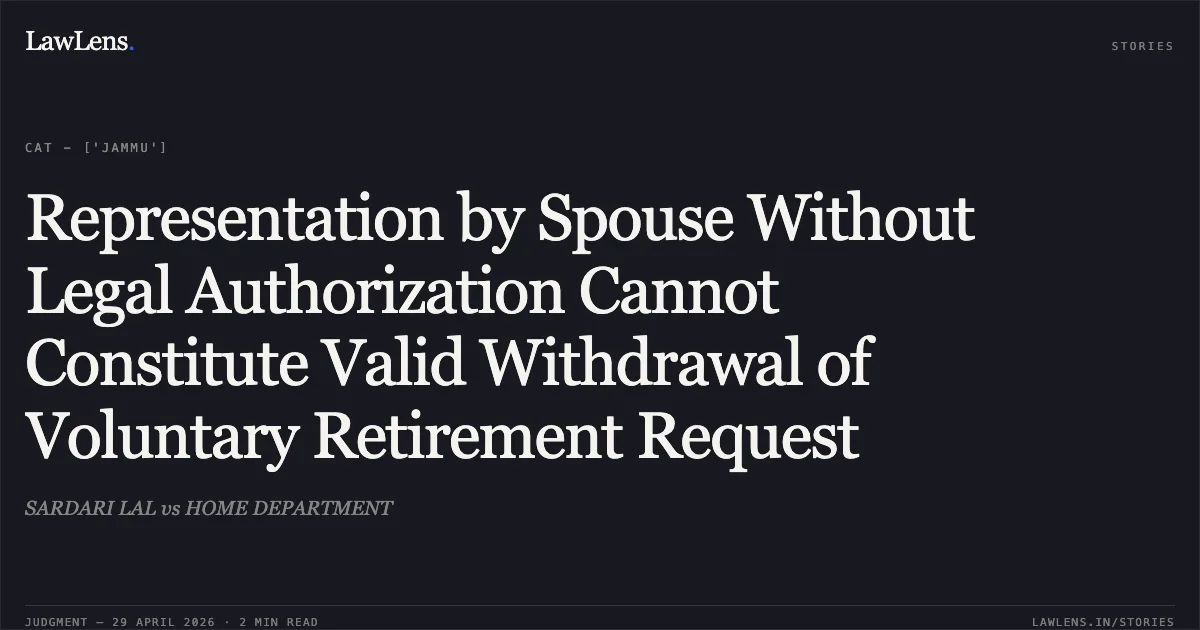
1. Whether a request for withdrawal of voluntary retirement submitted by the spouse of an employee, rather than the employee himself, constitutes a valid legal withdrawal
Source reference: p. 13 / para. 11-122. Whether the impugned order of voluntary retirement was vitiated by coercion, lack of jurisdiction, or procedural irregularity
Source reference: p. 15-16 / para. 14-16Law Applied
Article 230(1) of the Jammu and Kashmir Civil Service Regulations (CSR), Volume-I, which governs the procedure for voluntary retirement
Source reference: p. 5, 8Principle of service jurisprudence that voluntary retirement and its withdrawal are "acts personal to the employee"
Source reference: p. 14Doctrine that administrative instructions and rules regarding service status require personal authorization or recognized legal incapacity for a third party to act on behalf of the principal
Source reference: p. 14Reasoning
The Tribunal reasoned that voluntary retirement is a personal legal act; therefore, any withdrawal of such a request before acceptance must emanate directly from the employee or a legally authorized representative.
Source reference: p. 14Since the petitioner provided no evidence of legal incapacity or a power of attorney authorizing his wife to act, her representation carried no legal weight to nullify his signed application and subsequent clarification.
Source reference: p. 15The Tribunal rejected the plea of coercion, noting that the petitioner had multiple opportunities to retract his decision personally but instead reaffirmed his intent by specifying a retirement date in a second application.
Source reference: p. 15The Tribunal found that the petitioner’s post-retirement conduct—clearing his "No Demand Certificate" and verifying pay—demonstrated his acceptance of the retirement order.
Source reference: p. 18Regarding jurisdiction, the petitioner failed to prove that the DIG was not the competent authority under the specific service rules.
Source reference: p. 16Holding
The Tribunal answered the first issue in the negative, holding that a spouse’s representation is not a valid withdrawal of a personal service request.
The Tribunal dismissed the Transfer Application, upholding Order No. 44 of 2015 and the transfer order, concluding that the retirement was validly sanctioned based on the petitioner's own voluntary acts.
Source reference: p. 19-20Acts & Sections Cited
2 provisions across 2 statutes referred to in this judgment. Linked provisions open on LawLens.
Constitution of Jammu and Kashmir1
Jammu and Kashmir State Legal Services Authority Regulations, 19981
Original Court PDF
SARDARI LALvsHOME DEPARTMENT
Click to open original judgment
Original judgment, available to read, download and summarize on LawLens.in