Facts
The appellant, an insurance company, challenged a Trial Court judgment dated March 13, 2024, which had decreed the respondent's (plaintiff) claim for damages following a vehicular accident
Source reference: para. 1The respondent’s tanker, carrying rice bran oil, capsized on January 18, 2005, leading to total cargo loss
Source reference: para. 12, 14The insurance policy (Exbt.-A) contained Clause 2.1, which excluded coverage for loss or damage attributable to the "willful misconduct of the Assured"
Source reference: para. 2, 10Evidence established that the tanker, with a carrying capacity of 16 MT, was loaded with 26.640 MT of oil by the respondent
Source reference: para. 19, 22The appellant repudiated the claim on the grounds of overloading, citing a breach of Section 113(3)(b) of the Motor Vehicles Act, 1988
Source reference: para. 5Issues
1. Whether the act of overloading the vehicle by the insured constitutes "willful misconduct" under Clause 2.1 of the insurance contract to justify repudiation
Source reference: para. 5, 192. Whether the insurer successfully discharged the burden of proof to establish that the overloading was the proximate cause of the accident
Source reference: para. 6, 26Law Applied
Section 113(3)(b) of the Motor Vehicles Act, 1988, which prohibits the operation of a vehicle beyond its permissible laden weight
Source reference: para. 5National Insurance Co. Ltd. v. Swaran Singh & Ors. (2004) 3 SCC 297, which requires the insurer to prove that the breach of the Act was fundamental and that the damage flowed from such breach
Source reference: para. 17, 20B. V. Nagaraju v. M/s. Oriental Insurance Co. Ltd. (1996) 4 SCC 647 and Laxmi Chand v. Reliance General Insurance (2016) 3 SCC 100, which mandate that the insurance company must establish that the contributing factor of the accident was the specific breach of policy conditions
Source reference: para. 16, 18Reasoning
The court observed that while a breach of the Motor Vehicles Act does not automatically void an insurance claim, the insurer can repudiate if it proves the breach was the cause of the accident and occurred with the insured's knowledge
Source reference: para. 20, 26In this case, the Marine Survey Report (Exbt.-L) explicitly concluded that overloading was the cause of the accident
Source reference: para. 15, 25Although the respondent argued against the contents of Exbt.-L, the court noted that the respondent itself introduced the document during cross-examination of the appellant’s witness, thereby accepting its contents and existence
Source reference: para. 23, 24The court found that the substantial overloading (over 10 MT beyond capacity) was performed by the plaintiff, establishing "willful misconduct" and knowledge
Source reference: para. 25, 27The court determined that the appellant had discharged its burden of proof by showing a fundamental breach that directly resulted in the loss
Source reference: para. 27Holding
The High Court allowed the appeal and set aside the impugned judgment and decree of the Trial Court
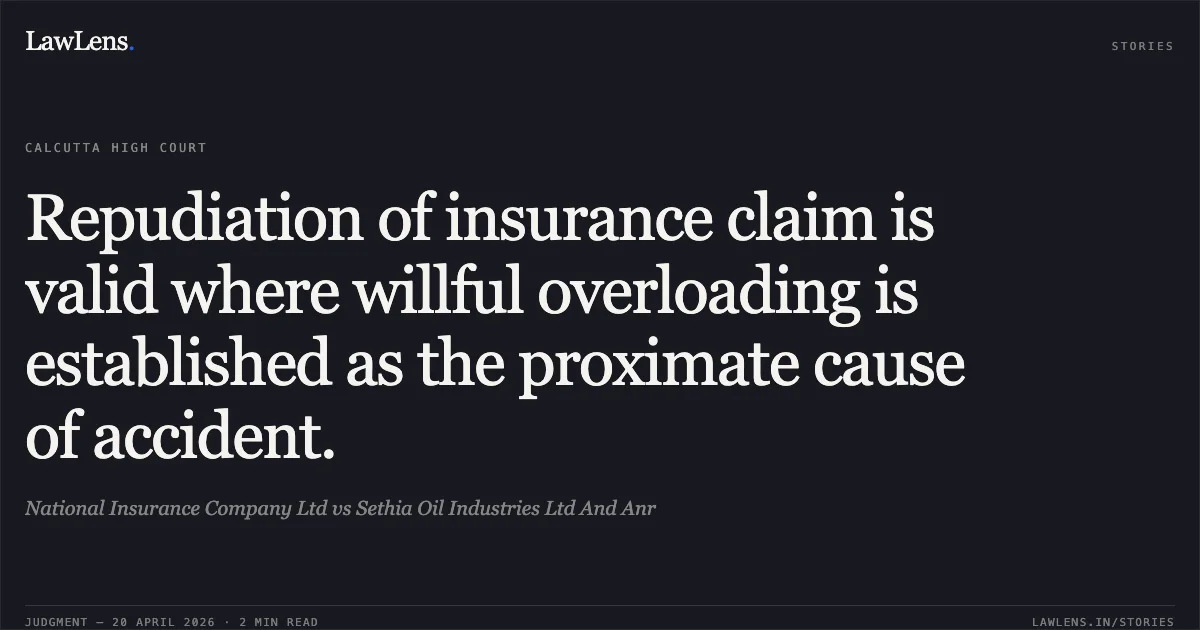
The Court held that the appellant was justified in repudiating the claim under Clause 2.1 of the policy because the accident was caused by overloading within the knowledge of the insured, constituting willful misconduct
Source reference: para. 27The Registrar was directed to return the security amount and accrued interest to the appellant insurance company within four weeks
Source reference: para. 30, 31Acts & Sections Cited
1 provisions across 1 statute referred to in this judgment. Each provision opens on LawLens.
Motor Vehicles Act, 19881
Original Court PDF
National Insurance Company LtdvsSethia Oil Industries Ltd And Anr
Click to open original judgment
Original judgment, available to read, download and summarize on LawLens.in