Facts
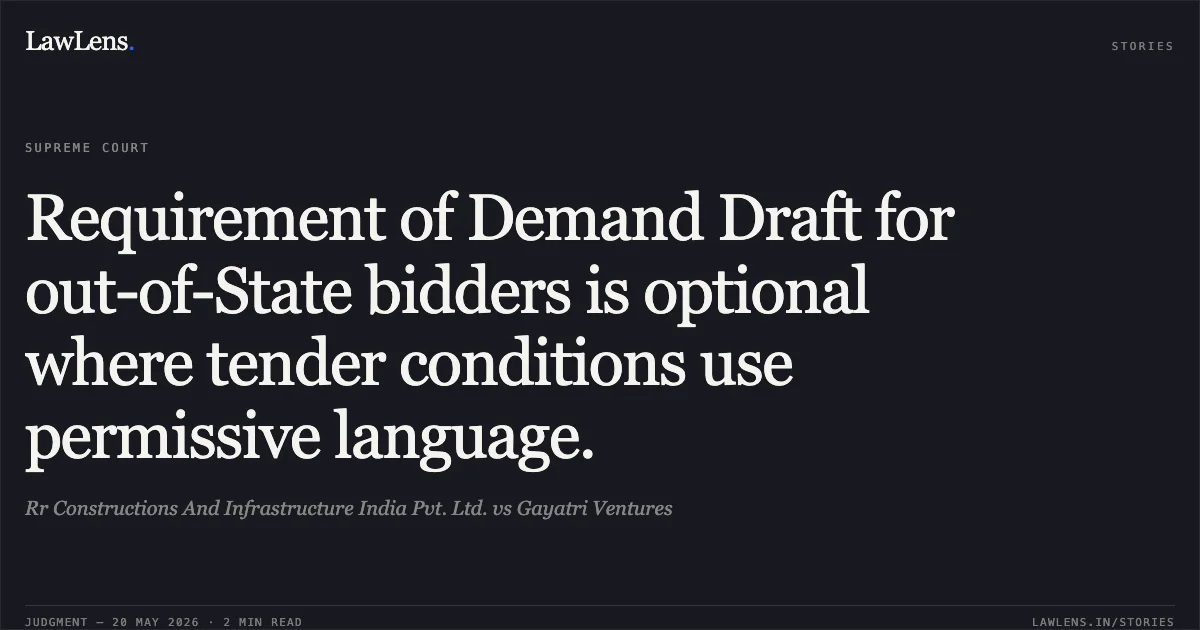
The appellant participated in a tender issued by the Water Resources Department, Chhattisgarh, for the "Construction of Head Work of Lamti Feeder Minor Tank Scheme"
Source reference: p. 3The appellant was disqualified by the High Court because it submitted its Earnest Money Deposit (EMD) via a Fixed Deposit (FD) instead of a Demand Draft (DD)
Source reference: p. 1The High Court held that for out-of-state bidders, a DD was mandatory based on its interpretation of the tender conditions
Source reference: p. 1-2Consequently, the financial bid of the 6th Respondent (Rs. 149 Crores) was accepted over the appellant’s lower bid (Rs. 120 Crores)
Source reference: p. 3During the pendency of the Special Leave Petition, a second disqualification was issued against the appellant regarding "Envelope B" (technical pre-bid qualification), which the appellant did not notice-respond to within 48 hours due to the subsisting High Court disqualification
Source reference: p. 5-6Issues
1. Whether the tender conditions (Clauses 2.13 and 2.15) made it mandatory for out-of-state bidders to submit EMD only in the form of a Demand Draft, thereby rendering a Fixed Deposit invalid
Source reference: p. 42. Whether the appellant’s failure to respond to a subsequent disqualification (Envelope B) within the stipulated 48 hours should preclude them from relief in light of the High Court's initial disqualification order
Source reference: p. 5-6Law Applied
The Court applied the principles of contractual interpretation regarding "permissive" versus "mandatory" language in tender documents. It focused on the use of the word "may" in Clause 2.13(b) and Clause 2.15 of the tender document to distinguish optional modes of security from mandatory ones
Source reference: p. 4The Court further interpreted Clause 2.13(a)(iv) regarding "Approved Interest Bearing Security," noting that a Fixed Deposit (FD) inherently possesses the character of an interest-bearing security
Source reference: p. 5Reasoning
The Court observed that Clause 2.13(a)(xiii) listed "Bank Draft" as a form of EMD, but Clause 2.13(b), which specifically addressed out-of-state bidders, used the phrase "may submit," indicating an option rather than a mandate
Source reference: p. 4Similarly, Clause 2.15, titled "Earnest Money for Tenders from other State," also employed the word "may"
Source reference: p. 4The Court rejected the State's argument that "Approved Interest Bearing Security" required a specific prior approval, finding that the term loosely referred to the nature of the security, which an FD satisfies
Source reference: p. 5Regarding the second disqualification (Envelope B), the Court reasoned that the appellant could not be faulted for failing to respond within 48 hours because any such response would have been futile while the High Court’s disqualification order on Envelope A was still in force
Source reference: p. 6Holding
The Court held that the appellant was qualified regarding "Envelope A," as the submission of a Fixed Deposit was a valid form of EMD under the tender terms
The Court declared the appellant's qualification on Envelope A and affirmed the Tendering Authority's initial stance
Source reference: p. 5Regarding the subsequent disqualification on Envelope B, the Court granted the appellant 48 hours from the uploading of the judgment to submit a representation to the Tendering Authority
Source reference: p. 6-7The Supreme Court allowed the appeal and set aside the High Court judgment
Source reference: p. 7Original Court PDF
Rr Constructions And Infrastructure India Pvt. Ltd.vsGayatri Ventures
Click to open original judgment
Original judgment, available to read, download and summarize on LawLens.in