01Facts
Central Coalfields Limited issued an employment notice dated 28.03.2023 for, inter alia, 126 posts of Electrician (Non-Excavation)/Technician, including three posts reserved for OBC (Non-Creamy Layer) candidates.
¶ 3–4Clause 7 required candidates claiming OBC (NCL) reservation to submit the relevant caste certificate and referred to the DoPT guidelines dated 31.03.2016 concerning the validity of creamy-layer status certificates.
¶ 3–4The petitioner applied online on 17.04.2023, relying on an OBC certificate dated 15.04.2023, participated in the Computer Based Test, and was included in the provisional list.
¶ 4–5At the document-verification stage, the respondents required an OBC (NCL) certificate relatable to the financial year 2022–23.
¶ 5–7The petitioner produced a certificate dated 12.04.2023, which stated that it was valid for one year from issuance but did not establish his non-creamy-layer status for the relevant financial year.
¶ 5–7He was consequently not shortlisted for medical examination and appointment and filed the writ petition seeking consideration for appointment against the OBC (NCL) category.
¶ 702Issues
i.1. Whether requiring the petitioner to produce an OBC (NCL) certificate establishing non-creamy-layer status for the financial year 2022–23 amounted to an impermissible alteration of the eligibility criteria after commencement of the recruitment process.
¶ 18ii.2. Whether the petitioner was entitled to consideration for medical examination and appointment on the basis of the OBC certificate dated 12.04.2023/15.04.2023, despite its failure to establish his non-creamy-layer status for the relevant financial year.
¶ 25–2903Law Applied
The Court applied the principle that recruitment authorities cannot introduce or alter eligibility or selection criteria midway through a recruitment process, as recognised in K. Manjusree v. State of Andhra Pradesh, (2008) 3 SCC 512, and reaffirmed by the Constitution Bench in Tej Prakash Pathak v. High Court of Rajasthan, (2025) 2 SCC 1.
¶ 22–23However, that principle does not prevent an authority from enforcing a condition already contained in the governing advertisement or applicable rules.
¶ 23The Court further relied on the DoPT guidelines dated 31.03.2016, under which a certificate concerning creamy-layer status is valid only for the financial year for which it is issued.
¶ 3, 14, 21Relying on Divya v. Union of India, (2024) 1 SCC 448, and Union Public Service Commission v. Gaurav Singh, (2024) 2 SCC 605, the Court held that where reservation eligibility depends upon a certificate for a specified financial year, failure to produce such a certificate is a substantive deficiency and not a curable technical irregularity.
¶ 27–2804Reasoning
The Court held that the expression “latest caste certificate” in Clause 7 could not be read in isolation because the petitioner sought the specific benefit of OBC (NCL) reservation, which required both membership of the OBC community and proof of non-creamy-layer status.
¶ 19–20Since the advertisement itself referred to the DoPT guidelines governing the financial-year validity of creamy-layer status certificates, the requirement of producing a certificate for financial year 2022–23 was not a new condition introduced during document verification.
¶ 21, 24The certificate relied upon by the petitioner merely stated that it was valid for one year from its date of issuance and did not establish his non-creamy-layer status for the relevant financial year; the defect therefore went to the substance of his entitlement to reservation rather than being a minor clerical defect.
¶ 25–27The respondents had uniformly applied the requirement, and the petitioner failed to show arbitrariness, discrimination, or violation of the recruitment notice.
¶ 31–3505Holding
The Court answered the issues against the petitioner.
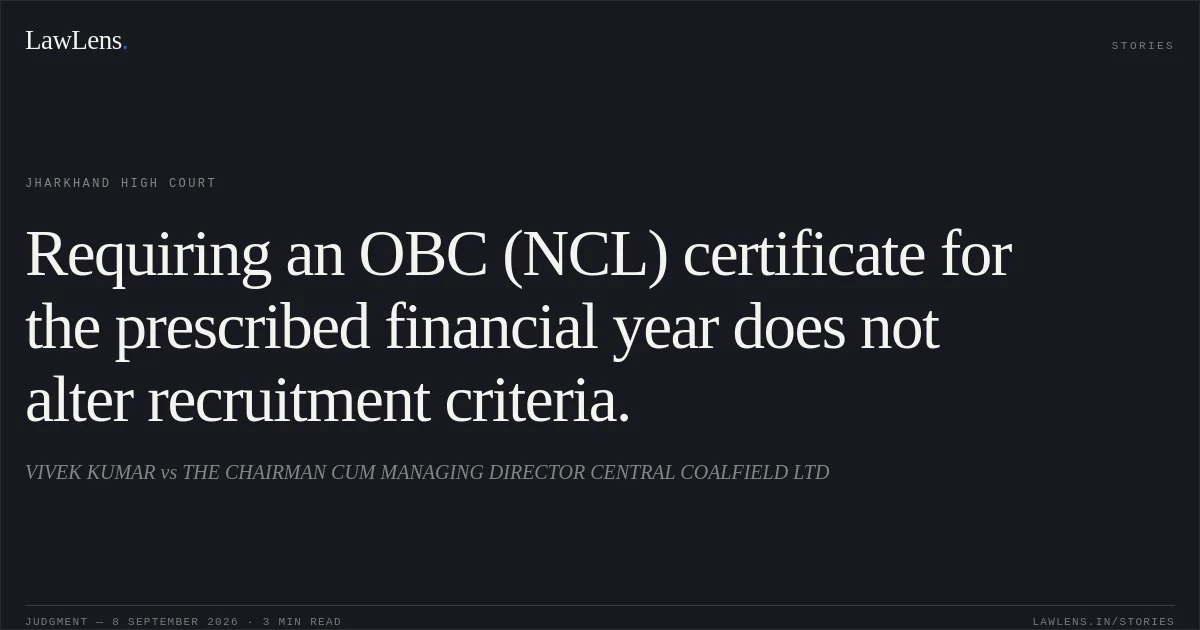
It held that the respondents had not changed the rules of recruitment but had enforced an eligibility requirement already incorporated in the advertisement and applicable guidelines.
¶ 29, 34As the petitioner failed to establish his OBC (NCL) eligibility for the financial year 2022–23, he had no enforceable right to consideration against the reserved post.
¶ 36–38The writ petition was dismissed, and the prayer for shortlisting for medical examination and consequential appointment was refused; any pending interlocutory application was also disposed of.
¶ 36–38Original Court PDF
VIVEK KUMARvsTHE CHAIRMAN CUM MANAGING DIRECTOR CENTRAL COALFIELD LTD
Click to open original judgment
Original judgment, available to read, download and summarize on LawLens.in