Facts
The Respondent (original Plaintiff) was a Relationship Manager at HDFC Bank, Nagpur. Following her termination on 28.02.2017, she filed a suit in Nagpur for declaration, restoration of service, and damages
Source reference: para 2The Applicants (Bank) filed an application under Order VII Rule 10 of the CPC, contending that the Nagpur court lacked territorial jurisdiction because the appointment letter conferred exclusive jurisdiction on Mumbai courts
Source reference: para 3-4This application was rejected by the Trial Court on 05.04.2018, a decision later upheld by the High Court in revision and review
Source reference: para 5-7Subsequently, the Supreme Court in Rakesh Kumar Verma v. HDFC Bank interpreted an identical clause, holding that Mumbai courts indeed held exclusive jurisdiction
Source reference: para 8-10Citing this change in law, the Applicants filed a second application under Order VII Rule 10 CPC
Source reference: para 11The Trial Court rejected it on 26.08.2025, holding the matter was barred by res judicata
Source reference: para 11Issues
1. Whether an erroneous decision on a question of territorial jurisdiction operates as res judicata in the same proceeding despite a subsequent Supreme Court judgment clarifying the law
Source reference: para 12, 212. Whether a change in the interpretation of law by a superior court allows a party to bypass the statutory bar against reviewing a settled issue in the same cause of action
Source reference: para 34-36Law Applied
The Court applied Section 11 of the CPC regarding res judicata, noting its mandatory nature for public policy and finality of litigation
Source reference: para 18, 31It relied on the distinction established in Ittyavira Mathai v. Varkey Varkey [para 15] and Urban Improvement Trust, Jodhpur v. Gokul Narain [para 16] between "inherent lack of jurisdiction" (which renders a decree a nullity) and "territorial or pecuniary jurisdiction" (which are procedural and do not render an order a nullity).
Source reference: para 15, 16It further applied the Explanation to Order 47 Rule 1 of the CPC, which stipulates that a subsequent reversal of a question of law by a superior court is not a ground for review
Source reference: para 22The court also contextualized the exceptions to res judicata found in Mathura Prasad Bajoo Jaiswal v. Dossibai N. B. Jeejeebhoy
Source reference: para 26-27Reasoning
The Court reasoned that while the Supreme Court in Rakesh Kumar Verma confirmed that Mumbai courts have exclusive jurisdiction, that ruling cannot undo the finality of orders already passed between these specific parties
Source reference: para 20-21The Court emphasized that territorial jurisdiction is a procedural aspect, not an inherent lack of subject-matter jurisdiction; therefore, an erroneous decision on the matter is binding unless set aside in appeal or revision
Source reference: para 14, 23, 38Regarding the Applicants' argument on exceptions to res judicata, the Court held that a change in legal interpretation only avoids res judicata when applied to a separate proceeding with a different cause of action
Source reference: para 28, 34Since the Applicants sought to revisit a settled issue within the same suit and same cause of action, the Explanation to Order 47 Rule 1 CPC acts as a statutory bar
Source reference: para 22, 35-36Allowing the second application would effectively bypass the prohibition against reviewing orders based on subsequent changes in law
Source reference: para 36Holding
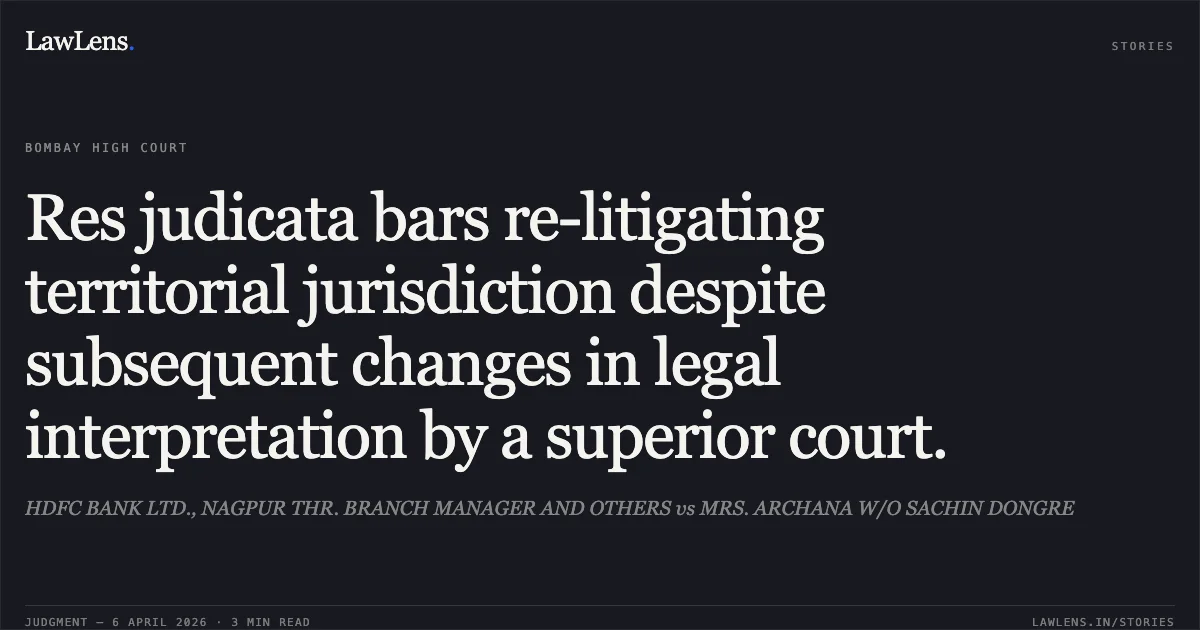
The Court held that the earlier determination on territorial jurisdiction, having attained finality, operates as res judicata between the parties
The subsequent Supreme Court decision in an unrelated matter does not entitle the Applicants to reopen a decided jurisdictional issue in the same ongoing suit
Source reference: para 35, 40The High Court dismissed the Civil Revision Application, affirming the Trial Court's rejection of the second Order VII Rule 10 application
Source reference: para 41Acts & Sections Cited
10 provisions across 4 statutes referred to in this judgment. Each provision opens on LawLens.
Code of Civil Procedure, 19085
Trade Marks Act, 19991
Banking Regulation Act, 19493
Hindu Marriage Act, 19551
Original Court PDF
HDFC BANK LTD., NAGPUR THR. BRANCH MANAGER AND OTHERSvsMRS. ARCHANA W/O SACHIN DONGRE
Click to open original judgment
Original judgment, available to read, download and summarize on LawLens.in