Facts
The Appellants (daughters of B.M. Seenappa) filed a suit for partition in 2007, claiming their father died intestate in 1985
Source reference: para 4, 7The Respondents (sons/legal representatives) asserted an oral partition in 1985 and a registered Partition Deed dated 16.06.2000, which excluded the daughters
Source reference: para 5-6In 2008, some defendants filed an application under Order VII Rule 11(d) CPC to reject the plaint, which was initially allowed but later set aside by the High Court in 2013 (R.F.A. No. 168/2009). The High Court held that daughters have a claim under Section 8 of the Hindu Succession (H.S.) Act regardless of coparcenary status
Source reference: para 8-10In 2021, the legal representatives of Defendant No. 4 filed a second application under Order VII Rule 11(a), (b), and (d) citing a "change in law" via the Vineeta Sharma (2020) judgment
Source reference: para 11The High Court allowed this second application and rejected the plaint
Source reference: para 15Issues
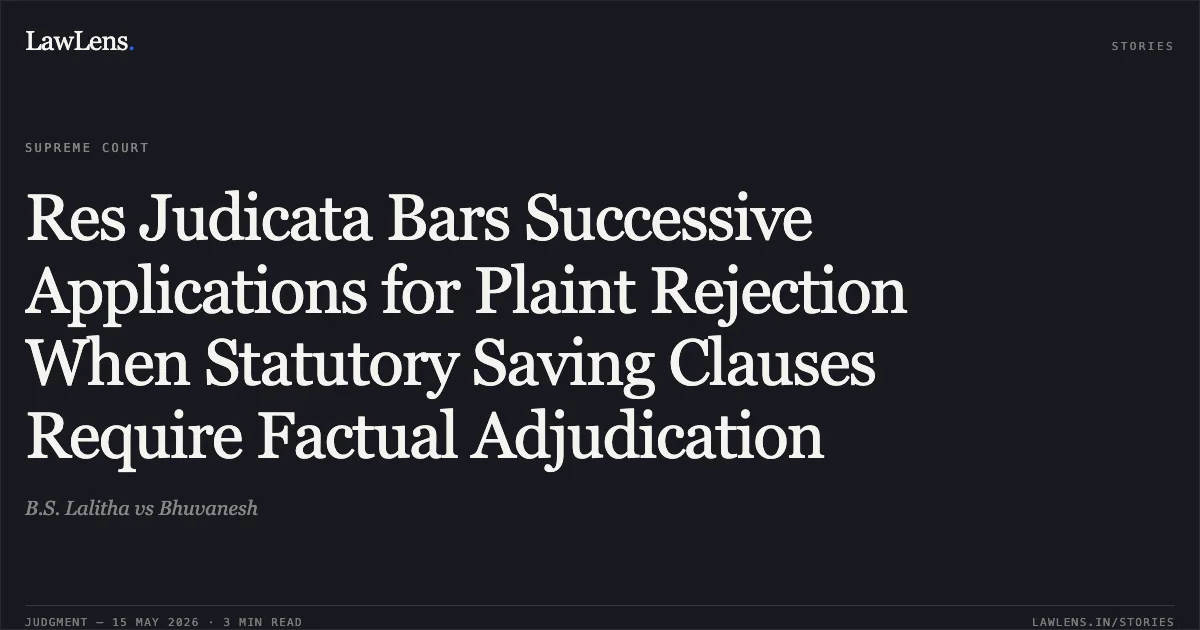
1. Whether the second application under Order VII Rule 11 was barred by the principle of res judicata
Source reference: para 292. Whether Section 6(5) of the H.S. Act operates as a jurisdictional bar to the institution of a suit for partition
Source reference: para 293. Whether the daughters possess a right under Section 8 of the H.S. Act independent of the 2005 Amendment
Source reference: para 29Law Applied
The Court applied Section 11 of the CPC (specifically Explanation IV regarding constructive res judicata and Explanation VI regarding common interest) to ensure finality in litigation stages
Source reference: para 34-39It relied on Satyadhyan Ghosal v. Deorajin Debi to establish that res judicata applies between stages of the same suit
Source reference: para 35The court interpreted Section 6(1) and 6(5) of the Hindu Succession (Amendment) Act, 2005, alongside Section 8 of the original H.S. Act, 1956
Source reference: para 44-47It further applied principles from Vineeta Sharma v. Rakesh Sharma, which clarified that Section 6(5) is a saving clause for registered partitions but does not invalidate the retroactive coparcenary rights of daughters
Source reference: para 50-51Reasoning
The Court reasoned that the 2013 High Court order had already attained finality; thus, a second application on substantially the same grounds was barred by res judicata because the defendants litigated under the same title
Source reference: para 37-39The Court rejected the "change in law" argument, noting that Vineeta Sharma did not alter the fundamental right of daughters to inherit under Section 8 (Class I heirs) upon their father's intestate death in 1985
Source reference: para 41-42, 65Regarding Order VII Rule 11, the Court emphasized that Section 6(5) is a "saving clause" and a defense on merits, not a jurisdictional bar that justifies rejecting a plaint at the threshold
Source reference: para 53-54The court found that the validity of the 2000 Partition Deed, executed without the daughters' consent, remains a triable issue of fact that cannot be resolved without evidence
Source reference: para 55-56Holding
The Court answered all issues in favor of the Appellants. It held that the second application was barred by res judicata and that Section 6(5) does not permit the summary rejection of a partition suit where Class I inheritance rights are claimed under Section 8
The Supreme Court set aside the High Court's order, restored the Trial Court's dismissal of the Order VII Rule 11 application, and directed that the suit (O.S. No. 5352/2007) proceed to trial. Status quo on the properties was ordered to continue
Source reference: para 71-73Acts & Sections Cited
7 provisions across 2 statutes referred to in this judgment. Each provision opens on LawLens.
Code of Civil Procedure, 19085
Original Court PDF
B.S. LalithavsBhuvanesh
Click to open original judgment
Original judgment, available to read, download and summarize on LawLens.in