Facts
The Appellants, formerly daily-rated employees, filed W.P.(S) No. 1298 of 2023 seeking pensionary benefits by counting their service from the date of initial appointment rather than regularization
Source reference: para. 2The matter was referred to the National Lok Adalat, which passed an award on 13.07.2024 based on a settlement where the Executive Engineer undertook to pay the differential benefits
Source reference: paras. 2, 9Following the State’s failure to implement the award, the Appellants filed a contempt petition, which was dropped on 07.11.2025 as the award was held not amenable to contempt jurisdiction
Source reference: para. 4Subsequently, the Appellants filed W.P.(S) No. 6739 of 2025 for enforcement of the award. A Single Judge dismissed this petition on 26.11.2025, holding it barred by res judicata and observing that a Writ Court should not act as an executing court
Source reference: paras. 1, 5The Appellants challenged this dismissal through the present Letters Patent Appeal (LPA).
Source reference: no citationIssues
1. Whether a subsequent writ petition seeking enforcement of a National Lok Adalat award is barred by the principle of res judicata
Source reference: para. 62. Whether the High Court, under Article 226 of the Constitution, can direct the implementation of a Lok Adalat award when State authorities fail to honor their undertaking
Source reference: paras. 11, 20Law Applied
The Court applied Section 21 of the Legal Services Authorities Act, 1987, which provides that every award of a Lok Adalat shall be deemed a decree of a civil court and shall be final and binding on all parties
Source reference: para. 10It relied on the precedent of State of Punjab v. Jalour Singh (2008) 2 SCC 660, which established that a Lok Adalat award is final and executable as a decree, and any challenge to it can only be made under Article 226/227 on extremely limited grounds
Source reference: para. 18Furthermore, the Court emphasized the State's obligation to act fairly and reasonably under Articles 14 and 21 of the Constitution of India
Source reference: para. 12Reasoning
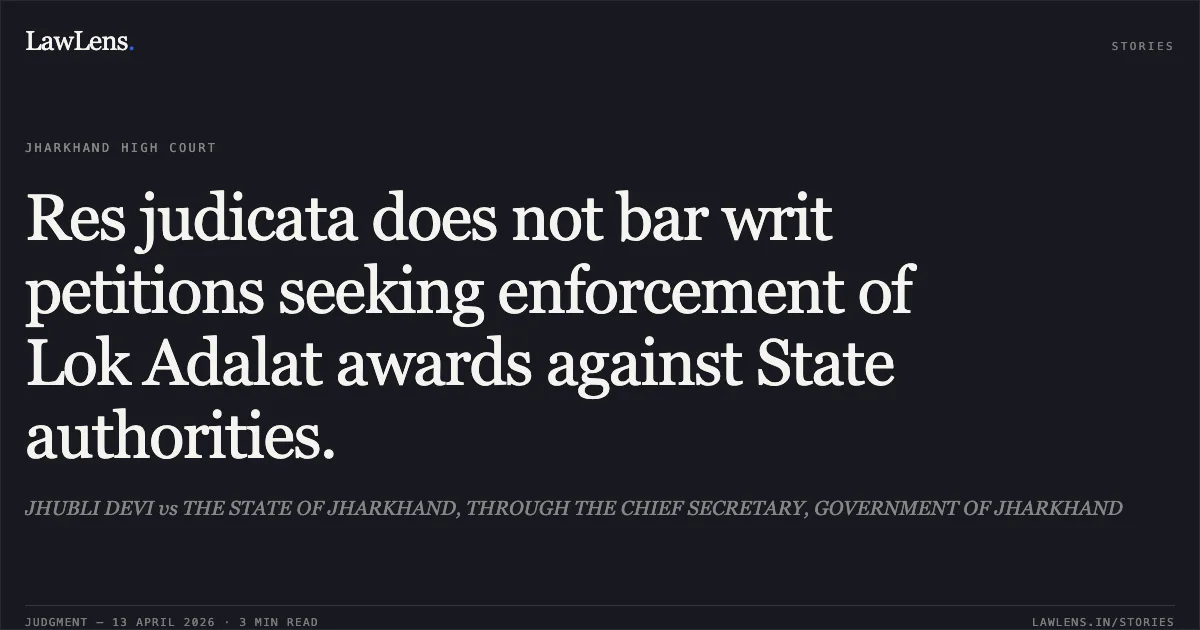
The Court held that the principle of res judicata was inapplicable because the earlier writ petition was disposed of via settlement in a Lok Adalat, not through an adjudication on merits by a court
Source reference: para. 6The non-implementation of the award gave rise to a fresh and continuing cause of action
Source reference: para. 7The Division Bench criticized the Single Judge’s refusal to exercise jurisdiction, noting that while an award is executable as a civil decree, the High Court is not precluded from issuing directions under Article 226 to prevent the State from arbitrarily defying its own statutory undertakings
Source reference: paras. 11-12The Court observed that the Appellants were elderly individuals suffering due to the "indifferent and whimsical attitude" of the State
Source reference: paras. 22-23Since the State failed to challenge the award or provide a cogent reason for non-compliance, technical objections regarding maintainability could not be allowed to defeat the interests of justice
Source reference: paras. 21-22Holding
The Court allowed the appeal and set aside the Single Judge's order.
It held that the writ petition was maintainable to enforce the statutory settlement reached in the Lok Adalat
Source reference: para. 12The Court directed the Respondents to implement the award dated 13.07.2024 within four weeks
Source reference: para. 23Additionally, due to the deliberate delay by the State, the Court ordered the payment of 6% interest per annum on the due amounts, calculated from the date of the Lok Adalat award until the actual date of payment
Source reference: para. 23Acts & Sections Cited
1 provisions across 1 statute referred to in this judgment. Each provision opens on LawLens.
Legal Services Authorities Act, 19871
Original Court PDF
JHUBLI DEVIvsTHE STATE OF JHARKHAND, THROUGH THE CHIEF SECRETARY, GOVERNMENT OF JHARKHAND
Click to open original judgment
Original judgment, available to read, download and summarize on LawLens.in


