Facts
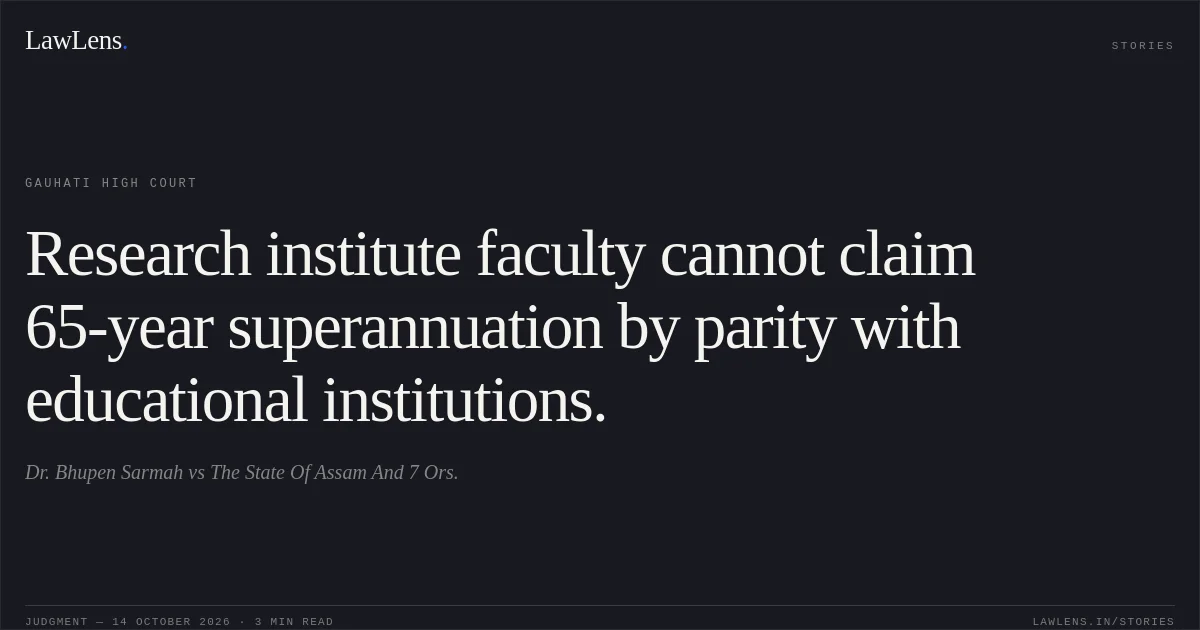
The petitioner, a Professor at the Omeo Kumar Das Institute of Social Change and Development (the Institute), sought superannuation at 65, relying on the State Cabinet decision of 19 September 2012 and notification of 26 September 2012, which raised the retirement age of professors in educational institutions, including medical colleges, to 65.
Source reference: para. 2, 5The Institute’s 2022 Service Regulations fixed the retirement age at 60 years, or as notified by the Government from time to time.
Source reference: para. 11–14, 39The State declined to raise the retirement age for the Institute’s professors.
Source reference: para. 13The petitioner challenged that decision, contending that UGC norms and the State’s 2012 decision applied to him and that the different retirement age violated Article 14.
Source reference: para. 2, 27–28The Union and the State maintained that the Institute was a research institute, not an educational institution, and that any change to its service conditions required the relevant approvals.
Source reference: para. 20–22, 26Issues
Whether the State’s 2012 decision and notification raising professors’ retirement age to 65 applied to professors employed by the Institute.
Source reference: para. 37–40, 50Whether the petitioner was entitled to a retirement age of 65 under UGC norms, the Institute’s Service Regulations, or Article 14, including on grounds of parity with professors in educational institutions.
Source reference: para. 27–28, 37–48Whether the Court could direct the Government to enhance the Institute’s professors’ retirement age.
Source reference: para. 42–45, 52Law Applied
Regulation 32.1 of the Institute’s Service Regulations, 2022, fixes the superannuation age of its permanent full-time faculty and academic staff at 60 years, unless a different age is notified by the Government.
Source reference: para. 39Clause 6(l) of the Government of India’s 10 March 2011 communication requires prior Government approval before an ICSSR-funded research institute alters its service conditions, which the Court treated as encompassing retirement age.
Source reference: para. 35–36Under Article 14, differential treatment is impermissible where similarly situated persons are treated differently without an intelligible basis; however, similarity of duties alone does not establish entitlement to identical retirement terms.
Source reference: para. 43–45The Court relied on Central Council for Research in Ayurvedic Sciences v. Bikartan Das, (2023) 16 SCC 462, for the principles that superannuation age is a policy matter governed by applicable service rules and that courts cannot legislate a different retirement age.
Source reference: para. 43–45It also relied on T.M. Sampath v. Secretary, Ministry of Water Resources, (2015) 5 SCC 333, and State of Maharashtra v. Bhagwan, (2022) 4 SCC 193, concerning the limits of parity claims by employees of autonomous bodies governed by their own service rules.
Source reference: para. 46–48Reasoning
The Court found that the Institute was a research institute, distinct from the educational institutions covered by the State’s 2012 decision; accordingly, that decision did not apply to the petitioner.
Source reference: para. 36–38, 50Regulation 32.1 governed his service and fixed retirement at 60 unless the Government notified otherwise.
Source reference: para. 40–41, 51The State’s decision alone was insufficient to alter the Institute’s retirement age; the Court held that concurrence of the Government of India was also required, and no such approval had been given.
Source reference: para. 40–41, 51The petitioner’s reliance on UGC norms and similarity of work did not overcome the Institute’s distinct status and governing service regulations.
Source reference: para. 43–48, 52–53The Court therefore found no basis for an Article 14 parity claim and held that setting the retirement age was a policy matter for the Government, not the Court.
Source reference: para. 43–48, 52–53Holding
The Court held that the 2012 State decision did not apply to the Institute; in any event, enhancement of the retirement age required concurrence from the Government of India.
The petitioner failed to establish entitlement to superannuation at 65 or a violation of Article 14.
Source reference: para. 49–55The writ petition was dismissed, with no order as to costs.
Source reference: para. 49–55Original Court PDF
Dr. Bhupen SarmahvsThe State Of Assam And 7 Ors.
Click to open original judgment
Original judgment, available to read, download and summarize on LawLens.in