Facts
The petitioner, Archana Dangi, is a native of Uttar Pradesh (UP) belonging to the 'Dangi' community, which is notified as an Other Backward Class (OBC) in UP.
Source reference: para. 1She holds an OBC certificate issued by the competent authority in District Jalaun, UP.
Source reference: para. 1Following her marriage to a resident of Madhya Pradesh (MP), whose community is also notified as OBC in MP, she migrated to Datia, MP.
Source reference: para. 1The petitioner qualified for the Uchcha Madhyamik Shikshak Eligibility Test-2018; however, during document verification on July 3, 2020, the respondents rejected her candidature on the ground that her caste certificate was issued by another state.
Source reference: para. 2The petitioner challenged this disqualification, arguing that since the 'Dangi' community is recognized as OBC in both UP and MP, she should be entitled to reservation benefits in MP following her marriage.
Source reference: para. 4-5Issues
1. Whether a person who migrates from one state to another is entitled to claim the benefit of reservation in the migrating state based on a caste certificate issued by their home state, even if the same caste is recognized as a reserved category in both states.
Source reference: para. 92. Whether a woman acquires the caste status of her husband for the purposes of reservation benefits under Articles 15(4) and 16(4) of the Constitution upon marriage.
Source reference: para. 13-15Law Applied
The court primarily relied on the principle that reservation in public services is state-specific and does not have a "Pan-India sweep".
Source reference: para. 10It applied the doctrine from Bir Singh v. Delhi Jal Board (2018), which held that a person notified as a Scheduled Caste/OBC in one state cannot claim that status in another state to which they migrate.
Source reference: para. 11Regarding marriage, the court followed Sobha Hymavathi Devi v. Setti Gangadhara Swamy (2005) and Sandhya Thakur v. Vimla Devi Kushwah (2005), establishing that reservation benefits are intended for the "really underprivileged" by birth and cannot be acquired through marriage.
Source reference: para. 13-14Furthermore, the court applied the doctrine of per incuriam to disregard a conflicting coordinate bench decision (Smt. Anusuiya Prajapati v. State of M.P.) because it failed to consider binding Supreme Court precedents.
Source reference: para. 16-18Reasoning
The court reasoned that the recognition of a caste as OBC is intrinsically linked to the specific social, economic, and educational backwardness faced by that community within a particular geographical territory.
Source reference: para. 10Consequently, migration does not result in the "carry-over" of caste status because the degree of backwardness in the home state may not be identical in the migrating state.
Source reference: para. 10The court rejected the petitioner's argument that marriage entitles a woman to her husband’s caste status for reservation purposes, clarifying that caste is determined by birth and an "advantageous start in life" cannot be bypassed by transplantation into a backward community via marriage.
Source reference: para. 13, 15The court further noted that the Petitioner's reliance on a previous Indore Bench judgment was misplaced, as that judgment was rendered per incuriam for failing to notice the Supreme Court's declarations in Bir Singh and Sobha Hymavathi Devi.
Source reference: para. 18Holding
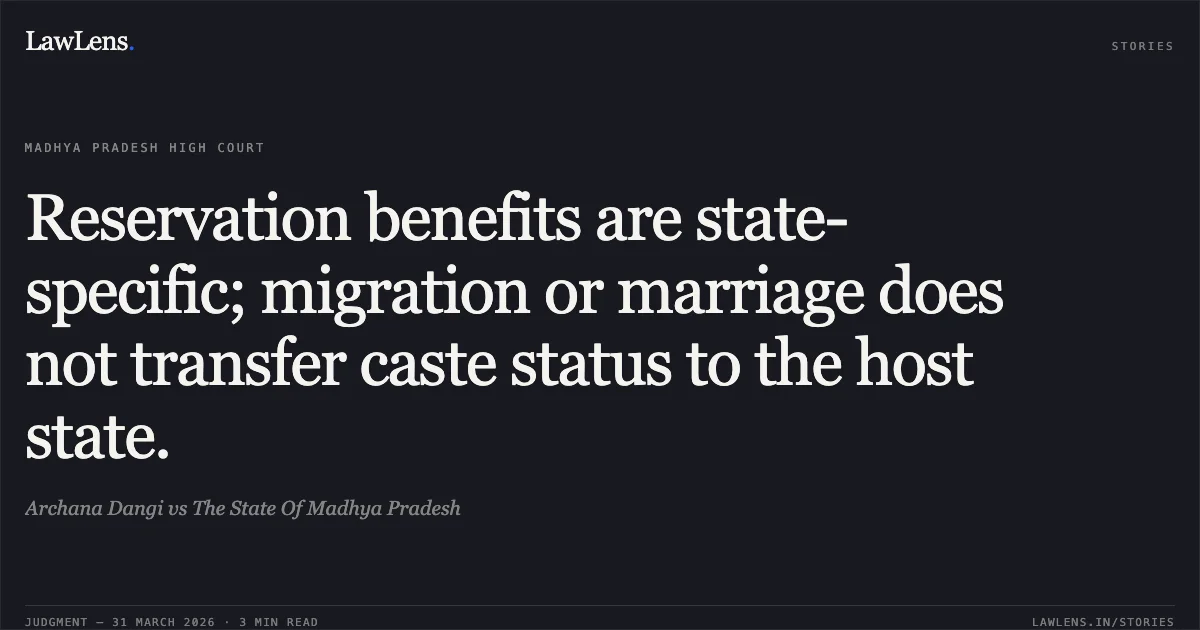
The court answered the issues in the negative, holding that the petitioner is not entitled to reservation benefits in Madhya Pradesh based on an OBC certificate issued by Uttar Pradesh.
The court upheld the respondents' decision to reject her candidature, ruling that neither the common nomenclature of the caste in both states nor her marriage to an OBC resident of MP confers a right to reservation in the migrating state.
Source reference: para. 15, 19The writ petition was accordingly dismissed.
Source reference: para. 20Acts & Sections Cited
2 provisions across 1 statute referred to in this judgment. Linked provisions open on LawLens.
M.P. Municipal Corporation Act, 19562
Original Court PDF
Archana DangivsThe State Of Madhya Pradesh
Click to open original judgment
Original judgment, available to read, download and summarize on LawLens.in


