Facts
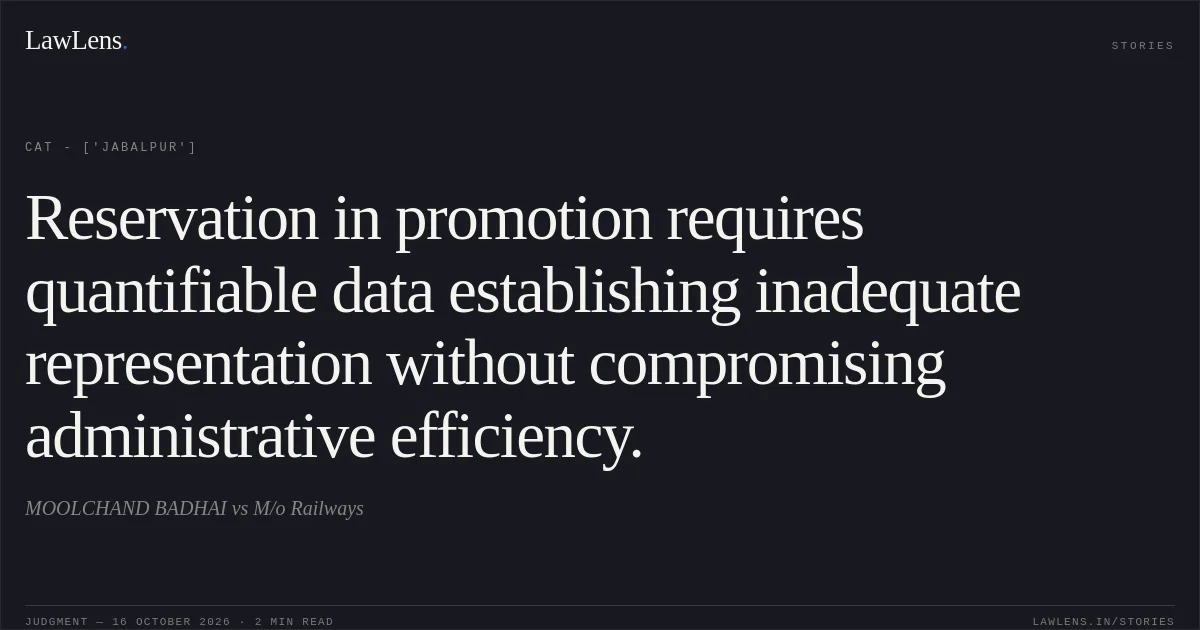
The applicants, Railway Technicians, challenged the promotion order dated 31 July 2015, under which junior employees (respondents 5–11) were promoted to Senior Technician with the benefit of reservation in promotion. The applicants contended that they were senior and had consequently been denied consideration for promotion under restructuring. After an unanswered representation dated 10 September 2015, they filed the Original Application.
Source reference: p. 3The respondents defended the promotions on the basis of Railway Board instructions and submitted that the issue arising from M. Nagaraj remained under examination.
Source reference: pp. 4–5Issues
1. Whether the respondents could grant reservation in promotion to the private respondents without first conducting the exercise and collecting the quantifiable data required by the Supreme Court’s decisions.
Source reference: pp. 6–72. Whether the applicants’ and private respondents’ promotion to Senior Technician required fresh consideration in light of those principles.
Source reference: pp. 6, 8Law Applied
The Tribunal relied on M. Nagaraj v. Union of India, (2006) 8 SCC 212, for the principle that reservation in promotion cannot be applied automatically or mechanically; the State must collect quantifiable data demonstrating inadequate representation of the relevant class and consider the effect on administrative efficiency.
Source reference: p. 6It noted that this principle was reiterated in U.P. Power Corporation Ltd. v. Rajesh Kumar, Civil Appeal No. 2608/2011, decided 27 April 2012.
Source reference: p. 6The Tribunal further stated that, absent the required exercise and data, promotion should proceed on seniority-cum-suitability, without preference based on caste or tribe status.
Source reference: pp. 6–7Reasoning
The Tribunal found no material showing that the respondents had undertaken the survey or collected the quantifiable data required by the cited Supreme Court authorities before granting reservation in promotion.
Source reference: pp. 6–8It therefore rejected the respondents’ reliance on Railway Board instructions as sufficient justification for the promotions.
Source reference: pp. 6–8Because the necessary assessment had not been shown, the Tribunal held that the applicants’ and private respondents’ promotions required fresh consideration in accordance with the governing principles.
Source reference: pp. 7–8Holding
The Tribunal allowed the Original Application and directed the respondents to undertake a fresh exercise concerning promotion of the applicants and respondents 5–11 to Senior Technician, in strict compliance with the Supreme Court’s principles.
The exercise was to be completed within three months of receipt of the certified copy of the order. Miscellaneous applications were disposed of, with no order as to costs.
Source reference: p. 8Original Court PDF
MOOLCHAND BADHAIvsM/o Railways
Click to open original judgment
Original judgment, available to read, download and summarize on LawLens.in