Facts
The petitioners were operating privately owned bus stands on their respective raiyati lands in Samastipur pursuant to permissions, licences, and agreements executed with the State authorities in or around 1992.
Source reference: paras. 3, 7They claimed to have regularly paid the applicable commercial and land rent/taxes in accordance with the relevant arrangements.
Source reference: paras. 3, 7In CWJC No. 10048 of 2016, the Circle Officer, Hasanpur, by letter dated 16 June 2016, demanded ₹70,810 from Rammurti Roy as “reserve deposit” for the financial year 2015–16.
Source reference: paras. 2, 4In CWJC No. 9326 of 2017, the Circle Officer, Dalsingsarai, by Memo No. 364 dated 19 June 2017, demanded ₹47,13,975 from Samant Kumar Chaudhary as “reserve deposit” for the financial year 2017–18.
Source reference: para. 6The petitioners challenged the demands as lacking statutory authority and as contrary to the terms of their licences, sanctions, and agreements.
Source reference: paras. 5, 8–14Issues
Whether the respondents were legally competent to demand “reserve deposit” or “reserve price” from operators of privately owned bus stands situated on their raiyati land in the absence of a specific statutory provision authorising such levy?
Source reference: para. 16Whether Section 117 of the Motor Vehicles Act, 1988, Rule 191 of the Bihar Motor Vehicle Rules, 1992, Government instructions, or the terms of the licences and agreements authorised the impugned demands?
Source reference: paras. 17–22Whether executive instructions or an undertaking to comply with Government directions could independently create a substantive fiscal liability not expressly provided by statute or contract?
Source reference: paras. 28–30Law Applied
The Court applied Section 117 of the Motor Vehicles Act, 1988, which empowers the State Government or an authorised authority, in consultation with the local authority, to determine parking places and halting stations for motor vehicles and public service vehicles.
Source reference: para. 17Rule 191 of the Bihar Motor Vehicle Rules, 1992 regulates parking places and halting stations, permits arrangements concerning privately owned places, and contemplates prescription of fees payable by public service vehicles using such places.
Source reference: paras. 18–20However, a fiscal liability cannot be imposed by implication; a tax, fee, or other financial burden must be traceable to an express statutory provision or valid contractual authority.
Source reference: paras. 23–25Relying on Ahmedabad Urban Development Authority v. Sharad Kumar Jayantikumar Pasawalla, 1992 AIR 2028, the Court held that delegated or executive authorities cannot impose a tax or fee in the absence of specific statutory conferment of power.
Source reference: paras. 23–25Executive instructions may regulate the exercise of an existing statutory power but cannot create a new levy or substantive fiscal liability without statutory authority.
Source reference: paras. 28–30Reasoning
The Court examined Section 117 and Rule 191 and found that their statutory purpose was to determine, regulate, and manage parking places and halting stations, including the prescription of fees payable by public service vehicles using those places.
Source reference: paras. 19–20Neither provision expressly authorised the imposition of a separate “reserve deposit” or “reserve price” upon the owner or operator of a privately owned bus stand.
Source reference: para. 21The respondents also failed to identify any express term in the petitioners’ sanctions, licences, or agreements authorising the impugned demands.
Source reference: para. 22The Court rejected the argument that general undertakings to comply with Government rules, circulars, or directions could supply the missing authority, since such undertakings could not confer a fiscal power that was absent from the statute or contract.
Source reference: para. 30The Government instructions relied upon by the respondents were likewise incapable of creating an independent financial liability.
Source reference: paras. 28–29The fact that the bus stands were privately owned and situated on the petitioners’ raiyati land further reinforced the need for specific legislative authority before imposing such a burden.
Source reference: para. 31Holding
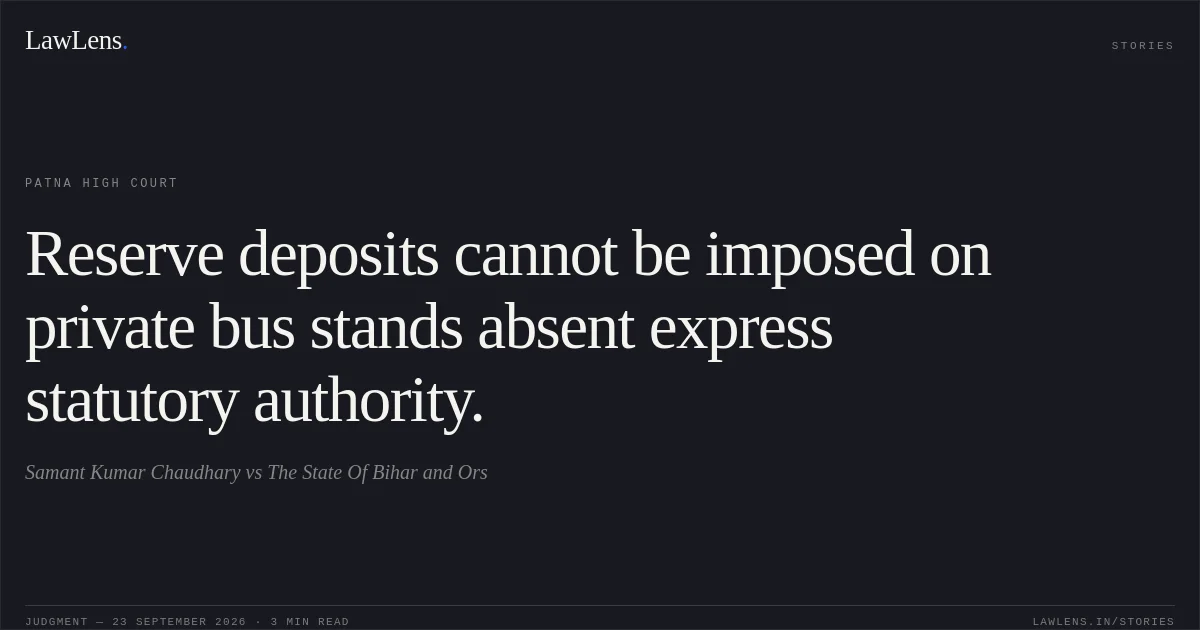
The Court held that the respondents lacked lawful authority to demand “reserve deposit” or “reserve price” from the petitioners in the absence of an express statutory provision or valid term in the applicable licence or agreement.
Both writ petitions were allowed.
Source reference: paras. 33–35The demand letter dated 16 June 2016, Memo No. 610, in CWJC No. 10048 of 2016, and the order dated 19 June 2017, Memo No. 364, in CWJC No. 9326 of 2017, were quashed to the extent that they demanded amounts towards “reserve deposit” or “reserve price”.
Source reference: paras. 33–35Acts & Sections Cited
1 provisions across 1 statute referred to in this judgment. Each provision opens on LawLens.
Motor Vehicles Act, 19881
Original Court PDF
Samant Kumar ChaudharyvsThe State Of Bihar and Ors
Click to open original judgment
Original judgment, available to read, download and summarize on LawLens.in