01Facts
Respondent No. 1 (R-1), a general (UR) category candidate, challenged the appointment of Respondent No. 2 (R-2), a Home Guard, and Respondent No. 3 (R-3), an SEBC candidate, as Civil Constables in the Commissionerate of Police.
¶ 2R-1 contended that both had availed age relaxation not available to UR candidates, so their appointment against UR vacancies was illegal.
¶ 2R-1 was placed immediately below R-3 in the common merit list.
¶ 3R-3 had secured more marks than R-1 but had availed SEBC age relaxation and was appointed under the UR category.
¶ 3 · ¶ 4 · ¶ 8The learned Single Judge directed Appellant No. 5 to appoint R-1 against a UR vacancy, to disengage R-3, and to accommodate R-3 only if a vacancy existed, within three weeks.
¶ 1The State contended that R-3's higher marks entitled him to UR selection, and that migration from SEBC to UR was permissible.
¶ 3R-2 and R-3 did not appear before the Court.
¶ 902Issues
i.1. Whether R-3, having availed age relaxation under the SEBC category, is still eligible for appointment under the UR category on the basis of the marks he secured in the common merit list.
¶ 403Law Applied
The Court relied principally on Gaurav Pradhan v. State of Rajasthan, (2018) 11 SCC 352, which holds that reserved-category candidates who availed age relaxation are not entitled to migrate to unreserved vacancies, though candidates already appointed through such migration should not be displaced.
¶ 4The Court further relied on Union of India v. Sajib Roy, 2025 SCC OnLine SC 1943, which holds that migration of a reserved candidate to general seats depends on the facts and the recruitment rules, and is barred where the rules impose an embargo.
¶ 5The Court referred to this Court's decision in State of Odisha v. Asish Kumar Mohapatra (W.P.(C) No. 3758 of 2017, decided 3 May 2017), which holds that a candidate must be eligible in all respects under the recruitment rules and advertisement, and that an age-barred candidate cannot be considered under the UR category.
¶ 6The Court examined Clauses 8 and 8(3) of the Orissa Police Service (Method of Recruitment and Conditions of Service of Constable) Order, 2010, which provide for reservation and bar carry-forward of unfilled reserved vacancies, and found no enabling clause permitting reserved candidates to migrate to general seats.
¶ 704Reasoning
The Court held that a candidate who takes age relaxation available under a reserved category cannot compete on merit with candidates who are not eligible for such relaxation.
¶ 4Applying Gaurav Pradhan, the Court found that R-3 could not migrate to the UR category merely because his marks exceeded R-1's, even though R-1 ranked next to him.
¶ 4 · ¶ 8The Court then examined the governing recruitment instrument, Clause 8 of the 2010 Order, and held that it contained no enabling provision for reserved candidates who had availed reservation benefits to migrate to general seats.
¶ 7This made the embarkation on Sajib Roy's "no embargo" route unavailable to the appellants, since the rules themselves offered no migration pathway.
¶ 5 · ¶ 7The Court therefore treated R-3's UR appointment as contrary to law and found the single judge's direction sustainable.
¶ 8Because R-2 and R-3 had not appeared, and the single judge had left R-3's accommodation to any available vacancy, the Court found no reason to disturb the order.
¶ 905Holding
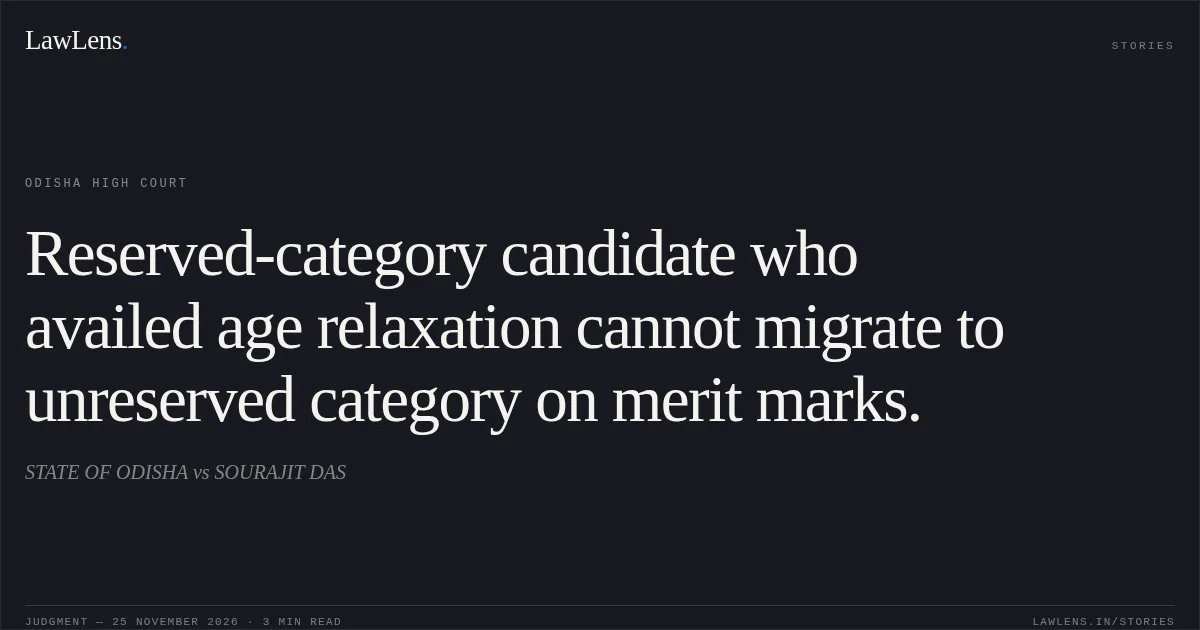
The Court answered the sole issue in the negative: a reserved-category candidate who has availed age relaxation cannot migrate to the UR category on the basis of marks in the common merit list.
¶ 8The writ appeal was dismissed and the impugned order of the learned Single Judge was confirmed.
¶ 9 · ¶ 10The direction to appoint R-1 against a UR vacancy, to disengage R-3, and to accommodate R-3 only against any available vacancy stands. Compliance was directed within six weeks if not already completed.
¶ 10Original Court PDF
STATE OF ODISHAvsSOURAJIT DAS
Click to open original judgment
Original judgment, available to read, download and summarize on LawLens.in